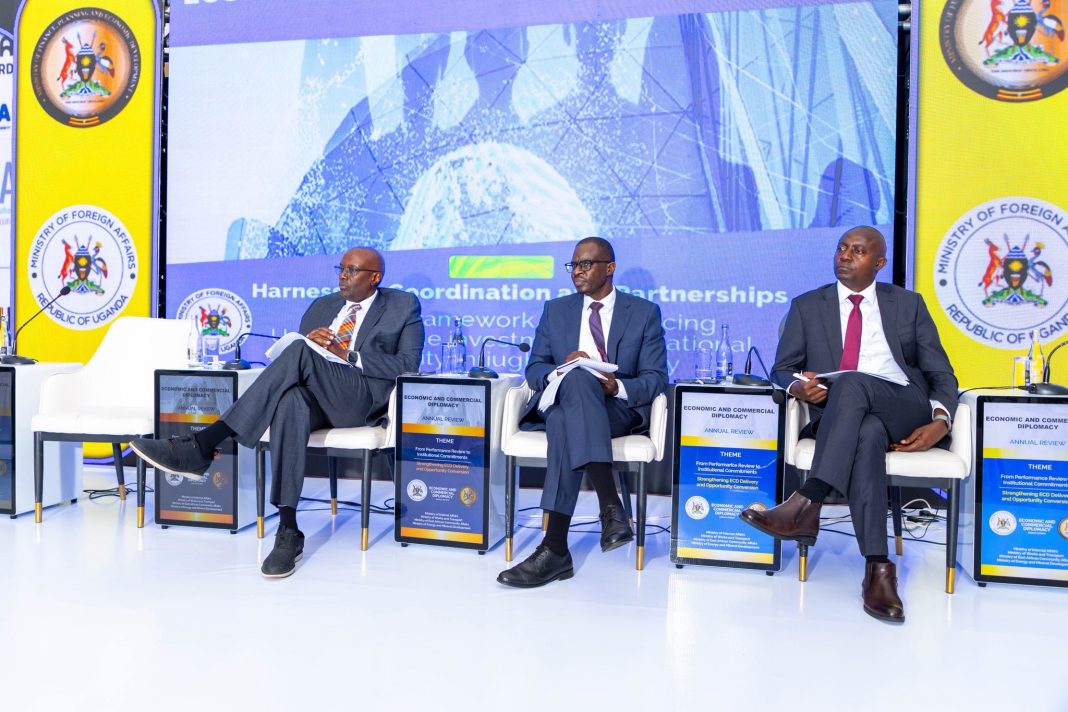
The Ministry of Foreign Affairs has launched the First Annual Economic and Commercial Diplomacy Performance Review Retreat, a new phase in Uganda’s strategy to use diplomacy as a tool for attracting investment, expanding exports, promoting tourism and creating jobs.
The three day retreat, which was opened in Kampala by Ambassador Richard Kabonero on behalf of Permanent Secretary Vincent Bagiire Waiswa, has brought together officials from Uganda’s missions abroad, Ministries, Departments and Agencies, and private sector partners to assess performance for the 2025/26 financial year and shape priorities for 2026/27.

Economic and Commercial Diplomacy has become one of the government’s key pillars for driving economic transformation by positioning Uganda’s embassies as investment and trade promotion centres rather than purely diplomatic outposts.
Opening the retreat, Kabonero said Uganda had completed the pilot phase of the programme and was now transitioning into full scale implementation after registering encouraging results.
He said about US$35 million, approximately Shs128 billion, had been invested through the programme in 2026, while returns presented during the retreat were projected to be nearly four times the initial investment.

“Economic and Commercial Diplomacy has played a critical role in advancing Uganda’s economic interests,” Kabonero said.
He praised officials from the Ministry of Foreign Affairs, Uganda’s missions abroad and partner institutions for translating the country’s Economic and Commercial Diplomacy Strategy into practical outcomes through stronger collaboration with government agencies.
“We appreciate and applaud the teams that have worked tirelessly to implement the Economic and Commercial Diplomacy mandate,” he said.
Kabonero said sustaining the programme’s momentum would require continued cooperation among Uganda’s foreign missions, government institutions and private sector players.
“The success of Economic and Commercial Diplomacy is a collective responsibility requiring the contribution of all stakeholders,” he said.
The programme forms part of Uganda’s broader economic strategy aimed at achieving faster industrialisation, increasing export earnings and attracting foreign direct investment under the government’s Tenfold Growth Strategy, which seeks to expand the country’s economy to US$500 billion in the coming years.
Officials from the Ministry of Finance used the retreat to push for stronger accountability and measurable results from Uganda’s diplomatic missions.
Moses Kabanda, Commissioner for Public Administration at the Ministry of Finance, Planning and Economic Development, said the review offered an opportunity to examine what had been planned, what had been achieved and which investment and trade opportunities had either been realised or lost.
He acknowledged that previous implementation reviews had shown progress in using Uganda’s missions abroad to promote trade, investment, tourism and strategic partnerships.
However, he said several challenges remained, including uneven performance across missions, limited follow up on investment leads, inadequate market intelligence, export readiness gaps among businesses and weaknesses in tracking and reporting results.
“We must move beyond identifying challenges and focus on practical solutions, clear responsibilities and timelines,” Kabanda said.
He urged participants to examine specific opportunities and determine the actions required from the Ministry, diplomatic missions and other government institutions to convert them into tangible investments and commercial partnerships.
Director of Budget Hannighton Ashaba echoed the call for greater accountability, saying government funding for Economic and Commercial Diplomacy should increasingly be linked to performance and measurable outcomes.
He said Uganda’s embassies play a vital role in opening international markets, attracting investors, promoting tourism and connecting local businesses with global opportunities.
“Economic and Commercial Diplomacy should not be measured by the number of meetings held or contacts established,” Ashaba said.
“It should be measured by whether engagements translate into exports, productive investment, business opportunities, employment and revenue.”
Ashaba called for stronger coordination between the Ministry of Foreign Affairs, diplomatic missions, government agencies and the private sector through clear work plans, timely follow up, stronger monitoring and greater accountability.
He said diplomacy should function as a practical bridge connecting Uganda’s productive sectors with international markets, investment, technology transfer and business partnerships, adding that continued government support should be matched by demonstrable value for money.
The retreat will assess performance against agreed Economic and Commercial Diplomacy targets, review priority sectors including trade, tourism, investment, technology transfer and strategic partnerships, and develop the annual implementation plan for the 2026/27 financial year.
It is expected to conclude with an implementation matrix assigning priority actions, responsible institutions and timelines as Uganda seeks to strengthen the role of its diplomatic missions in delivering measurable economic outcomes.