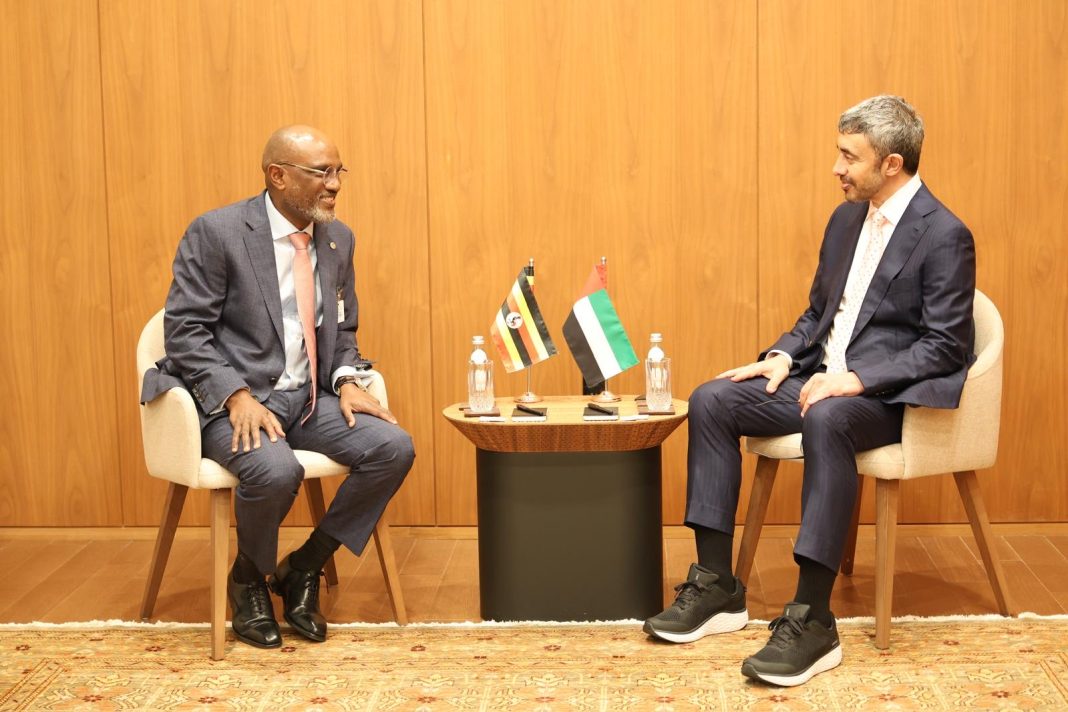
Uganda has regained unrestricted travel access to the United Arab Emirates after the Gulf nation announced the lifting of restrictions imposed during the Ebola outbreak.
The breakthrough was announced by Foreign Affairs Minister Adonia Ayebare after meeting his UAE counterpart, Sheikh Abdullah bin Zayed Al Nahyan, on the sidelines of the 81st United Nations General Assembly in New York.

Ayebare said the UAE had agreed to lift the restrictions after sending a delegation to Uganda to inspect preparedness at the Uganda Civil Aviation Authority and other relevant institutions.
“His Highness informed me of the decision to lift travel restrictions on Uganda subject to a delegation of UAE visiting the Uganda Civil Aviation Authority and other entities to assess preparedness,” Ayebare said.
Pasted markdown.md

“This will be done in the next seven days,” he added.
The planned reopening follows Uganda’s declaration that the Ebola outbreak had ended, although normal travel arrangements will only resume after the UAE delegation completes its assessment.
The UAE introduced the restrictions in June as a precaution against Ebola, suspending new visas for Ugandan nationals while requiring travellers from Uganda to spend at least 21 days outside the country before entering or transiting through the Emirates. Cargo operations continued, but thousands of Ugandans seeking jobs in the Gulf saw recruitment and visa processing disrupted.
Uganda declared the outbreak over on July 28 after health authorities established the source and transmission chains and confirmed there was no unexplained community transmission.
The outbreak recorded 20 confirmed cases, including 18 recoveries and two deaths.
The expected reopening carries major economic significance because the UAE remains one of Uganda’s biggest destinations for migrant workers.
According to figures from the Ministry of Gender, Labour and Social Development, between 100,000 and 160,000 Ugandans live and work in the UAE, mainly in Dubai, Sharjah and Abu Dhabi, where they are employed in domestic work, hospitality, private security, construction, retail and business development. Their annual remittances are estimated at between $260 million and $350 million (Shs1 trillion and Shs1.3 trillion).
The development comes as Parliament continues examining Uganda’s labour export programme and whether workers abroad receive adequate protection before departure and after arriving in destination countries.
The Committee on Gender, Labour and Social Development previously raised concerns about monitoring systems for Ugandans working overseas, while Gender Minister Henry Tumukunde argued that labour migration should include preparation, monitoring and support throughout a worker’s stay abroad.
The committee has recommended a centralised database for migrant workers, stronger monitoring mechanisms and the deployment of additional labour attachés to improve protection for Ugandans in destination countries.
Parliament has also heard concerns from the Ministry of Foreign Affairs about increasing demands for consular assistance and repatriation, particularly in the Gulf region, highlighting the need for closer coordination between labour authorities and Uganda’s diplomatic missions abroad.
Speaker Jacob Marksons Oboth has previously called for labour attachés in countries partnering with Uganda on labour externalisation, saying dedicated officials are needed to handle labour related concerns affecting Ugandans abroad.
While recruitment agencies and workers are hopeful that travel will soon resume, the UAE’s planned inspection means the restrictions will only be formally lifted after the assessment is completed and visa processing is fully restored.