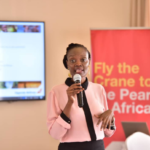
Uganda Airlines Chief Executive Officer, Jenifer Bamuturaki, and her team have failed to appear before Parliament’s Committee on Commissions, Statutory Authorities and State Enterprises (COSASE) to answer queries raised in the Auditor General’s 2023/24 report.
COSASE chairperson Medard Lubega Ssegona expressed disappointment at Bamuturaki’s absence, warning that the committee would take stronger measures if the airline’s management failed to appear at the rescheduled meeting on Wednesday.

“We summoned the group through the current accounting officer, who has not shown up. She is the one to account for. And you know, not showing or turning up for scrutiny is a choice. But I also know that choices have consequences. The matter was not limited to spare parts for the aircraft. It is a matter of accountability for the entire budget or the entire sums that were dispersed,” Ssegona said.
The national carrier’s top management had been summoned to account for several issues raised in the audit, including persistent financial losses, legal liabilities, fleet management risks, and slow implementation of parliamentary recommendations. However, they neither showed up nor sent an official communication to the committee.
The Auditor General’s report revealed that Uganda Airlines made a net loss of Shs237.8 billion in the financial year 2023/24, a reduction from Shs323.5 billion the previous year. Despite the improvement, the report warned that the airline remains financially unsustainable, with losses driven largely by high fuel costs, aircraft depreciation, and crew allowances.

The report also highlighted contingent liabilities of $3.16 million (about Shs11.9 billion) from pending court cases linked to contract terminations, unpaid work, negligence claims, and lost baggage. Concerns were further raised about operational risks after Mitsubishi Heavy Industries discontinued spare part production for CRJ-900 aircraft, leaving parts of the fleet vulnerable to grounding. Uganda Airlines also ranked among the worst-performing state enterprises in return on assets, with liquidity ratios falling below acceptable thresholds.
Parliament was equally concerned that only five of 53 planned activities for the year were fully implemented, while 22 activities worth Shs89.8 billion were not implemented at all. Out of 18 recommendations made earlier by the House, only 12 had been fully acted upon.
The airline’s leadership is now under pressure to respond to Parliament’s concerns over accountability and its financial performance, as lawmakers push for answers on the future sustainability of the national carrier.