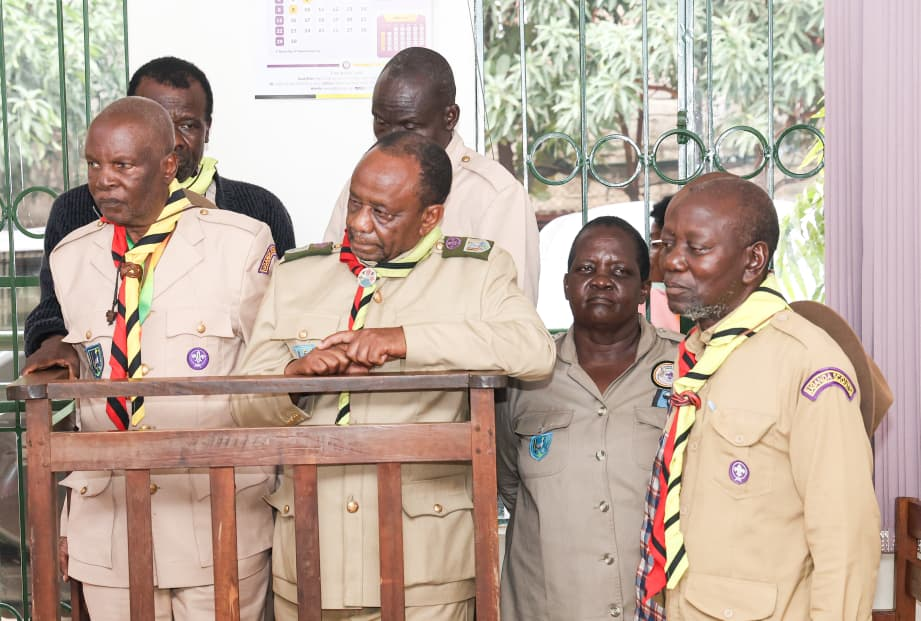
The State House Anti-Corruption Unit (SH-ACU), working with the Criminal Investigations Directorate (CID) and the Office of the Director of Public Prosecutions (ODPP), on Thursday arraigned seven scout leaders at the Makindye Magistrate’s Court on charges arising from the alleged forcible takeover and destruction at the Kaazi–Busaabala National Camping and Scouts Centre.
Those charged are Buragahare Mujuni Patrick, Butumbwire Stephen, Mugisha John, Musoke Stephen Brian, Mununuzi Alex, Orwanga Michael Richard, and Anyango Francis. Prosecutors say the group operating under a splinter faction calling itself the Boys Scouts Association mobilised a crowd on June 24, 2025, broke into Uganda Scouts Association (USA) offices at Kaazi, and destroyed property including kitchens, latrines, a watchtower, water tanks and piping.

“We have arraigned seven scout leaders on charges of unlawful occupation, malicious damage, conspiracy, forcible detainer and forcible entry,” SH-ACU said in a statement posted on X.
According to court proceedings, the suspects face counts of unlawful occupation of land belonging to another, malicious damage to property, conspiracy to commit a felony, forcible detainer and forcible entry. The charge sheet cites Kyadondo Block 273, Plot 5.
Magistrate Rhona Tukundane granted each suspect Shs5 million cash bail with Shs10 million non-cash surety bonds and adjourned the case to September 8, 2025, for hearing. State prosecutor Henry Turyomujuni said court investigations are complete.

“Given the sensitivity of the land question in Uganda and Buganda, it would be foolhardy to sit back and hope the storm caused will subside on its own,” High Court Justice Bonny Isaac Teko wrote in a July 18 ruling that temporarily restrained ministerial directives touching the Kaazi title.
The 120-acre Kaazi campsite on the shores of Lake Victoria has hosted generations of Ugandan scouts for nearly nine decades. Historical records note it was initially given to the scout movement during Ssekabaka Daudi Chwa’s reign and has long been treated as the movement’s national camping home.
The dispute intensified in March 2025 when State Minister for Lands Sam Mayanja directed the cancellation of the Kabaka of Buganda’s title over the wider Kaazi area (Block 273, Plot 5), arguing it should revert to the estate of Daudi Chwa II and to the Uganda Scouts Association. The Buganda side challenged this in court, leading to the July 18 temporary injunction halting 16 directives pending a full hearing.
In his directive, Minister Mayanja asserted: “The land is the private Mailo belonging to the estate of the late His Highness Daudi Chwa II,” and ordered corrections to the land register.
Tensions at the site have since spilled into the open. In late July, scouts under the Uganda Scouts Association reported being blocked by heavily armed personnel from accessing the campsite for meetings tied to the National Scouts Camp scheduled for August 22–28, 2025. Leaders alleged ongoing grading, tree felling and demolition of structures at Kaazi despite court orders.
The scouts leadership also petitioned authorities—including the Ministry of Education and Sports, the Attorney General, NEMA, and SH-ACU—seeking intervention over what they call internal fissures exploited by encroachers and the alleged illegal occupation of sections of the campsite. Education ministry officials acknowledged the matter and advised formal escalation to defence and security organs overseeing the ground.
Thursday’s arraignment and bail set the stage for a substantive hearing in September even as the broader ownership and management questions remain before the High Court. Scouts leaders say they will pursue “all legal avenues” to reclaim the campsite and secure it for national activities, while SH-ACU has signalled continued investigations into alleged criminal actions at Kaazi.
“We will not allow individuals to take the law into their own hands and destroy national heritage property under the guise of leadership wrangles,” an SH-ACU official said.
Kaazi remains a national symbol for the scout movement and a flashpoint in Uganda’s land governance debates, pitting historical donations and leases, ministerial reviews, and kingdom claims against contemporary encroachment and commercial pressures. Whether the site can be secured for public youth work without further environmental and institutional damage now hinges on the courts—and on stakeholders respecting the orders already in place