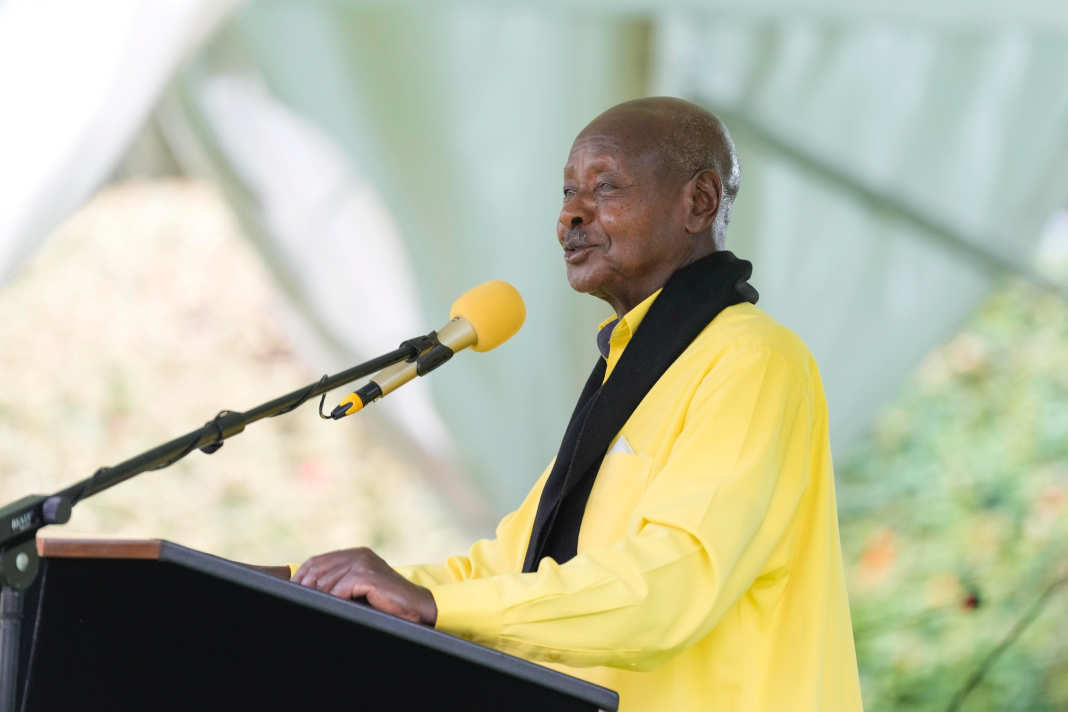
President Yoweri Kaguta Museveni has defended senior NRM cadre Moses Karangwa against accusations of being of Rwandan origin, saying such sectarian sentiments have no place in Uganda’s politics and warning that tribalism was the root cause of Uganda’s darkest years.
In a statement issued on Friday, the President dismissed claims raised during the recent NRM Central Executive Committee (CEC) elections in Buganda that questioned Karangwa’s background.

“In the contest between Kasolo, Kiwanda, Karangwa, etc., there was talk of Karangwa having come from Rwanda originally. This is not correct. As a matter of fact, Karangwa is one of the most active NRM cadres and Buganda is a multi-cultural unit,” Museveni said.
The President stressed that any concerns about Karangwa should be based on his actions, not ethnicity.
“The issue I have been intending to sort out with Karangwa is the signed letter I got from the Kayunga area accusing him of being involved in land-grabbing; but not ethnicity,” he clarified.

Museveni cautioned that allowing tribal sentiments to influence politics risked undermining the unity the NRM had built since the 1980s.
“Principled unity, around the four principles, without discrimination, is a time-tested strategy that is correct,” he said.
Turning to Uganda’s history, Museveni warned that sectarianism was the single biggest contributor to political instability in the post-independence period.
“By 1962 – Independence time, Ugandans had been politically fragmented into three sectarian groups. These were: DP for the Catholics; UPC for the Protestants and some Muslims; and Kabaka Yekka for Buganda Protestants and some Muslims,” he explained.
According to Museveni, these divisions forced opportunistic alliances that collapsed within two years, leading to the 1966 Obote–Muteesa clashes and the 1971 Amin coup. Noting, “By 1979 when we defeated Idi Amin, 500,000 Ugandans had been killed extrajudicially and the economy had collapsed so much that people had no soap, no salt, no clothes, no paraffin.”
Museveni said that by 1980, ordinary Ugandans were fed up with sectarian leaders. He narrated how after the disputed elections, people urged him to act.
“I stopped to put fuel in my Isuzu at Kyazaanga. Immediately, the crowd gathered around me and started saying: ‘bbakko kyokola’ (you must do something). I told them: ‘You did not vote for UPM. Why did you vote for the incapable DP?’ Their answer: ‘Vva Kubyobuluulu. Bbakko kyokola’ (forget about the elections. Do something),” he said.
This, he added, reflected the popular consensus for change that justified the NRA’s decision to launch the armed struggle in 1981 and noted that when NRA launched the Kabamba attack on the 6th of February, 1981, 80% of Ugandans were with us. After Kabamba, it would have been irresponsible for anybody to talk of DP, UPC, Kabaka Yekka, UPM, Nabudere group, etc. They were all NRM with equal rights, risks and responsibilities.
He noted that the NRM’s strength has always come from building the broadest possible consensus.
“We have been able to put together this broadest possible consensus because of the correct ideology of the four ideological principles of patriotism, Pan-Africanism, socio-economic transformation and democracy,” he said.
Museveni also highlighted how the NRA deliberately absorbed former adversaries to create a united national army. He listed battalions created from UNLA, UFM, FUNA, and Fedemo fighters, among others.
“That is how we built a very strong army, did not frustrate genuine Ugandans that were interested in soldiership, and took advantage of their different skills regardless of the political groups that had mobilized them,” Museveni said.
He added that unlike the pre-1986 armies that killed each other along ethnic lines, the UPDF had remained united.
“No single soldier has died on account of intra-UPDF conflicts on sectarian grounds—unlike what used to happen between 1962 and 1986,” the President said.
Museveni credited this inclusivity for producing some of Uganda’s most respected commanders, noting that many who once fought against the NRA were now among the UPDF’s senior officers.
Museveni further reminded Ugandans that sectarian politics had only ever brought bloodshed and economic collapse. He urged leaders and citizens alike to focus on ability and commitment rather than ethnicity.
“Even if the population in Buganda was mainly Baganda, you should look for capacity and dedication, not ethnicity,” he stressed.
Museveni said the NRM’s survival and Uganda’s stability depended on rejecting tribalism. “Principled unity, without discrimination, is a time-tested strategy that is correct,” he declared.