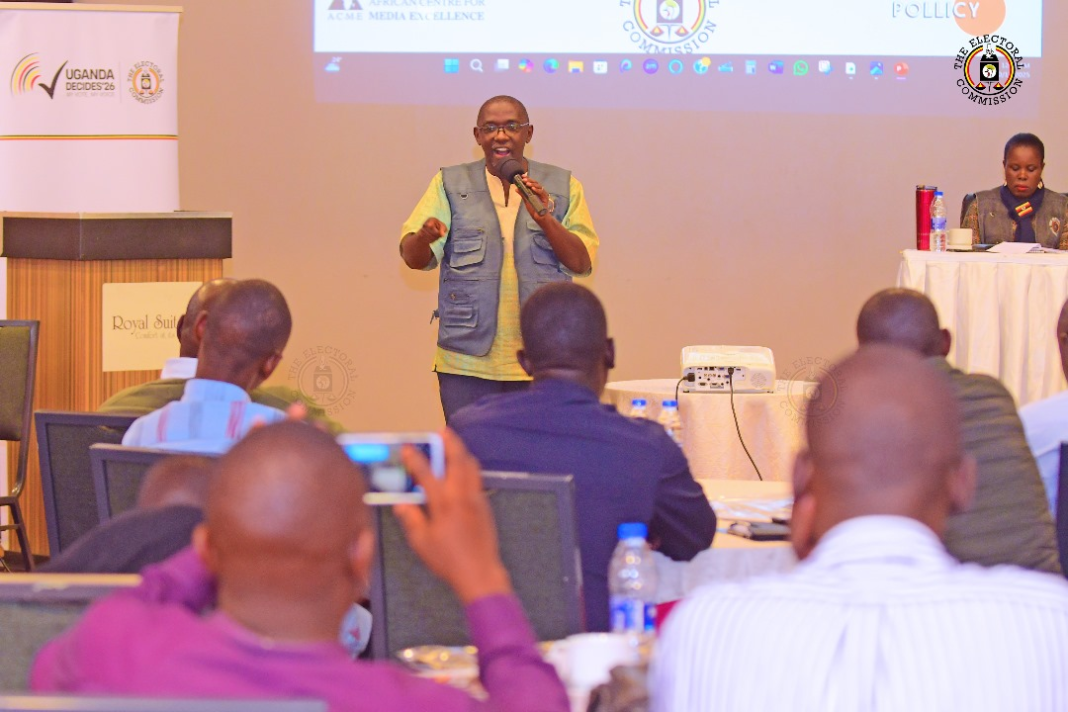
The Electoral Commission (EC), in partnership with the African Centre for Media Excellence (ACME), has launched regional refresher training sessions for editors on professional coverage and reporting of the 2026 General Elections.
The first session was held at Royal Suites- Bugolobi in Kampala and led by Dr. George Lugalambi, the Executive Director of ACME. The initiative seeks to strengthen professionalism, accuracy, and responsible reporting as the country moves closer to the election period.

According to the EC, the trainings are timely as they come ahead of the nationwide nominations for Members of Parliament and the flagging off of campaigns set to begin in November. Training sessions for the Central region will take place in Masaka on Monday, 20 October, while those for the Western, Northern, and Eastern regions will be held in Mbarara, Lira, and Mbale, respectively, on Tuesday, 21 October.
Speaking during the Kampala session, EC spokesperson Julius Mucunguzi underscored the critical role of the media in shaping how citizens engage with the electoral process.
“Professionalism, responsible journalism, and playing the roles we are supposed to play as journalists in the best interest of the citizens and the voters should be known, awarded, and recognized. This reflection of this training is very significant because it makes sure that we don’t lose sight of the reasons why we do journalism,” he said.

Mucunguzi urged journalists to remain objective, particularly during the nominations and campaign period when emotions tend to rise.
“Many important issues have been raised that should be food for thought for us as we go back to the newsrooms to plan for covering nominations next week and the campaigns that will soon unravel across the country. In November, the whole country is going to be active, and everyone will be looking for votes. That is when the greatest role of the media will be tested,” he said.
He emphasized that the training series was being organized across regions to ensure balanced and credible coverage from every part of Uganda.
“Every vote and every voter everywhere matters. And every reporter doing this work, whether in Eastern, Northern, or Central Uganda, matters. That is why this training is being organized,” Mucunguzi added.
He also advised journalists to acquaint themselves with the Compendium of Electoral Laws, which guides how elections are conducted and how results are declared.
“Elections are guided by the law. Every journalist interested in covering elections should have a copy of this compendium. It is available at the Law Development Centre, the Uganda Law Reform Commission, and even online. Journalists must invest in understanding these laws because a journalist who doesn’t read is very dangerous; they can easily make mistakes,” he said.
Mucunguzi cautioned against misrepresentation and sensational headlines that distort the true picture of events during polling.
“Sometimes we go to three polling stations, find a problem, and then write a headline saying ‘Violence Mars Elections in Uganda.’ That is misleading. We have more than 70,000 polling stations, and if less than ten have issues, that should not define the entire process. Let us be factual and responsible,” he said.
He also reminded editors and reporters of the responsibility that comes with their influence, both in mainstream and digital platforms.
“The power that we wield as journalists, editors, influencers, and digital practitioners is enormous. The more the power, the greater the responsibility, and this kind of engagement helps us to reflect, to stay professional, and to ensure that every citizen is served with credible information during the election period,” he stated.
Speaking at the launch, Jennifer Kyobutungi, the Regional Electoral Officer, outlined the activities that have already been concluded under the ongoing electoral roadmap and emphasized the Commission’s readiness for the next stages.
“That was way back from August 11-12, 2025. We conducted the nominations and campaign meetings for special interest groups — older persons, persons with disabilities, and the youth between August 13-17,” Kyobutungi said.
She added, “Polling for the district and city older persons took place on the 15th of August, followed by PWD committees on the 18th, and the youth on the 19th. All those activities were successfully concluded.”
She further highlighted that nominations for local government chairpersons, mayors, and councillors were held between 11th and 24th September 2025, while presidential nominations took place on 23rd and 24th September 2025 at the Electoral Commission headquarters in Ntinda, Kampala.
“Now where we are, we are preparing for the nomination of candidates for parliamentary elections in line with Section 9 of the Parliamentary Elections Act,” she added.
She noted, “These nominations will take place strictly on 22nd and 23rd October 2025, with no extension. Media personnel should help inform the public that these dates are final.”
According to Kyobutungi, campaigns for both parliamentary and local government elections will commence on 10th November 2025 and run until 12th January 2026 in line with the electoral law.
She reminded the public and candidates that any campaign activities before this period are illegal, noting that adherence to the electoral calendar is crucial for a credible and transparent election process.