KAMPALA — While lawmakers in the August House debate a law that could see ordinary citizens jailed for 20 years over a foreign bank transfer, the streets of Kampala remain eerily oblivious. This “dangerous” vacuum of public awareness has prompted a 16-year-old media mogul to sound a national alarm, claiming the government is effectively legislating in a graveyard of civic silence.
But beyond the question of awareness, a deeper concern is taking shape: whether the National Sovereignty Bill signals a decisive shift toward tighter state control over citizens’ financial and civic space—with minimal public resistance.
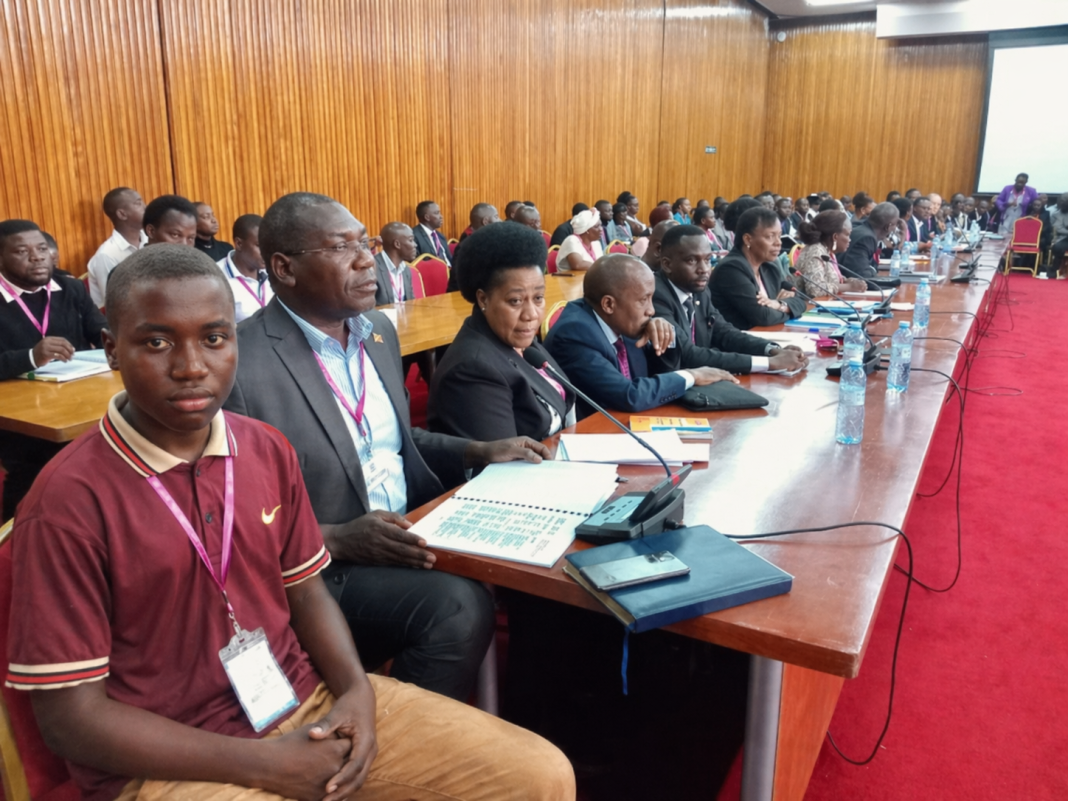
Nyanzi Martin Luther, CEO of Apex Media Services, emerged from proceedings at the Parliament of Uganda with a stark conclusion—not just that Ugandans are uninformed, but that the balance of power between the state and the individual may be quietly tilting.
“People don’t even know this law is being discussed,” he said. “But it has the potential to affect how they receive money, how organizations operate, and how communities survive.”

The bill, introduced by David Muhoozi, seeks to regulate foreign influence by imposing strict controls on external funding. Its penalties are severe: up to 20 years’ imprisonment and fines in the billions for unauthorized foreign financial transactions.
Redefining Control
Supporters frame the legislation as a necessary defense mechanism—an assertion of Uganda’s right to shield itself from external interference. Veteran politician Yusuf Nsibambi has described it as a long-overdue legal framework to protect national interests.
However, critics argue the bill’s implications stretch far beyond sovereignty.
At issue is not just foreign influence, but who ultimately controls the flow of resources within Uganda—and under what conditions. By centralizing approval authority, the state could gain unprecedented oversight over NGOs, community initiatives, and even individual financial decisions linked to international sources.

Citizens on the Frontline
Civil society actors warn that the people most likely to feel the impact are not foreign entities, but ordinary Ugandans.
Chapter Four Uganda has cautioned that vague definitions within the bill could expose citizens to prosecution for routine transactions, while Miria Matembe has warned that thousands of vulnerable households depend on foreign-supported programs that could be disrupted.
For many families, remittances, scholarships, and NGO support are not abstract concepts—they are lifelines.
Yet under the proposed law, such lifelines could become regulated channels, requiring state clearance and carrying legal risks if mishandled.
From Policy to Power
For Luther, the shift is particularly striking. Just weeks before, he had advocated for increased government support to local organizations through a proposal submitted to Deputy Speaker Thomas Tayebwa.
Now, he says, the conversation has moved in the opposite direction—from enabling civil society to tightening its operating space.
“What we are seeing is not just policy,” he said. “It is a restructuring of how power flows—from citizens upward, rather than outward.”
The Silence Factor
Perhaps the most unsettling element of the debate is not the bill itself, but the environment surrounding it.
There has been no widespread public campaign to explain its provisions. Public discourse remains limited, fragmented, and largely confined to policy circles. Meanwhile, Parliament continues to process the bill alongside major national decisions, including the approval of a multi-trillion-shilling budget.
Political analyst Charles Onyango-Obbo has warned that such conditions risk producing laws that are technically sound but socially disconnected.
A Turning Point
The National Sovereignty Bill may ultimately pass or be amended. But its broader significance may lie in what it represents: a test of how laws are made, who participates in that process, and how power is negotiated between the state and its citizens.
“When enforcement starts, it will not ask whether you understood the law,” Luther said. “It will only ask whether you followed it.”
As Uganda edges closer to a decision, the country faces a defining moment—not just about sovereignty, but about transparency, participation, and the future relationship between government and the governed.
For now, the debate continues behind parliamentary walls. Outside them, the silence persists.