Government of Uganda will generate over two million green jobs in the next ten years, Ministry of Gender, Labour and Social Development Permanent Secretary, Aggrey David Kibenge, has revealed.
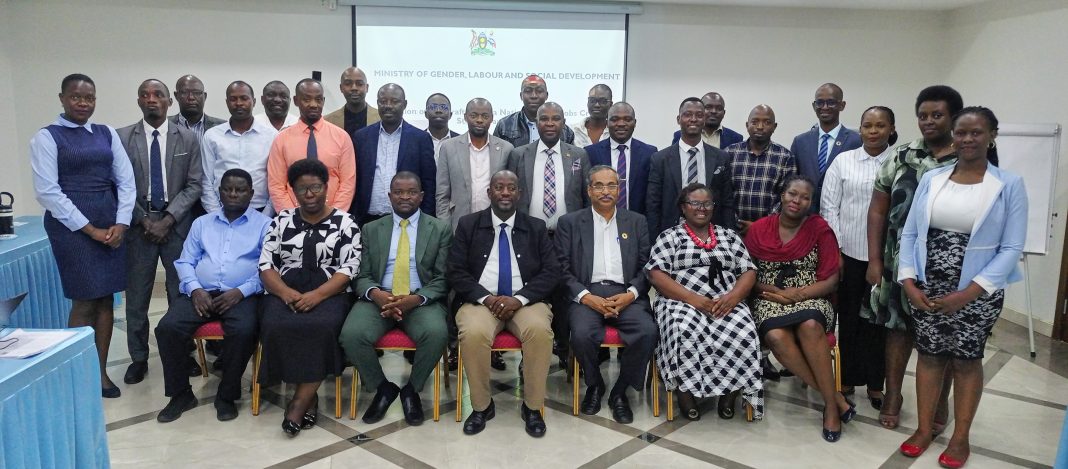
This was during a stakeholders’ validation workshop on the draft ten-year Uganda National Green Jobs Creation Strategy and Plan in Entebbe today.

Kibenge said Uganda’s rapidly growing working and employed population comes with escalating activities – both commercial and subsistence – such as expanding settlements, sand mining, car washing, cultivation, infrastructure development, and urbanisation, among others.
These activities, he said, have resulted into deterioration of natural resources such as forests, wetlands, soils, vegetation and fresh water.
In his message delivered by Zachary Kansiime, the Ministry’s Senior Skills Development, Technology Uptake and Innovation Officer, Kibenge said Uganda’s environmental stress is further compounded by heavy reliance on non-sustainable energy sources, citing the 92.7% of households who depend on biomass for cooking, with 64.5% using firewood and 28.2% using charcoal. This widespread dependence contributes to deforestation, land degradation, and increased carbon emissions. Climate change further compounds these challenges.


In the recent past, Uganda has been exposed to several climate change related natural hazards such as flooding, prolonged droughts, erratic rainfall and landslides especially in Mount Elgon region and Kasese areas where there has been devastating loss in life and property.
He added that transitioning to green growth is stimulated by the low labour productivity. According to ILO Modelled Statistics (2022), Uganda’s labour productivity is USD 3.6 GDP per hour worked, ranking Uganda 175th out of 185 countries. As a result, this low labour productivity negatively impacts on direct foreign investment and economic expansion, and hampers Uganda’s labour competitiveness within the region and internationally.
“A key contributing factor is the persistent skills gap and education system inefficiencies. While millions enter the education system, only a small proportion complete secondary and post-secondary education,” he said.
“In order to reverse the trend and address these challenges, all key economic sectors should adopt climate smart low carbon technologies which require a new set of skills/jobs – the green jobs – for expanding green and decent employment and promoting a just transition to a sustainable economy,” Kibenge added.
Green jobs are tasks, especially ones that are paid, that efficiently use energy/raw materials and minimise the generation of wastes and pollution.
According to UN-ILO (2016), Green Jobs are decent jobs that contribute to preservation or restoration of the environment, in traditional sectors such as manufacturing and construction, or in new, emerging green sectors such as renewable energy and energy efficiency. The green jobs incorporate aspects such as improving energy and raw materials efficiency; limiting greenhouse gas emissions; minimizing waste and pollution; protecting and restoring ecosystems; and supporting adaptation to the effects of climate change.
Mr Kibenge said it is within this context that the Ministry has developed the ten-year framework to guide Uganda’s transition towards a greener, more productive, and employment-intensive economy.
The strategy aims to promote the creation, protection, and sustainability of decent green jobs that enhance productivity, environmental stewardship, and inclusive economic growth across all sectors of the economy.
According to the draft strategy, green jobs must respond to the decent work principles. “A decent job involves opportunities for work that is productive, delivers fair income, provides security in the workplace, offers social protection and better prospects for personal development, gives people the freedom to express their concerns and guarantees equal opportunities and equal treatment for all,” it partly reads.
Isaac Rubagumya, the Green Jobs Programme Coordinator, said the move to green jobs is arguably one of the most important elements of the green transition due to its criticality in creating economic incentives for change (financial capital), stabilising social sentiment for change, equity and mandate for change.
“This strategy will provide policy options that enhance and exploit synergies between economic growth, environmental sustainability and social equity across all sectors of the economy,” said Rubagumya. “Besides addressing persistent development challenges that seem insurmountable by the conventional development model, empirical evidence suggest that accelerated achievement of medium term and long-term targets is therefore highly hinged on the transition to green growth which makes this transition a must rather an alternative.”
The workshop was attended by representatives from Ministries, Departments and Agencies; development partners; employers’ and workers’ organisation; the private sector, civil society organisations and academia.