President Yoweri Museveni has unveiled “Pearl Sweet” as the commercial name of Uganda’s crude oil. This milestone is the beginning of a new chapter in the country’s economic transformation as it prepares for first oil production from the Albertine Graben.
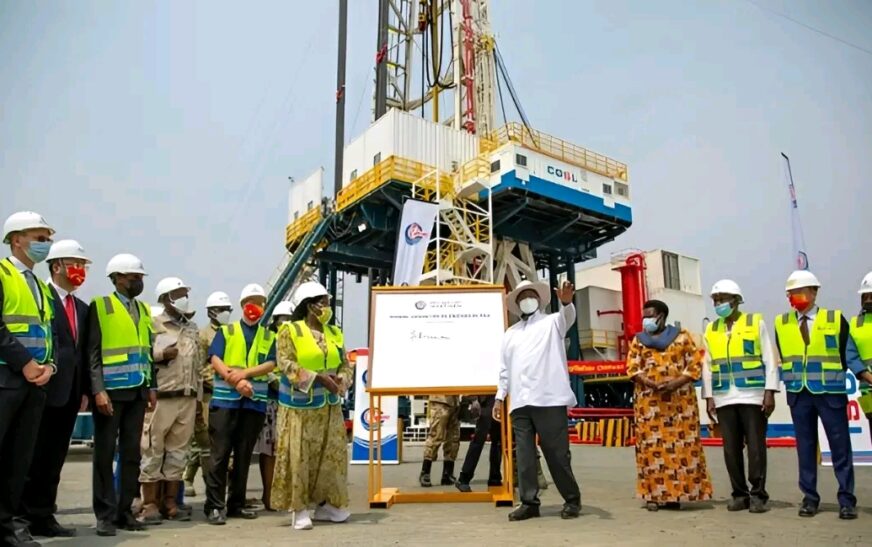
The announcement was made on Wednesday at the Kingfisher Development Area in Kikuube District, where the President concluded an oversight visit before presiding over the Crude Oil Naming Ceremony attended by Prime Minister Robinah Nabbanja, Energy Minister Dr Monica Musenero, officials from the Ministry of Energy, the Uganda National Oil Company (UNOC), and executives from CNOOC and TotalEnergies.

The naming of Uganda’s crude gives the oil an internationally recognised commercial identity, allowing it to be marketed and traded on global markets as the country inches closer to becoming East Africa’s newest oil-producing nation. The name combines “Pearl,” drawn from Uganda’s identity as the Pearl of Africa, with “Sweet,” a reference to the crude’s low sulphur content, which makes it easier and less costly to refine.
Addressing guests at the ceremony, Museveni said the occasion represented far more than branding Uganda’s crude, arguing that it symbolised decades of planning to ensure the country’s petroleum resources become a catalyst for industrialisation.
“Today, I concluded an oversight visit to the Kingfisher Development Area and presided over the Crude Oil Naming Ceremony, where I officially launched the name of Uganda’s crude oil as ‘Pearl Sweet’,” the President said.

He described the development as one of the most significant achievements in Uganda’s oil journey.
“This marks an important milestone in our journey to develop Uganda’s oil and gas resources for value addition and economic transformation,” he added.
Museveni reiterated that his government’s strategy has never been to export raw resources without creating value within the country. Instead, he said, Uganda intends to build an integrated petroleum industry that includes refining crude domestically, producing petrochemicals and utilising associated natural gas to generate electricity.
“Through refining, petrochemical industries and the use of associated gas for electricity generation, we shall maximise the value of our resources here at home and reduce dependence on imported petroleum products,” he said.
The President also recalled that he initially questioned the idea of constructing the East African Crude Oil Pipeline before insisting that Uganda’s refinery should receive priority access to the country’s crude oil.
“You can export some of the crude, but the refinery must get priority,” Museveni said, maintaining that domestic processing would save the country billions spent annually on imported fuel.
Government estimates indicate Uganda spends about $2 billion each year importing petroleum products, a cost officials expect to reduce substantially once local refining begins.
Museveni further challenged government institutions to ensure that future oil revenues are invested wisely rather than being consumed through recurrent expenditure.
“The revenues from oil must be invested in durable infrastructure and productive sectors for the benefit of the Bazzukulu,” he said.
He emphasised that the resource should finance projects capable of serving generations to come, including roads, railways, electricity infrastructure and industrial development.
The President commended the oil companies, engineers, technicians and Ugandan professionals who have contributed to advancing the country’s petroleum industry over the years.
“I commend all the oil companies, technical teams and Ugandan professionals whose efforts have brought us to this milestone,” Museveni said.
The Kingfisher project, operated by CNOOC Uganda, is expected to produce about 40,000 barrels of oil per day at peak production. Together with the larger Tilenga Project, operated by TotalEnergies, Uganda’s combined production is projected to reach approximately 230,000 barrels per day once both developments are fully operational.
Officials say the Kingfisher Central Processing Facility has already reached mechanical completion and commissioning activities are underway ahead of first oil. The facility includes systems for crude oil processing, water separation and liquefied petroleum gas production.
Associated natural gas from the project will not be flared but will instead generate about 80 megawatts of electricity while also supplying LPG for domestic cooking, creating additional revenue streams and reducing environmental emissions.
Uganda’s oil industry has also become a significant source of employment, with officials reporting that more than 18,000 people are currently employed directly in the sector, about 91 percent of them Ugandan nationals, while thousands more have benefited through indirect and induced jobs. Ugandan companies have also secured contracts worth more than $2.2 billion during the ongoing development phase.
The country’s commercially recoverable oil reserves are estimated at about 1.7 billion barrels, part of the broader 6.5 billion barrels discovered in the Lake Albert Basin. Beyond Kingfisher and Tilenga, government plans include continued exploration in other regions such as Moroto, Kadam, Lake Kyoga and Hoima as Uganda seeks to expand its petroleum resources.
The unveiling of Pearl Sweet is regarded as one of the final symbolic and commercial steps before Uganda joins the ranks of Africa’s oil-exporting nations, with the government insisting that the country’s petroleum wealth will be measured not only by exports, but by the industries, infrastructure and economic opportunities created from the resource at home.