Stanbic Bank
Stanbic Bank
21.8 C
Kampala
Stanbic Bank
Stanbic Bank
Home Blog Page 80

Police caution parents on children’s safety ahead of August school holidays

Police Spokesperson, Kituma Rusoke.

As Uganda prepares for the second term school holidays in August 2025, the Uganda Police Force (UPF) has warned parents and guardians about the rising risks to children during this period.

ACP Rusoke Kituma, Police spokesperson, said that during holidays, children are often sent away from their homes, which increases their vulnerability.

 “We record numerous cases involving violations of children’s rights, accidents, parental negligence, and offenses committed between children,” Kituma said.

Sexual abuse remains one of the most concerning issues during the holidays. According to Kituma, offenders often include guardians, neighbours and village troublemakers around trading centres, relatives, coaches and trainers. “We also encounter cases of sexual activity between children,” he added.

Corporal punishment is another major challenge. “This commonly involves the intentional use of physical force to cause pain or injury to a child. It destabilizes families, particularly because several suspects are breadwinners in their households,” Kituma said.

Many offenders claim ignorance or show remorse only after serious harm has been done.

Child labor and harmful employment continue to pose serious risks. Kituma explained, “The law prohibits employing or engaging children in activities that could harm their health or physical, mental, spiritual, moral, or social development. Harmful work includes exposure to sexual abuse, underground work, dangerous machinery, handling heavy loads, exposure to chemicals, or involvement in illicit activities.”

He warned that some bars exploit children in pornographic performances known locally as “ebimansulo.”

Recruitment of children into criminal activities is also prevalent, particularly by rogue village groups. Neglect remains a serious concern in slum areas, where children are sometimes abandoned at home or locked inside while parents engage in activities such as prostitution.

 “This creates severe risks, including fire-related tragedies, if children are left unattended. We also record cases where parents leave candles burning, endangering the children further,” Kituma noted.

The police have also observed illegal practices by parents who attempt to seek compensation from suspects after their children have been abused, a practice locally known as “sorting” the parent. Kituma stressed that such actions are unlawful.

The Uganda Police Force has urged all parents to remain vigilant and keep emergency contact numbers for the police and local council chairpersons readily available.

“We call upon parents to take proactive measures to safeguard their children during the holidays,” Kituma said.

Stories Continues after ad

Coffee prices recover to expected levels boosting Uganda’s farmers and exports

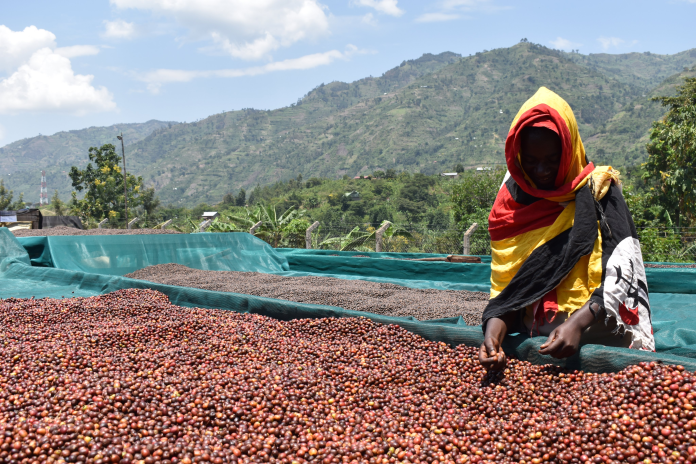
Coffee beans.

The Ministry of Agriculture, Animal Industry and Fisheries has announced the recovery of coffee prices, bringing relief to farmers after months of unstable earnings.

In a statement dated August 18, 2025, the Minister of Agriculture, Animal Industry and Fisheries, Frank K. Tumwebaze confirmed that prices had risen to expected levels, fulfilling earlier predictions that the market would stabilize by mid-August.

“As per today’s coffee market report from our Department of Coffee Development, a kilogram of coffee is selling at between Shs13,000–14,000 (FAQ) and Shs13,500–14,000 (Arabica parchment) per kilo,” Tumwebaze said.

He noted that this trend reflected renewed confidence from international buyers and the resilience of Ugandan farmers, whose quality produce continues to attract demand in global markets.

The Daily Coffee Market Analysis Report of 18th August 2025 showed that Robusta futures for September delivery gained $38, closing at $4,001 per ton on the London market, while Arabica futures for December delivery rose by 6.75 cents, closing at 237.45 cents per pound on the New York market. The gains were attributed to short-covering and reduced exports from Brazil and Vietnam, which gave Uganda’s coffee a stronger competitive edge.

At the local level, the indicative farm-gate prices showed significant improvements. Kiboko (dry cherries) traded at Shs6,700–7,000 per kilo, FAQ (fair average quality) at Shs13,000–14,000, Arabica parchment at Shs13,500–14,000, and Drugar at Shs12,000–12,500. Export statistics also indicated that Uganda shipped 380,167 sixty-kilogram bags in July 2025, up from 345,562 bags in June, reflecting both improved prices and sustained international demand.

Tumwebaze emphasized that quality remains central to Uganda’s coffee competitiveness.

“This reflects our commitment, confidence in Uganda’s quality coffee by international buyers, and farmers’ resilience. I call upon all farmers and actors in the coffee value chain to continue focusing on maintaining high-quality standards at harvesting, drying, and processing,” he said.

He further encouraged farmers to adopt good agricultural practices to increase both productivity and quality, while also urging them to strengthen cooperatives for better bargaining power and to embrace value addition initiatives to cushion themselves against future global price shocks.

The minister reassured farmers that the government remained committed to supporting them. “I urge you all therefore, to maintain the momentum and most importantly to continue adhering to correct practices in production, harvesting, and post-harvest,” he said, adding that coffee would continue to be safeguarded as a strategic export crop and a lifeline for millions of Ugandan households.

Coffee remains Uganda’s leading cash crop and top foreign exchange earner, contributing over 20 percent of export revenues and supporting the livelihoods of more than 1.7 million households across the country.

Stories Continues after ad

Afrigo band pulls off splendid Stanbic-sponsored 50th Anniversary concert despite heavy downpour

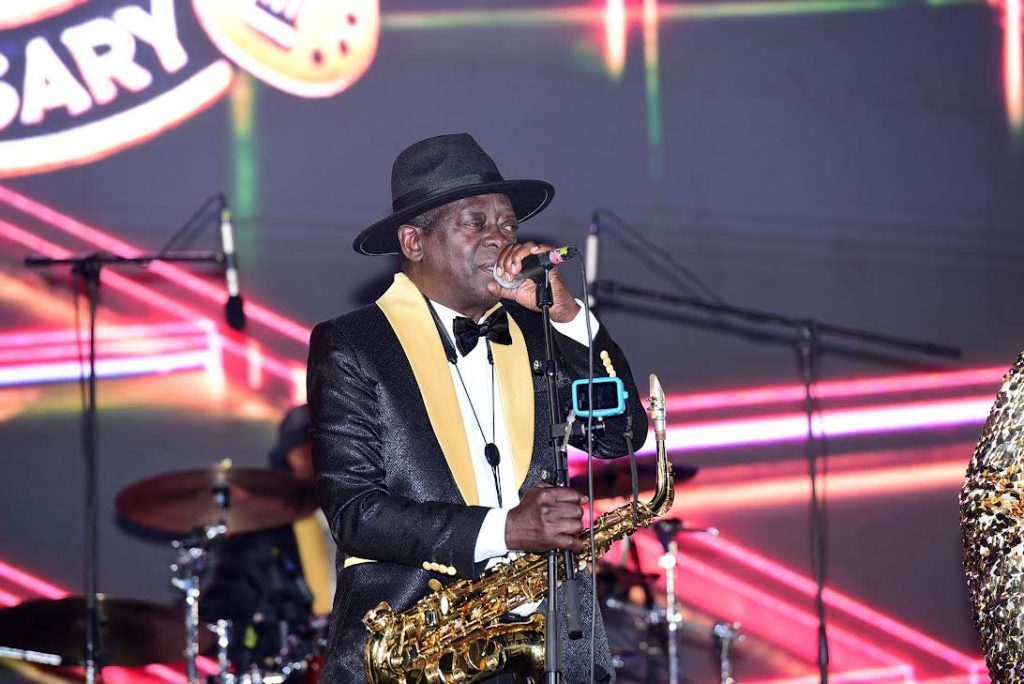
Congolese music legend Kofi Olomide performing.

LUGOGO – Not even a heavy evening downpour could dampen the spirit of celebration as thousands of cross-generational revelers flocked to Lugogo to witness Uganda’s oldest and most celebrated band, Afrigo, mark its golden jubilee in spectacular fashion. The sold-out concert turned into a true testament of music, love, and loyalty as fans braved the rain to celebrate 50 years of Afrigo’s unmatched legacy.

This landmark edition featured Congolese music legend Kofi Olomide, who electrified the stage with his signature Ndombolo dances, driving the crowd into frenzy.

“Celebrating the legacy of Afrigo is something we have yearned for as a country, and it perfectly aligns with our purpose: ‘Uganda is our home, we drive her growth’,” said Lois Kwikiriza, Brand and Marketing Manager at Stanbic Bank Uganda, the event’s main sponsor.

Kwikiriza praised the fans’ resilience: “The rains we witnessed were a blessing in disguise, as they tested our love for Afrigo and Ugandan music. We passed with distinction because sponsors, friends, and supporters all chose Afrigo regardless of the downpour.”

She added: “As Stanbic, we are happy that Ugandans celebrated their very own in a truly Ugandan style. We promise to continue spicing up events like these so that our clients can enjoy good vibes, transact seamlessly, and together propel Uganda’s growth.”

The evening’s official host, Douglas Lwanga of Next Media, wasted no time firing up the soaked but jubilant crowd.

At 8:10 p.m., Abeka Band opened with the Buganda Kingdom anthem, captivating royal loyalists before rolling out timeless Ugandan classics from music legends such as Mesach Semakula, Sweet Kid, Henry Tigan, King Michael, Chance Nalubega, and Betty Mpologoma. By 9:00 p.m., the stage was ready for the main act.

Amid thunderous cheers, Afrigo Band made a grand entrance dressed in elegant black-and-gold outfits. Veterans Moses Matovu, Rachel Magoola, and Joanita Kawalya delivered soul-stirring performances of timeless hits including Batuuse, Jim, Teri Mubi, Emaali, Olumbe Lw’Obwavu, Obangaina, and Nfunda N’omubi. Fans danced and sang along to the sweet live music, enjoying discounted drinks courtesy of Flexipay and Uganda Breweries.

Later, the much-anticipated Kofi Olomide stormed the stage with his energetic Papa Mobimba performance, also featured in his hit collaboration Waa with Diamond Platnumz. He thrilled the crowd with more of his iconic hits, including Senga, Effrakata, and Ekotite. The sight of revelers unleashing their best Ndombolo moves became one of the night’s highlights.

As midnight drew near, the skies lit up with a dazzling five-minute fireworks display, followed by the launch of the Afrigo at 50 Commemorative Book. The ceremony was presided over by Prince David Wassajja, representing the Kabaka of Buganda, alongside Nyombi Thembo, Executive Director of the Uganda Communications Commission.

Delivering the Kabaka’s message, Prince Wassajja said: “The King would have loved to be with you today, but due to unavoidable circumstances, he delegated me to convey his message. He asked me to tell you that he is extremely proud of Afrigo and the enormous contribution you have made to the art and music of our motherland.”

Speaking after the show, Ali Allybai, CEO of Talent Africa Group, reflected on the event’s success: “From day one, I knew that Afrigo at 50 was never going to be just a concert, but a historic celebration of resilience, culture, and timeless music.”

He hailed Ugandans for standing by their own and promised more spectacular shows in the future.

Stories Continues after ad

People tell off Erias Lukwago, give developers chance as Ham takes over Nakivubo Channel

Artistic impression of Nakivubo Channel, which businessman Hamis Kiggundu wants to develop.

Kampala businessman Hamis Kiggundu, popularly known as Ham, has embarked on an ambitious project to redevelop the Nakivubo Channel, the city’s most notorious drainage stretch that has for decades been a source of floods, pollution, and insecurity.

Ham, through his company Ham Enterprises, has sealed off parts of Nakivubo Channel to construct modern infrastructure as part of the Nakivubo Stadium redevelopment, a project approved by the Kampala Capital City Authority (KCCA). He insists the upgrade is both a national duty and a legacy investment.

“Nakivubo Channel has been a source of floods, insecurity, and loss of life for too long. This redevelopment is about giving Kampala a clean, safe, and modern drainage system. It’s a responsibility we owe our people, and a statement that Uganda is ready for the future,” Ham said.

The project, partly guided by CAF and CHAN inspection teams, is expected to transform Kampala’s most problematic drainage system into an eco-friendly urban corridor, complete with underground flood-control chambers, solid waste filtration, pedestrian walkways, and green spaces. Officials from CAF have already commended the works, noting their importance ahead of Uganda’s hosting of the 2027 Africa Cup of Nations (AFCON).

Lord Mayor Erias Lukwago lamented that the initiative was fraudulent, accusing Ham Enterprises of ‘grabbing’ public property and encroaching on a vital drainage channel.

“It is unacceptable for someone like Hamis Kiggundu to step in and claim to develop Nakivubo Channel on our behalf as KCCA, without any approved plans, and in the name of charity. What he is doing is illegal. If his intentions are genuine and lawful, why doesn’t he present his proposal openly and transparently?” Lukwago said.

But his criticism has sparked backlash from city dwellers, traders, and analysts who argue that political fights are stifling meaningful development.

Gabito Thomas Okurut, a resident, said politicians are only “whining” instead of embracing progress.

“What was the open channel helping them with, other than harboring thieves? All those trenches should be developed. We don’t see open trenches in developed countries,” he remarked.

Another city trader added that the redevelopment would bring order and safety to the central business district:

“I don’t see any issues provided he has properly designed for sufficient storm water flow. With proper engineering, this will even stop theft around the area,” he said.

Others argued that opposition to the project ignores the bigger picture, including the economic opportunities lost when Kampala missed hosting parts of CHAN due to structural weaknesses.

“The larger ecosystem of Kampala service providers has missed out on millions in accommodation, transport, food, and trade because of political fights and ego showboating. If you’re tangibly concerned about Kampala, you should be sharing those deficits instead of fighting development,” said one commentator.

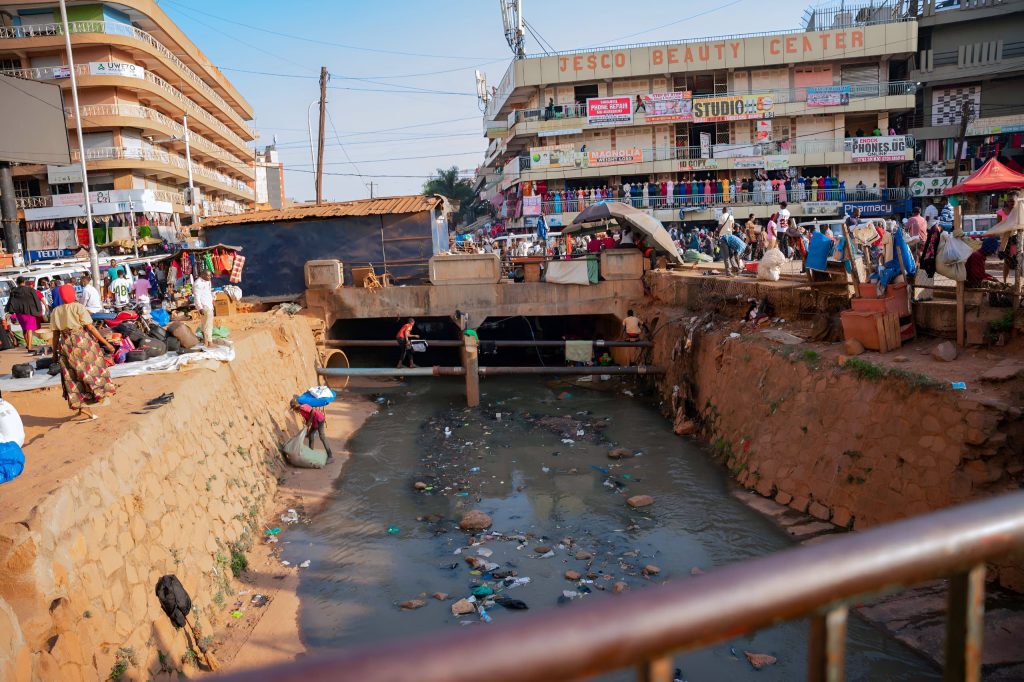
Current Nakivubo Channel

A Long-Standing Problem

For decades, Nakivubo Channel has been synonymous with flooding, pollution, and safety hazards in Kampala’s heart. The new development, estimated at billions of shillings, is intended to mitigate these risks while modernizing the city’s infrastructure.

Experts say Lukwago’s resistance is misplaced. “His focus on one developer overlooks widespread encroachment elsewhere, like at Garden City and Hotel Africana. Nakivubo’s redevelopment is a step towards sustainable planning,” one urban planner observed.

As the project advances, it has been hailed as a model of self-driven development, relying on local investment rather than foreign aid. Supporters argue it will position Kampala as a smart city, boost tourism, and create new business opportunities.

Despite the political side, Ham’s backers insist that the redevelopment of Nakivubo is not just about concrete and steel, but about transforming one of Kampala’s biggest urban liabilities into a lifeline.

Stories Continues after ad

Rotary Clubs empower vulnerable girls with baking and entrepreneurship skills

Rotary District 9213 Governor Geoffrey Martin Kitakule, presiding over the ceremony.

At least 48 young women from Kampala’s urban slums are set to graduate with life-changing baking and entrepreneurship skills, thanks to a joint initiative by Rotary Clubs in Uganda and The Netherlands.

The training, conducted at Chesire Home, Mpererwe, targeted vulnerable girls, mostly single mothers from communities in Kamwokya, Kazo in Kawempe, Kamwanyi in Luzira, and Acholi Quarters in Kinawataka. According to Uganda’s statistics, nearly 16 percent of young people are unemployed, with the situation more severe among young women in informal settlements.

To address this challenge, the Rotary Club of Kampala partnered with the Rotary Club of Kitante, the Rotaract Club of Kampala City and Rotary Vorst of District 1560 in The Netherlands, securing a $41,000 Rotary Foundation Global Grant to fund the two-year empowerment program.

On Friday, August 15, Rotary District 9213 Governor Geoffrey Martin Kitakule will preside over the graduation ceremony, where certificates will be handed to the trainees who have completed a one-month intensive course in pan-baked products.

The curriculum combined both theoretical and practical sessions. Modules covered financial planning, sales forecasting, pricing strategies, marketing, and customer identification, while hands-on training included making and selling popular products such as mandazi, chapati, samosas, doughnuts, and half cakes.

Each graduate will also be eligible for an interest-free start-up loan of up to Shs2 million, repayable within one year. Those who successfully repay will progress to the second phase of the program, acquiring advanced oven-based baking skills, sitting for UVTAB exams, and accessing up to Shs9 million in additional start-up capital. Internships will also be offered at leading bakeries such as Hot Loaf, Karveli, and Katalemwa Bakery.

The training was implemented in partnership with Bake for Life Holland through its Ugandan non-profit branch, BISS, which will continue to mentor and monitor the graduates’ businesses. Local community-based organizations, including Slum Life Survival in Kazo, Single Mothers Club in Luzira, and Kamwokya Christian Caring Community, played a key role in identifying the beneficiaries.

“Rotary’s mission is not only to uplift individuals from poverty but to transform them into job creators and entrepreneurs,” said officials involved in the project.

Globally, Rotary brings together over 1.4 million members across 46,000 clubs in more than 200 countries, working to tackle pressing humanitarian challenges, from promoting peace and education to fighting poverty and disease.

This latest project demonstrates Rotary’s growing focus on economic empowerment, with hopes that the young women will inspire others in their communities to break free from cycles of poverty and unemployment.

Stories Continues after ad

Speke Resort Munyonyo welcomes Indian spiritual leader Bageshwar Dham Sarkar for a luxurious stay

Uganda tycoon Sudhir Ruparelia welcomes Bageshwar Dham Sarkar, Shri Dhirendra Krishna Shastri, the revered Peethadhishwar of Bageshwar Dham in Madhya Pradesh, India at the Commonwealth Resort Munyonyo.

Speke Resort Munyonyo, Uganda’s premier luxury destination, has rolled out its signature red-carpet hospitality for Bageshwar Dham Sarkar, Shri Dhirendra Krishna Shastri, the revered Peethadhishwar of Bageshwar Dham in Madhya Pradesh, India, who is in the country for a special staycation.

The spiritual leader’s visit marks yet another milestone in the resort’s tradition of hosting world-renowned figures, blending five-star service with meaningful cultural connections.

Upon arrival, Shri Shastri was warmly received by business mogul Sudhir Ruparelia, Chairman of the Ruparelia Group of Companies, under whose portfolio the resort falls.

Renowned as Uganda’s largest and most opulent resort, Speke Resort and Commonwealth Resort Munyonyo offers unmatched elegance and comfort. Accommodation options range from lavish Presidential Suites and private Cottages to stylish Executive and Superior Rooms, all boasting sweeping views of Lake Victoria and the resort’s tropical gardens.

The resort is famed for hosting high-profile international summits, heads of state, and prestigious events, featuring East and Central Africa’s largest conference facilities. Guests enjoy a full luxury experience, with five gourmet restaurants, two chic bars, 19 fully equipped conference halls, and five outdoor venues ideal for weddings, business retreats, and grand celebrations.

During his stay, Shri Shastri is expected to engage in cultural exchange, moments of spiritual reflection, and enjoy the signature hospitality that has made Speke Resort Munyonyo a jewel in Uganda’s tourism crown.

Stories Continues after ad

Equity Bank expands Tupange Business Forum to boost SME growth nationwide

Tupange Equity Business Forum with a vibrant gathering of over 500 small and medium enterprise (SME) leaders at Hotel Africana on Wednesday.

Equity Bank Uganda launched the 2025 edition of its flagship Tupange Equity Business Forum with a vibrant gathering of over 500 small and medium enterprise (SME) leaders at Hotel Africana on Wednesday. Now in its second year, the initiative is extending its reach beyond Kampala to Mbale, Arua, Hoima, and Fort Portal, taking vital financial and business development support directly to entrepreneurs across the country.

The forum offers SMEs more than just access to credit. Participants benefit from mentorship, business advisory services, market linkages, and financing solutions designed to boost competitiveness. Equity Bank Uganda’s Head of SME, Olivia Mugaba, praised branch managers for their role in mobilising participants and reminded attendees that SMEs generate seven out of every ten new jobs in Uganda. She reaffirmed the bank’s commitment to supporting its growth through integrated value chain financing.

Executive Director Claver Serumaga unveiled a suite of innovations tailored for SMEs—from agent banking and point-of-sale services to ERP-integrated internet banking, real-time supplier financing, and unsecured loans of up to Shs1.5 billion. He also announced the upcoming Pay with Equity platform, set to streamline daily transactions for business owners.

“Our mission is to transform lives, provide dignity, and create wealth opportunities,” Serumaga told the audience.

“Every service we provide must help SMEs succeed. If we’re not enabling transformation, we’re not meeting our purpose.” He highlighted the importance of youth-focused programs, customised financial packages, and faster guarantees to enable enterprises to grow sustainably.

Dr. Fred Muhunza, Economic Advisor to the President, commended the bank’s integrated value chain approach, noting that financing every link from suppliers to buyers builds stronger, more resilient businesses.

Pastor Robert Kayanja, another guest speaker, praised the bank for supporting social enterprises, citing initiatives in Karamoja where Equity Bank has funded tractors and farming projects to combat hunger and improve livelihoods.

One of the highlights of the event was the recognition of outstanding SME clients, including Nuhu Kanyike, Managing Director of Falkan Investments Limited, who received an award for excellence in enterprise growth.

By expanding Tupange Equity Business Forums to more regions, Equity Bank aims to modernise SME operations, enhance efficiency, and strengthen market presence. The approach goes beyond individual businesses, seeking to grow entire ecosystems so that when SMEs thrive, communities thrive alongside them.

With its mix of financial innovation, hands-on support, and national outreach, Equity Bank Uganda is positioning itself not just as a lender, but as a long-term partner in building resilient, future-ready enterprises that will power Uganda’s economic growth.

Stories Continues after ad

Gov’t secures Shs534.9b loan to upgrade Lusalira–Nkonge–Lumegere–Ssembabule road

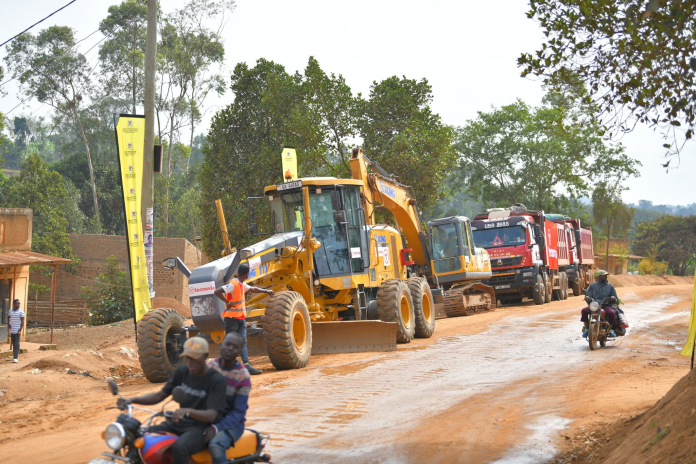
Contractor on theLusalira–Nkonge–Lumegere–Ssembabule Road.

The Government of Uganda has signed a financing agreement to upgrade the 97-kilometer Lusalira–Nkonge–Lumegere–Ssembabule Road (Package 4) from gravel to a Class II bitumen standard, significantly enhancing regional connectivity and economic integration. The project is valued at approximately Shs534.9 billion ($147 million / EUR 126.44 million), exclusive of VAT.

Under the arrangement, Citibank Uganda serves as the Mandated Lead Arranger, contributing Shs479.8 billion ($132 million), while the Government of Uganda will provide Shs55.11 billion ($15.1 million) in equity and cover applicable taxes. Additional financing will be supported by Absa Bank (Mauritius) Limited, the Development Bank of Southern Africa, and African Trade and Investment Development Insurance.

The works will be undertaken by Tecnovia Group, a joint venture between Tecnovia S.A. of Portugal and Tecnovia Angola, with oversight by the Uganda National Roads Authority. Construction is expected to begin in January 2025 and run for 36 months, with completion targeted for the end of 2027 or early 2028. The road will be upgraded to a Class II bitumen surface and will feature shoulders, drainage channels, culverts, and planned grade-separated intersections and underpasses.

The Lusalira–Nkonge–Lumegere–Ssembabule Road begins in Mubende District at Lusalira, passes through Nkonge, Kabamba, and Lumegere, and ends in Sembabule District. It is set to serve as an alternative corridor linking the Northern Corridor routes of Kampala–Masaka–Mbarara and Kampala–Mubende–Fort Portal. The upgrade is expected to reduce vehicle operating costs, cut travel time, and improve access to social and economic services, while stimulating trade and mobility across the Central Region.

Speaking at the signing ceremony, State Minister for Finance (General Duties) Henry Musasizi emphasized the road’s role in boosting local economies and enhancing national connectivity. Minister of Transport and Works Gen Edward Katumba Wamala called for the inclusion of local contractors and urged compliance with Uganda’s local content laws. The loan facility has a 10-year maturity period with a three-year grace period. Interest is pegged to the six-month EURIBOR plus five percent, with a 2.25 percent insurance premium, bringing the effective rate to approximately 9.08 percent. Additional charges include a 1.75 percent commitment fee, a 1.4 percent arrangement fee, and an annual agency fee of EUR 15,000.

By modernising this strategic 97-kilometer route, the government aims to strengthen economic resilience, improve regional integration, and open up new opportunities for communities along the corridor. The government says the project is part of a wider strategy to transform the country’s road network into a reliable enabler of trade, investment, and socio-economic growth.

Stories Continues after ad

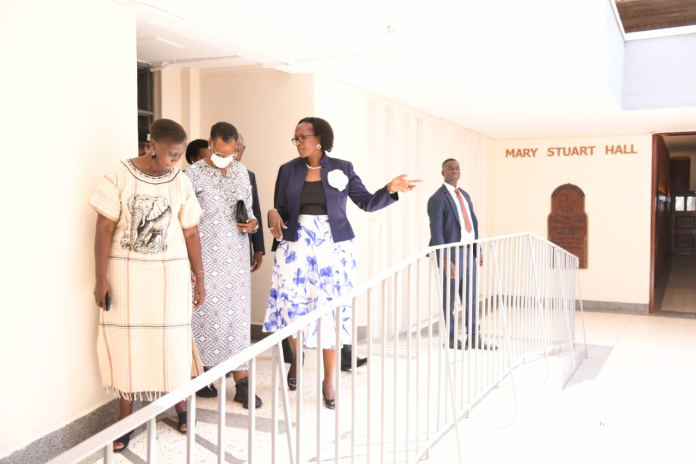
First Lady reopens renovated Mary Stuart Hall at Makerere University after Shs10.5b upgrade

First Lady and Minister of Education and Sports, Janet Museveni, is being shown around the renovated Mary Stuart Hall.

Makerere University’s iconic Mary Stuart Hall has been officially reopened after a Shs10.5 billion facelift, in a ceremony presided over by the First Lady and Minister of Education and Sports, Janet Kataaha Museveni. The First Lady hailed the renovation as proof of the NRM Government’s commitment to creating conducive learning environments in higher institutions.

Janet Museveni recalled touring the university’s halls of residence during the #COVID-19 lockdown and being deeply concerned about their poor condition. She thanked God and the Ministry of Finance for prioritising the funding and praised the National Enterprise Corporation (NEC) for completing the work on time and to a high standard.

The upgrade, she said, is part of a wider plan to modernise all halls of residence at Makerere and other public universities. She urged students to maintain the facility with discipline, good character, and wise financial habits, while embracing moral guidance through programs such as the Emerging Leaders Program, which promotes the SAFE framework — Sober, Addiction-Free, Financially Faithful, and Education-Focused.

Vice Chancellor Prof. Barnabas Nawangwe described the reopening as a momentous occasion for Uganda’s oldest and largest female students’ hall, named after Mary Stuart, wife of Uganda’s first Anglican Archbishop and a champion of women’s admission to Makerere.

Before renovation, he said, the hall had a lift that had not worked in 50 years, leaking roofs, and poorly lit corridors. NEC’s year-long renovation included a modern lift, improved lighting, upgraded pantries, new washrooms and laundry facilities, a reading room, and a senior common room. NEC has also pledged to install solar lighting and landscape the grounds.

Prof. Nawangwe thanked President Yoweri Museveni for directing the renovations and announced plans to refurbish Complex Hall for Girls once funds are released.

University Council Chairperson Mrs. Lorna Magara hailed the reopening as a milestone in Makerere’s infrastructure transformation under the First Lady’s nine years of stewardship. She highlighted a 116% increase in staff salary allocations, a 132% rise in the development budget, and the introduction of Shs20 billion in annual research funding. Mary Stuart Hall’s capacity has risen from 376 to 512 female students, contributing to a total of 1,357 on-campus spaces for women.

However, she noted that the university still accommodates only 13% of its 30,000 students, many of whom rent in areas that may not meet safety standards, and called on the government to prioritise more student housing.

Both the First Lady and university leaders urged students to take pride in the refurbished hall and safeguard it for future generations, describing it as more than a building — a symbol of progress, resilience, and the transformative power of education.

Stories Continues after ad

Climate Resilience must not displace the poor: A call for just urban adaptation in Kampala

Mr. Deus Mukalazi

By Deus Mukalazi

Board Chair, UBUNTALISM GLOBAL, a member of the MUNGAANO INITIATIVE FOR CLIMATE JUSTICE

Kampala faces an uncertain climate future. Like the rest of the world, Kampala is experiencing climate change, mostly with increased temperatures and more intense rainy seasons, which are less predictable and more erratic, leading to flooding and food insecurity. The recorded temperature has increased by 1.50 °C over the last 50 years. Although the amount of rain hasn’t changed much, it now comes at more unpredictable times. This makes the urgency to build climate climate-resilient city necessary. A Kampala Climate Change Action Strategy was put in place in 2019. City authorities, donors, and planners are investing heavily in infrastructure upgrades—stormwater drainage systems, roads, and greening projects—meant to help the city cope with these pressures. But while these efforts are necessary, they have also created a new crisis: the forced displacement and marginalization of the urban poor.

Across informal settlements in Kampala—such as Bwaise, Katanga, Kinawataka, Lubigi, and Kisenyi—residents are increasingly living in fear of eviction. The very communities that have long been excluded from formal housing, water, and sanitation services are now being blamed for occupying wetlands and flood-prone areas. Under the guise of climate adaptation and environmental protection, entire neighborhoods are being cleared, often without compensation, relocation, or a meaningful chance to be heard. In the rush to make Kampala “climate smart,” justice is being left behind.

Climate risks in Kampala do not affect everyone equally. Informal settlements, which house over 60% of the city’s population, are often built on marginal lands such as wetlands, steep slopes, or floodplains. These areas were not chosen out of preference but out of necessity. They reflect decades of neglect in housing policy, rising land values in central areas, and a failure to provide affordable alternatives for low-income earners.

When floods hit, these communities suffer the worst losses—destroyed homes, waterborne disease outbreaks, disruption of livelihoods, and death. Yet when adaptation projects are planned, these same communities are often treated as the problem rather than partners in the solution.

True climate resilience requires acknowledging this imbalance and addressing it, not reinforcing it. It is not enough to build bigger drainage channels or expand roads if doing so leaves the most vulnerable even worse off than before.

One of Kampala’s flagship climate actions is wetland restoration. Wetlands are vital ecosystems that regulate floods, purify water, and store carbon. However, the implementation of wetland recovery projects in urban areas has largely targeted settlements of the urban poor, not the factories, upscale homes, or commercial developments that have also encroached on wetlands—sometimes with tacit approval or licenses.

This selective enforcement raises critical questions. Why are evictions more common in low-income settlements than in commercial zones? Why are ordinary citizens penalized for settling in places where the state failed to provide alternatives? And why is there no serious effort to integrate housing, livelihoods, and climate adaptation into a single, coherent urban plan? The answer lies in the lack of climate justice framing in Kampala’s urban adaptation strategies.

Adaptation without justice is no adaptation at all.Adaptation, by its very definition, should enhance the ability of communities to cope with climate shocks—not expose them to new vulnerabilities. If building a storm drain means displacing hundreds without compensation, it is not resilience—it is injustice disguised as progress.

Just urban adaptation must be guided by the principle of “not harm.” This includes: securing land for vulnerable residents, especially those with long histories of informal occupancy, meaningful participation in planning processes, where communities help shape the projects that affect them, equitable compensation and resettlement, not only for physical displacement but also for economic and social disruption and integration of nature-based solutions with inclusive urban design—like retaining wetlands while upgrading housing in adjacent communities. Without these safeguards, adaptation becomes yet another driver of inequality and exclusion.

Cities around the world are demonstrating how climate resilience can be built with, not against, the poor. In Durban, South Africa, informal settlements have been integrated into flood management plans through co-designed infrastructure and participatory mapping. In Nairobi’s Mukuru slum, residents developed their climate resilience strategies, which were adopted into the city’s adaptation plan. These approaches are not only more just—they are more effective, because they are rooted in the lived realities of those most affected.

Kampala can do the same. Uganda’s own National Climate Change Policy recognizes the need for socially inclusive adaptation. The Kampala Climate Change Action Strategy also emphasizes equity and citizen engagement. The challenge is translating these principles into practice on the ground. What is needed now is a shift in mindset—from “clearing the poor to save the environment” to “working with the poor to protect both people and nature.” This means investing in informal settlement upgrading, enhancing community-based early warning systems, and ensuring that urban infrastructure is designed to serve everyone—not just the privileged.

Climate change will reshape Kampala in profound ways. But the question is: will we allow it to deepen injustice, or will we use it as an opportunity to build a fairer, more resilient city? Urban adaptation must not be reduced to engineering projects and technical blueprints. It must be a democratic process that centers the voices, needs, and rights of all city residents—especially the poorest.

The floods that engulf Kampala’s slums are not just the result of climate change. They are also the outcome of policy choices, governance failures, and social neglect. If we want a resilient Kampala, we must first build a just Kampala. Let us not solve one crisis by creating another. Climate resilience must never come at the cost of human dignity, inclusion, or justice.

Stories Continues after ad