Stanbic Bank
Stanbic Bank
24.5 C
Kampala
Stanbic Bank
Stanbic Bank
Home Blog Page 91

Byanyima calls for renewed solidarity over HIV response amidst budget cuts

Ms Winnie Byanyima.

UNAIDS Executive Director Winnie Byanyima has expressed alarm over a crisis in the global HIV response, urging the international community to rally behind a renewed effort to prevent millions of new infections and deaths.

In a statement accompanying the latest UNAIDS report, Byanyima revealed that by the end of 2024, remarkable gains had been made in the fight against HIV.

“This report shows that at the end of 2024, just before a sudden collapse in funding triggered a crisis in the global AIDS response, the remarkable efforts of communities and governments had brought down the numbers of new HIV infections by 40% and of AIDS-related deaths by 56% since 2010,” she said.

However, she cautioned that significant gaps remain.

“It also shows that huge gaps in HIV prevention remained, with 1.3 million new infections in 2024—almost unchanged from the year before,” she said.

Byanyima highlighted the promise of medical innovation as a potential game-changer.

“We started 2025 excited about a transformative opportunity to tackle HIV with lenacapavir, a new long-acting medicine that can prevent HIV infection with twice-a-year injections. This is just one of a suite of new long-acting medicines. Within the next few years, annual injections and monthly tablets to prevent HIV could be a reality.”

She added that such developments could herald an “HIV prevention revolution” but only if access is widened.

“We could be on the verge of an HIV prevention revolution that reduces new infections towards epidemic control if the world comes together again to overcome monopolies, drive down prices, and ensure everyone who could benefit has access to these new, highly effective prevention tools.”

Troublingly, a major disruption occurred in early 2025 following the withdrawal of the single largest donor to the global HIV response.

“The sudden withdrawal of the single biggest contributor to the global HIV response disrupted treatment and prevention programmes around the world in early 2025,” she said, noting that international aid accounts for 80% of prevention programs in low- and middle-income countries.

According to UNAIDS modeling, if this funding loss becomes permanent, the consequences could be devastating:

“There could be an additional 6 million HIV infections and an additional 4 million AIDS-related deaths by 2029.”

Adding to the concern, Byanyima noted a reversal in global human rights progress, “The number of countries criminalizing the populations most at risk of HIV has risen for the first time since UNAIDS began reporting.”

Despite the funding crisis and shrinking civic space, communities have stepped up.

“When formal systems broke down in Ethiopia, young volunteers formed WhatsApp groups to check on their peers, mothers banded together to support children’s treatment, and youth collectives used community radio to share health information.”

Byanyima acknowledged that while the traditional model of global HIV financing may be nearing its end, a new framework is emerging.

“The consensus behind the old model of financing the HIV response may be coming to an end, but the international community is forging a new, more sustainable path.”

At a major international conference in Seville, countries agreed to explore progressive reforms to boost domestic investment.

“Nations embraced calls for debt relief, international tax cooperation and reform of international financial institutions—the first steps towards a new economic settlement that can give countries the fiscal space needed to invest in the global HIV response.”

She praised progress in domestic HIV financing, noting that 25 out of 60 low- and middle-income countries have already found ways to increase their investment into 2026.

“This is the future of the HIV response—nationally owned and led, sustainable, inclusive and multisectoral.”

Still, she warned that global support remains essential, “This transformation cannot happen overnight. Global solidarity and renewed commitment from funding partners will be needed as countries plan and lead sustainable transitions towards self-financing.”

Ending AIDS, she emphasized, is within reach, “The HIV response has already saved 26.9 million lives. With an HIV prevention revolution, we could end AIDS as a public health threat, saving many more lives.”

And the shift could bring significant economic benefits, “It could be better value for money too: UNAIDS estimates that if the world embraces new technologies, efficiencies and approaches, the annual cost of the HIV response could fall by around US$ 7 billion.”

Byanyima noted that the AIDS response may be in crisis, but there is power to transform. Communities, governments and the United Nations are rising to the challenge.

Stories Continues after ad

UK-based COLAS firm to revamp over 100 roads across Kampala

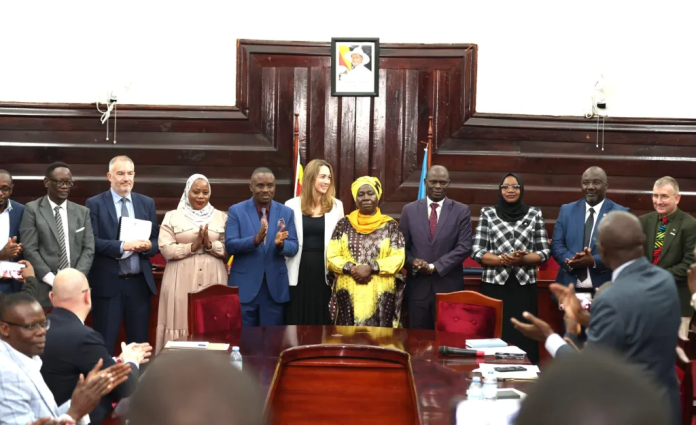
Minister for Kampala Hajjat Minsa Kabanda [standing in front of while lady], State Minister Kabuye Kyofatogabye [ standing next to minister Kabanda on the right] , KCCA Executive Director Hajjat Sharifah Buzeki [4th left, standing], Kampala Lord Mayor Erias Lukwago [5th left, standing], and the Deputy British High Commissioner to Uganda, Tiffany Kirlew [3rd left, standing].Photo by Simon Kabayo/Eagle Online.

Kampala Capital City Authority [KCCA] has entered into an agreement with UK-based global infrastructure firm COLAS to launch the Kampala City Roads and Bridges Upgrading Project [KCRBUP], a transformative infrastructure initiative that will rehabilitate and upgrade more than 118 roads across all five divisions of Uganda’s capital city.

Valued at €250 million [approximately Shs1 trillion], the four-year project is fully financed by UK Export Finance [UKEF]. Central Division will see the most extensive work with 54 roads, followed by Nakawa [27], Kawempe [15], Makindye [14], and Rubaga [8].

The signing ceremony, held at the Mayor’s Parlour on Thursday, was attended by Minister for Kampala Hajjat Minsa Kabanda, State Minister Kabuye Kyofatogabye, KCCA Executive Director Hajjat Sharifah Buzeki, Kampala Lord Mayor Erias Lukwago, and the Deputy British High Commissioner to Uganda, Tiffany Kirlew.

The project will deliver wide-ranging improvements including modern pedestrian walkways, underground drainage systems, solar-powered street lighting, and urban landscaping, measures designed to enhance safety, reduce congestion, and beautify the city.

Three pedestrian bridges will be built at key points to improve safety and accessibility: Uganda Management Institute [Jinja Road], Kawempe Hospital, and Queensway [Entebbe Road].

“This partnership is a major step toward making Kampala a resilient, liveable, and sustainable city,” said KCCA Executive Director Buzeki. “Our residents deserve safe, accessible, and attractive roads, this project brings that vision closer to reality.”

This agreement adds to ongoing KCCA road projects, including the Kampala City Roads Rehabilitation Project [KCRRP], which spans 70 kilometres, and the Greater Kampala Metropolitan Area Urban Development Programme, covering at least 81 kilometres.

Combined, these initiatives are set to greatly enhance road connectivity, stormwater drainage, and urban mobility in the capital.

Minister Kabanda stressed the importance of robust oversight and prioritising local content. “We must ensure Ugandans benefit directly from this investment,” she said, calling for the use of local labour and materials.

Between 200 and 300 Ugandans are expected to be employed directly, with at least 40 percent of the work subcontracted to local companies. A majority of the construction materials will also be sourced locally.

“We are grateful to President Museveni, the Ministry of Finance, and our political leaders whose support has been instrumental,” Buzeki added. “We are committed, alongside all stakeholders, to delivering this project with the urgency it deserves. The people of Kampala have waited long enough.”

Deputy British High Commissioner Kirlew hailed the agreement as a reflection of the strong UK–Uganda partnership.

“This marks the sixth major UKEF-backed infrastructure project in Uganda and the second involving COLAS in the past eight years,” Kirlew noted. “Upon financial close, UKEF’s total portfolio in Uganda will exceed USD 1 billion, a clear indication of the UK’s long-term commitment to the country’s development.”

COLAS, which operates in more than 50 countries and has an annual turnover of €16 billion, has pledged to use low-carbon technologies and innovative construction methods for the Kampala project. This includes recycling existing road materials and deploying efficient traffic management systems to minimise disruption during construction.

Lord Mayor Erias Lukwago welcomed the initiative, calling it “a great moment” for the city. “We are not doing well in terms of mobility, this will significantly improve our infrastructure,” he said, while stressing the need for timely and transparent implementation.

COLAS Country Manager, Eng. Jensen Lars, thanked the Ugandan government and KCCA for their trust. “We are proud to support Kampala’s transformation and will uphold the highest standards of safety, transparency, and sustainability,” he said.

The project builds on COLAS’ growing footprint in Uganda, including its current involvement in the construction of Kabalega International Airport in Hoima.

Some of the roads slated for improvement include Kamwokya–Mbazira Road, Clinic Road, Gowan Road, Katale Road, and Katoogo Road. Others are Klementi Lubwama Road, Mulago Church Road, Mulwanyamuli Road, and Ssebagala Road.

In Makindye and surrounding areas, upgrades will be made to St Kizito Jambula Road, Junju Road, Buziga Islamic Road, Kabali Kabwa Road, Kakembo Road, Kansanga Kiwafu Road, Kiyingi Road, Lubowa Road, Muwuliriza Road, and Tank Hill Bypass. Additional roads such as Faraday Road, Kampala Road, Kirombe Road, Mulwana Kibira Road, and Naalya Road will enhance connectivity in both central and suburban areas.

With works set to commence shortly, residents of Kampala are looking forward to smoother, safer, and greener roads, and a capital city that is future-ready.

Stories Continues after ad

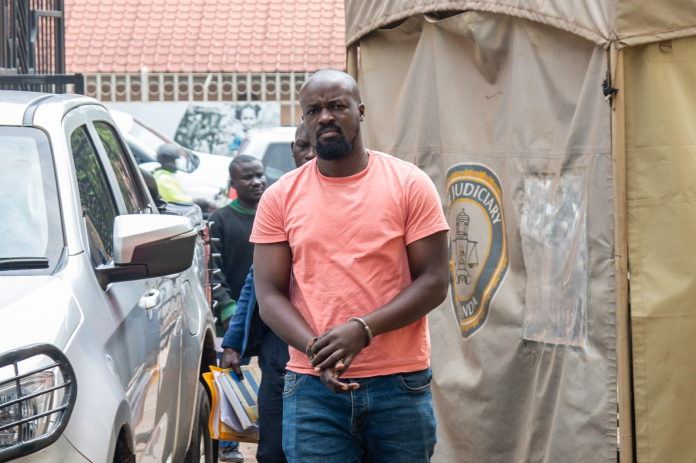
Lawyer charged over theft of Shs200m from Prof. Kanyeihamba

Lawyer Andrew Obam.

The Anti-Corruption Court on Tuesday, 9 charged Obam Andrew, an advocate of the High Court with money laundering in connection with the theft of over $56,500 (Shs202 million)from retired Supreme Court Judge Prof. George Kanyeihamba.

According to the State House Anti-Corruption Unit, working in collaboration with the Criminal Investigations Directorate (CID) and the Office of the Director of Public Prosecutions (ODPP), Obam was arraigned for allegedly conspiring with David Kaliisa , who served as a driver to Prof. Kanyeihamba to fraudulently obtain funds through stolen cheques.

The prosecution alleges that between October 2022 and September 2024, the duo orchestrated a scheme to steal and illegally transfer the funds from Prof. Kanyeihamba’s accounts. The money was reportedly deposited into the account of Loi Advocates — a law firm where Obam Andrew is the sole signatory.

“The accused conspired to defraud and launder over Shs56,500 using cheques that were unlawfully obtained from Prof. Kanyeihamba,” authorities said in a statement released Tuesday.

Obam was remanded to Luzira Prison until July 14, 2025 when he is expected to return to court to take a plea.

The State House Anti-Corruption Unit emphasized its ongoing commitment to prosecuting white-collar crimes particularly those involving trusted professionals. The investigation is ongoing, and more charges or suspects could arise as inquiries deepen.

Stories Continues after ad

Makerere University clarifies global ranking amidst misreporting

Makerere University has clarified its global standing following misinterpretation of its position in the 2025 university rankings.

The University emphasized that its performance is often evaluated using multiple international metrics and ranking systems, including those by Times Higher Education (THE) and the Center for World University Rankings (CWUR).

In a statement, the Office of the Vice Chancellor, Prof. Barnabas Nawangwe, stated: “It is pertinent to inform our stakeholders that, in addition to the ranking by Times Higher Education, Makerere University is also ranked by other international agencies. According to the latest Centre for World University Rankings (CWUR) report, Makerere University is ranked 13th in Africa and 912th globally, maintaining its position as Uganda’s leading university.”

He added that EduRank, another global ranking body places Makerere 7th in Africa and among the top 5% of universities worldwide, with notable distinction in Health Sciences research.

“We wish to reassure our stakeholders, partners, alumni, students, and the general public that Makerere has regained its international reputation as a leader in collaborative research, with the highest impact noted in the SDGs,” Prof. Nawangwe added.

The clarification came following a letter from Times Higher Education dated July 9, 2025, addressed to Makerere University’s Director of Quality Assurance, Dr. Misinde.

The letter, authored by Victor Okeugo, Business Development Manager for Sub-Saharan Africa, clarified that the published performance of Makerere in the 2025 World University Rankings (WUR) places it in the 1201–1500 band.

Okeugo stated, “The number 41 position stated in the article is inaccurate. Institutions within each band are listed alphabetically, not based on score.”

He further noted, “The article has conflated the World University Rankings 2025 and Sub-Saharan Africa University Rankings when comparing Makerere University’s performance over time. This is also inaccurate.”

Makerere University reaffirmed its dedication to excellence in teaching and research, highlighting its continuous efforts in innovation and quality improvement.

“Makerere University remains firmly committed to excellence in teaching and learning, groundbreaking research and innovation, and the continuous improvement of our academic and research environment,” said Prof. Nawangwe.

According to the Ministry of Finance, Makerere’s improving rankings enhance Uganda’s reputation in the international academic and scientific community.

Stories Continues after ad

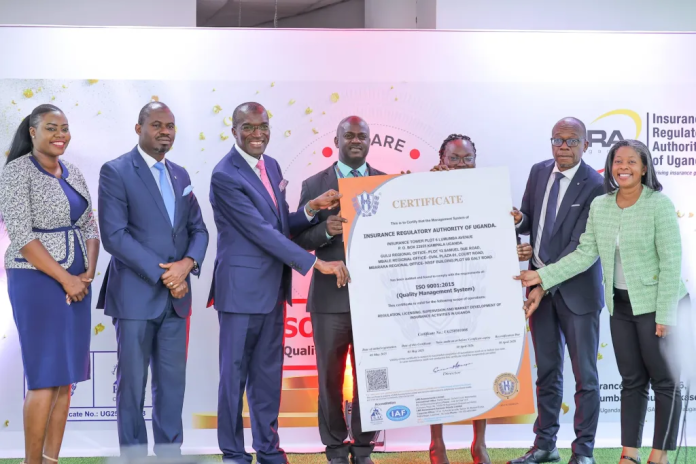
IRA attains ISO 9001:2015 certification as Uganda sets new standard in insurance regulation

Insurance Regulatory Authority Chief Executive Officer, Ibrahim Kaddunabbi Lubega and other top executives celebrate the achievement.

The Insurance Regulatory Authority of Uganda (IRA) has attained the ISO 9001:2015 Certification, a globally recognized standard for quality management systems, marking a significant milestone in the regulator’s pursuit of service excellence and accountability.

The achievement signals the IRA’s commitment to elevating the standards of regulation in Uganda’s insurance sector to match global best practices. It follows a six-year voluntary effort by the Authority to align its internal management systems, processes, and service delivery mechanisms with international benchmarks.

“This certification reaffirms our commitment to excellence and continuous improvement in insurance regulation,” said Hajji Ibrahim Kaddunabbi Lubega, the IRA’s Chief Executive Officer, during the certification announcement.

ISO 9001:2015 is one of the world’s most widely used quality management standards, adopted by over one million organizations across 189 countries, according to ISO.org. By joining that league, Uganda’s insurance regulator aligns itself with internationally recognized principles of transparency, customer satisfaction, and continuous performance evaluation.

Hajji Lubega emphasized that pursuing ISO certification was not mandatory for IRA, but a deliberate and strategic step intended to position the Authority — and by extension the entire Ugandan insurance industry — for greater scrutiny, credibility, and improvement.

“If we make promises to the public about service, we must deliver according to international best practices,” he said, adding in Luganda, “Enkola eyo tugitwala ng’omusango kwe tuyina eri eggwanga.” (That level of service is not a favour, but a responsibility we owe to the nation.)

Research shows that ISO-certified institutions typically see 15–20% increases in customer satisfaction, thanks to greater operational efficiency and transparency. The IRA aims to set a precedent for other regulatory bodies across Africa by becoming an example of quality-driven public service delivery.

Hajji Lubega called on insurance service providers to also work towards ISO certification, noting that doing so would build public confidence and improve responsiveness to evolving customer demands.

“This certification enhances public trust. It also means we are challenging the rest of the insurance sector to match these standards by being ISO certified,” he said. In Luganda, he added, “Omuntu wa bulijjo alina okulaba nti ddala enkola yaffe ey’emirimu ekyuuse.” (The ordinary Ugandan must see that our way of working has truly changed.)

Susan Lubega, Managing Partner at Quality Assurance and Management Consulting, said the certification empowers the public to question service quality and hold the Authority and insurers to higher standards. She emphasized that ISO brings clarity to expectations on both sides — the regulator and the public.

Dorcus Mukite, a Senior ISO Auditor and Consultant who led the vetting process, said the audit revealed that IRA was already operating with a high level of institutional discipline and leadership.

“Actually, our job was mostly to formalize and verify. IRA was already doing what was required — in fact, they exceeded expectations in several areas,” she said, noting the authority met 11 core standards.

James Muwawu, an IRA board member, congratulated the management and staff on the milestone but reminded them that certification is not the end of the journey. Maintaining ISO status requires ongoing audits, evaluations, and a culture of continuous improvement.

“We commit as the board to continue supporting Management in upholding the principles of the ISO quality management system,” Muwawu said.

According to the Ministry of Finance, Planning and Economic Development, the certification elevates IRA’s status regionally and internationally, placing it among regulators whose systems meet global standards.

Musa Lukwago, a Senior Economist at the ministry, noted that this international validation brings with it new responsibilities and expectations.

“You’ve opened up to the world,” he said. “Now they will want to track your performance — whether you’re keeping on track or not.”

Protazio Sande, IRA’s Director of Planning, Research, and Market Development, said the certification creates clarity around the roles and expectations of both the regulator and the industry.

“With this achievement, the public will know what to expect from insurance companies, and service providers will clearly understand the performance levels required of them by the regulator,” Sande said.

The ISO 9001:2015 Certification represents more than just a plaque on the wall for the IRA. It is a declaration of intent — to lead with integrity, regulate with efficiency, and serve Ugandans with the quality they deserve.

Stories Continues after ad

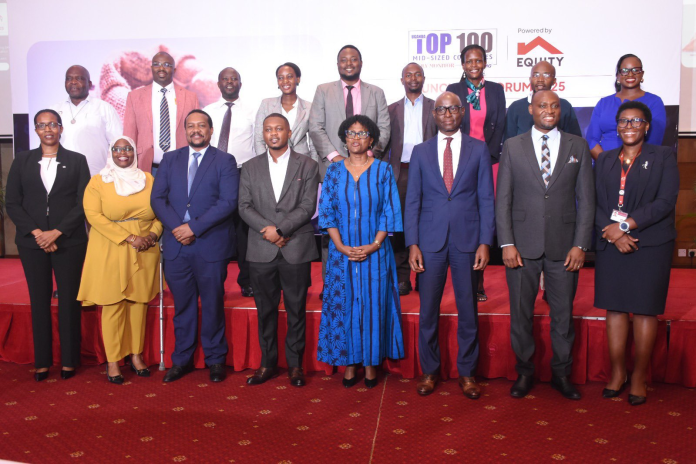
Equity Bank, partners launch top 100 mid-sized companies survey 2025

Equity Bank Uganda Limited together with Nation Media Group and KPMG, has officially launched the 17th edition of the Top 100 Mid-Sized Companies Survey 2025, under the theme “Driving Inclusive Business Growth- Empowering SMEs across All Sectors for Economic Transformation.”

The launch, held at the Sheraton Hotel Kampala, re-affirmed Equity Bank’s unwavering commitment to supporting Uganda’s thriving SME ecosystem through tailored financial solutions, business advisory, capacity building and market access initiatives.

Speaking during the event, Mr. Claver Serumaga, the newly appointed Executive Director at Equity Bank Uganda emphasized the Bank’s dedication to transforming lives and building sustainable enterprises, “At Equity Bank, we go beyond providing banking services. We journey with SMEs from ideation to expansion, walking hand-in-hand to nurture growth. Our continued investment in this survey and beyond is a reflection of our belief in the transformative power of entrepreneurship.”

As Uganda’s premier financial partner for SMEs, Equity Bank is participating for the second consecutive year as the exclusive banking partner, committing to a three-year sponsorship of the survey. The bank is currently serving over 15,000 SMEs with more than Shs500 billion in financing across sectors such as; agriculture, logistics, construction and manufacturing- efforts aligned with its continental Africa Recovery and Resilience Plan, which is injecting $65 billion into real sector businesses across Africa.

Olivia Mugaba, Head of SME at Equity Bank, passionately highlighted the real-world impact of the Bank’s partnerships, “The story of Equity Bank is truly a story of transformation- of changing lives and enabling growth from the grassroots up. I recall a client who started with a $10 million loan and now manages a $2 billion portfolio. That’s the kind of impact we live for. This partnership has defined who we are- a bank that empowers SMEs to thrive, scale and become industry leaders.”

The 2025 survey seeks to identify and celebrate Uganda’s fastest-growing, most resilient SMEs- those with annual revenues between $360 million and $25 billion, and at least three years of audited financials. The process involves two detailed assessments: one on financial health and another evaluating governance, digital readiness, and innovation. Participation is free and nationwide research begins immediately, led by a team of 50 trained surveyors.

Benson Mwesigwa, Associate Director at KPMG Uganda, emphasized the purpose behind the survey, “Now that the survey is officially launched, our next step is to hit the ground running- deploying a team of over 50 researchers across the country to engage SMEs directly, collect valuable data and support them through this process. This is more than just a ranking’s a journey of discovery, capacity building, and connecting businesses to the partners, capital, and insights they need to grow.”

The launch also introduced the Bank’s parallel initiative ‘Tupange Business ne Equity’, a series of SME forums scheduled across Uganda in the coming weeks. These forums aim to equip businesses with financial management tools, digital skills, and advisory support, further underlining Equity’s holistic approach to SME development.

Susan Nsibirwa, Managing Director of Nation Media Group, applauded the strength of the partnership. 

She noted, “Having Equity Bank as our official banking partner is a perfect fit. They have a solid reputation for serving SMEs, not just in Uganda but across the region. We believe their contribution will be key in growing the Top 100 Club and the businesses it represents.”

The 2025 Top 100 Survey will run through July to September, culminating in a gala dinner in October to unveil the final rankings. The campaign also includes themed forums on; finance, tourism and technology, with key sessions led by Huawei and the Uganda Securities Exchange.

With this powerful collaboration, Equity Bank, Nation Media Group and KPMG are not just spotlighting successful SMEs- they are cultivating the next generation of business leaders driving Uganda’s economic transformation.

Stories Continues after ad

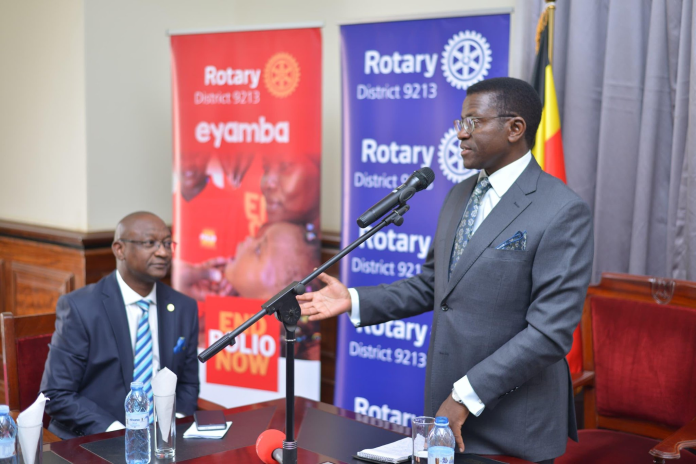
Katikkiro Mayiga applauds Rotarians for competence-based leadership as he welcomes Kitakule to Mengo

Katikiro of Buganda, Peter Mayiga addressing Rotarians who called on him at his Bulange Mengo office. Seated is Geoffrey Kitakule, the new District 9214 Governor. Mayiga commended Rotary for fostering service-oriented leadership and partnering on causes that align closely with the Kingdom’s values.

The Katikkiro of Buganda, Charles Peter Mayiga has commended the Rotary International for its competence-driven leadership and dedication to community development, noting that the organization continues to achieve extraordinary impact even with limited resources.

Speaking at Bulange Mengo while receiving a delegation from Rotary District 9214 led by newly installed District Governor Geoffrey Martin Kitakule, Mayiga commended Rotary for fostering service-oriented leadership and partnering on causes that align closely with the Kingdom’s values.

“With limited resources, Rotary is doing unlimited good,” Mayiga said.

He attributed Rotary’s effectiveness to its deliberate and thoughtful approach to leadership selection.

“I would love to implore comrades for your better selection of leaders that enables you to implement your tasks and improve the conditions of our people. We look forward as a Kingdom to work together because of our shared vision and values,” he added.

A Paul Harris Fellow himself, Katikkiro encouraged leaders across all sectors to emulate Rotary’s thoughtful and solutions-based leadership.

“Leadership must aim at solving problems. We must think critically before speaking. Let us focus on clean water access, poverty alleviation, youth empowerment, education for vulnerable children and healthcare for marginalized communities,” he advised.

In his address, District Governor Geoffrey Martin Kitakule reaffirmed Rotary’s commitment to building a stronger Uganda through service, innovation and strategic partnerships with Buganda Kingdom as a critical ally.

“On behalf of Rotary District 9213, I extend our warmest greetings and deepest gratitude for the opportunity to visit the heart of the Buganda Kingdom,” he said.

He noted that the relationship between Buganda Kingdom and Rotary International is one that has matured into a meaningful and impactful partnership over the years, founded on rotary’s shared commitment to community development.

Kitakule highlighted several key areas where Rotary and Buganda are already working closely — and where further collaboration is expected:

1. Youth Empowerment

“Youth development remains a cornerstone of our shared efforts. Uganda is one of the youngest nations globally… Rotary is working closely with the Buganda Kingdom on programs such as ‘Vijana Poa,’ aimed at tackling youth unemployment.”

He specifically cited the Center of Excellence being built in Kira Municipality by the Rotary Club of Bweyogerere-Nansana, urging the Kingdom to support the finalization of its Memorandum of Understanding to attract long-term investment.

2. Environmental Conservation

“Protecting the environment is not just a global responsibility, it is also a deeply cultural one,” he said.

Rotary clubs have supported initiatives like Kibira kya Kabaka and environmental advocacy around Lake Victoria and the River Nile. Kitakule appealed for the Kingdom’s voice in campaigns to save the Nile Basin, calling it “a shared treasure for future generations.”

3. Healthcare and Innovation

He praised the Rotary Club of Kampala Ssesse Islands for deploying a floating hospital and medical ambulances to serve Uganda’s island communities — calling it a model of innovative healthcare delivery.

4. Language Inclusion and Community Reach

“We are actively promoting the creation of local language-speaking Rotary and Rotaract clubs,” Kitakule noted, referencing the newly formed Luganda-speaking club in Ssingo-Mityana. He called on the Kingdom to help support similar efforts across Buganda.

5. Collective Action and Cultural Engagement

“This Rotary year, our focus is not only on doing good but on doing good together,” Kitakule emphasized, recognizing Buganda’s role in fostering unity and cultural pride.

He also asked for the Kingdom’s support in storytelling, requesting access to platforms like CBS and BBS to help share Rotary’s “impact stories” under the Rotary Eyamba campaign.

He noted, “A tree is known by its fruits. We want the world to see the fruits of being a Rotarian — real lives changed, communities uplifted.”

Concluding his remarks, Kitakule extended a warm invitation to the Katikkiro and Kingdom officials to attend the Rotary District 9213 Conference (DISCON 101), scheduled for April 16–18, 2026, in Entebbe.

He said, “Your presence will honour us and reinforce our joint commitment to ‘Uniting for Good.’”

As the visit concluded, both the Buganda Kingdom and Rotary reaffirmed their shared dedication to building a more inclusive, healthy, and empowered society. With strong leadership, cultural synergy and people-first strategies, this partnership is poised to deliver lasting change across the region.

Stories Continues after ad

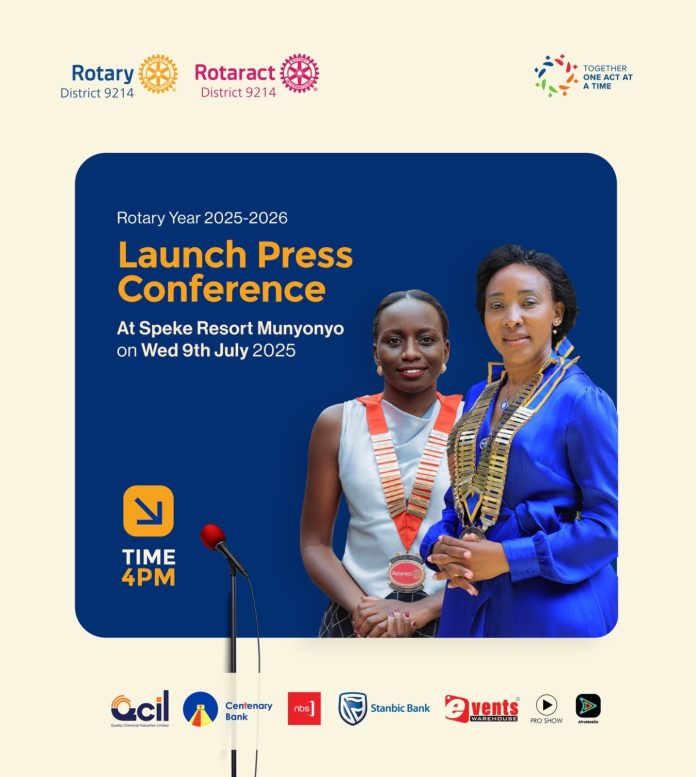
Rotarians from District-9214 launch new year of impact and service at Speke Resort Munyonyo

In a vibrant celebration of purpose and unity, Rotarians from across the region gathered at the elegant Peak Resort in Munyonyo to officially launch the 2025–2026 Rotary Year, a moment marked by commitments, renewed energy and a powerful call to service.

The event raised an opportunity to showcase the district’s commitment to the theme “Unite for Good,”

With emotion and enthusiasm, the District Governor Elect, Kawooya addressed the attendees, accepting the mantle of leadership with gratitude and conviction.

“Your support…I do accept this assignment with joy, with gratitude, and with unwavering commitment to lead, to motivate, to serve, and most importantly, to inspire and make our district, our continent, and our world a better place,” Christine Kyeyune declared to applause.

Hosted by the Broadway Club of Muyenga, the event brought together Rotary actors, partners and friends of the movement to celebrate the beginning of what was repeatedly described as “a new Rotary” — a season of unity, leadership, and transformative action.

“A new Rotary is upon us. A season for us to unite for good. A season for us to write the next chapter of service, of leadership, and of impact,” one member said, setting the tone for what promises to be a year of bold steps and community-first thinking.

Among the highlights of the event was the unveiling of several new initiatives and campaigns aligned with Rotary’s global mission to serve above self. Attendees were encouraged to join in the journey of collective impact “one act at a time.”

“On this night, we’re going to unveil a number of things. We’re going to launch so many initiatives…bold steps we are taking to make this year different,” the Rotarian continued.

The event, characterized by elegance, optimism and camaraderie, not only celebrated tradition but also paved the way for innovation within Rotary’s service model. From community-driven outreach to international collaboration, the 2025–2026 Rotary Year is expected to focus on practical action, youth leadership, and sustainability.

The Rotarian urged, “Join me as the speakers of Munyonyo as we celebrate the Rotary year of action. Get ready to enjoy, to serve above self—and together, it will be one act at a time.”

As the sun blessed over Lake Victoria, Munyonyo stood not only as a scenic host but as a symbol of Rotary’s enduring values of fellowship, integrity and service in pursuit of a better world.

Stories Continues after ad

Tycoon Sudhir’s Pearl Power One redefines Kampala skyline

The skyline of Uganda’s capital has a stunning new icon, Pearl Power One, a sleek 19-storey high-rise that marks the first phase of the expansive Pearl Business Park, a transformative development by property mogul Dr. Sudhir Ruparelia and his Ruparelia Group.

Located on Yusuf Lule Road, just in Kampala’s Central Business District, Pearl Power One rises from the grounds of the former Chieftaincy of Military Intelligence (CMI) headquarters, turning what was once a government installation into a shining hub of modern business and innovation.

“We are now in the final touches of Phase One, and the building is ready for occupancy,” Dr. Ruparelia said on December 31, 2024, ahead of the New Year launch.

A Modern Business Haven

The tower offers 16 floors of Grade A lettable office space, totaling approximately 27,240 square meters, with 2 floors of underground parking capable of accommodating 360 vehicles — a major solution to Kampala’s chronic parking shortages.

Designed for multinational corporations, blue-chip companies, startups, and SMEs, Pearl Power One boasts:

 ·High-speed elevators

 ·Dual fibre optic internet connectivity

·Automated fire detection and suppression systems with sprinklers and a 145,200-litre reserve tank

·Three fire extinguishers and three foam stations per floor

 ·State-of-the-art fitness centre and sauna

 · 170 CCTV cameras across public spaces and strict access control protocols

 · Internet access points with links from both Kira Road and Yusuf Lule Road.

Strategic Location and Mixed-Use Vision

Positioned on one of Kampala’s most accessible corridors, Pearl Power One provides easy access to the city centre, Mulago Hospital, Makerere University, and major commercial hubs. Its location is intentionally planned to support the live-work-play model, bringing business, lifestyle, and wellness under one urban ecosystem.

Pearl Power One is just the beginning. The 20-acre Pearl Business Park masterplan includes:

 · A five-star hotel

 · A modern shopping mall

 · A world-class hospital

 · Several other commercial towers

Once complete, the park will become Uganda’s largest mixed-use commercial development, offering a futuristic city-within-a-city experience.

Kampala’s Silver Lining

According to building schematics and development partners, Pearl Business Park will not only set new standards in office design and leasing but also elevate Kampala’s global investment profile.

“This project will redefine Uganda’s real estate landscape,” the Ruparelia Group said at the groundbreaking, projecting Pearl Power One as the “biggest silver lining on the Kampala skyline.”

With environmentally conscious design, energy efficiency systems, and top-tier tenant amenities, Pearl Power One is more than a building — it is a statement of what the future of Ugandan real estate looks like.

Stories Continues after ad

Tayebwa commends China for strengthening Uganda relations

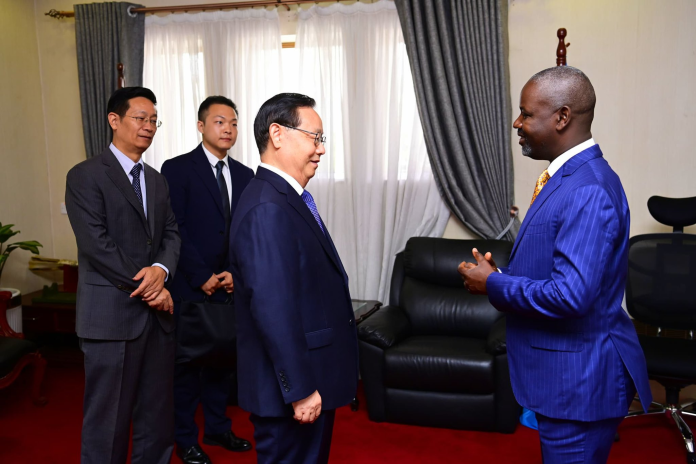
Deputy Speaker Thomas Tayebwa interacting with Chinese delegation led by H.E. Jiang Zuojun, Vice-Chairman of the Chinese People’s Political Consultative Conference and Chairman of the Central Committee of the China Zhi Gong Party.

Deputy Speaker of Parliament, Thomas Tayebwa, has commended China’s growing engagement with Uganda, describing it as historic and transformative while calling for stronger collaboration to address trade imbalances and expand legislative cooperation.

Tayebwa made the remarks on Tuesday during a high-level meeting at Parliament with a visiting Chinese delegation led by H.E. Jiang Zuojun, Vice-Chairman of the Chinese People’s Political Consultative Conference and Chairman of the Central Committee of the China Zhi Gong Party.

The visit marked a milestone in the diplomatic and legislative relations between Kampala and Beijing, setting the stage for expanded partnerships in trade, infrastructure, and health.

“I want to appreciate H.E. Xi Jinping, the President of the People’s Republic of China, for the great friendship he has exhibited towards Uganda in particular and Africa at large,” Tayebwa said. “His good working relationship with H.E. President Museveni has ensured steady development of our country, and our relations are at a level never seen before.”

The Deputy Speaker, accompanied by a cross-section of Members of Parliament, applauded China’s tangible contributions to Uganda, particularly in times of crisis. He cited Beijing’s donation of eight million Yuan worth of anti-malaria drugs, 50,000 #Covid-19 testing kits, and 600,000 vaccine doses at the height of the pandemic.

“Indeed, China proved the old saying ‘a friend in need is a friend indeed’. This helped us to save our people,” Tayebwa remarked.

While noting the increase in Uganda’s exports to China, Tayebwa expressed concern over the persistent trade imbalance. Uganda exported goods worth only $54 million to China in 2024, compared to $1.1 billion in imports from Beijing.

“I request for technical support so that we can meet the required standards in the short term,” he appealed, urging China to assist in building Uganda’s export capacity.

On his part, H.E. Jiang Zuojun reaffirmed China’s commitment to deepening ties with Africa and Uganda, calling the current China-Africa relationship the most robust in history.

“Just as President Xi Jinping of China notes, the friendship of China and Africa transcends time and space and is passed down through generations. Now China-Africa friendship is at its best, elevating to a China-Africa community with a shared future for a new era,” Jiang said.

He noted that following the 2023 Beijing Summit of the Forum on China-Africa Cooperation, Uganda was elevated to the status of a Comprehensive Strategic Cooperative Partner — a development he said reflected the depth and potential of the bilateral partnership.

Adding to the discussions, Nathan Nandala-Mafabi (Budadiri County West) called on the Chinese delegation to revive former trade initiatives such as the China-Uganda Coffee Company, which once aimed to streamline Uganda’s top export into the Chinese market.

“There was a company called China Uganda, which was formed to deal in coffee, and I would imagine that company should be revived if it is dead, for the purpose of allowing coffee, which is our leading export, to enter the China market,” Nandala-Mafabi stated.

The Chinese delegation’s visit, the first by the Central Committee of the China Zhi Gong Party to Uganda’s Parliament, concluded with both sides pledging to deepen bilateral and legislative engagement in the spirit of mutual development.

Stories Continues after ad