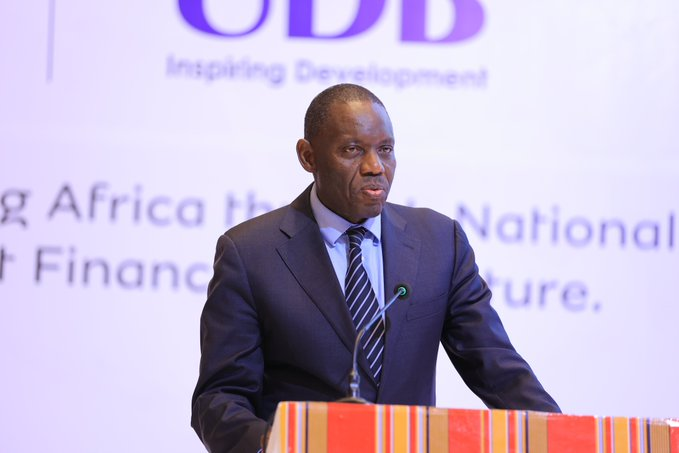
Bank of Uganda Governor Michael Atingi-Ego has urged national development banks across Africa to focus on correcting market failures and catalyzing private investment rather than competing with commercial banks.
Speaking at the close of the Uganda Development Financing Summit at Speke Resort Munyonyo on Tuesday, September 2, 2025, Dr. Atingi-Ego said institutions such as the Uganda Development Bank (UDB) should provide long-term, high-risk financing that commercial lenders are ill-suited to offer.

“Going to a commercial bank for a 10-year loan from a bank whose liability averages two years is really suicidal,” he warned, noting that the mismatch between short-term deposits and long-term credit raises borrowing costs for both businesses and individuals.
The Governor emphasized that development finance must be “purposeful, inclusive and forward-looking”, targeting projects that traditional financiers avoid while unlocking private sector growth. If development banks were stronger, he argued, they would provide long-term capital, leaving commercial banks to focus on short-term working capital.
Africa’s financing needs are immense. Estimates put the continent’s annual development funding requirement at between $900 billion and $1.3 trillion—around 43% of GDP. Achieving the Sustainable Development Goals (SDGs) by 2030 would cost about $1.3 trillion annually, with up to $250 billion required for climate action alone.

To close this gap, Dr. Atingi-Ego urged African governments to strengthen both national and continental lenders, such as the African Development Bank. Yet he acknowledged the challenge of funding development banks themselves, questioning whether options like issuing corporate bonds are viable given high interest rates.
“Can we maybe consider sustainable financing, where development banks run a sustainability agenda so they can direct funding to projects that are viable and long-term?” he asked.
Currently, UDB lends at an average interest rate of 12%, down from 15%—a level President Museveni recently described as still too high, though he underscored the bank’s importance to Uganda’s growth strategy.
Dr. Atingi-Ego said national development banks must take the lead in value addition and bankable project creation to drive Uganda’s ten-fold growth agenda, which envisions expanding private sector credit from the current $7.5 billion (12% of GDP) to at least $80 billion.
“Development financing is critical,” he said, adding that without robust development banks, African economies risk being trapped in cycles of expensive credit and underinvestment.