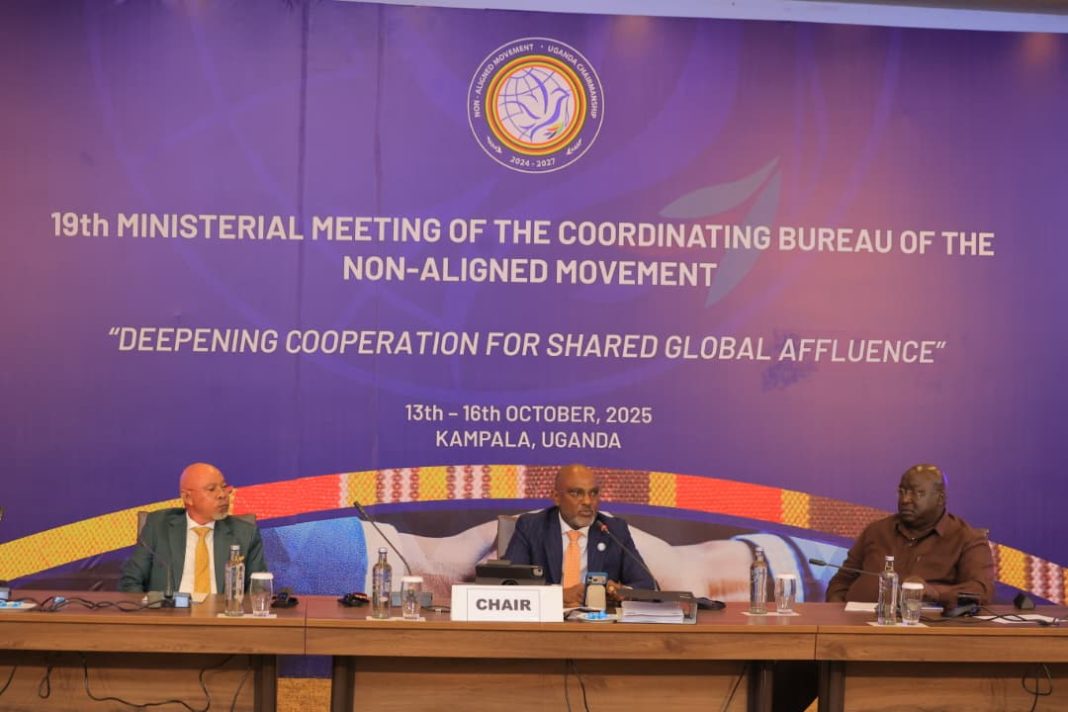
The 19th Midterm Ministerial Meeting of the Non-Aligned Movement (NAM) has kicked off today at Speke Resort Munyonyo, bringing together ministers and delegates from NAM member states, observer countries, and international organizations to review progress made since Uganda hosted the 19th NAM Summit in January 2024.
The NAM Ministerial Meeting, held under the theme “Deepening Cooperation for Shared Global Affluence,” will run from October 14 to 18, 2025.

Opening the meeting, Minister of Foreign Affairs Gen. Jeje Odongo reaffirmed Uganda’s commitment to advancing the principles and objectives of the Non-Aligned Movement as its current Chair.
“As Chair of the Non-Aligned Movement Coordinating Bureau, Uganda remains steadfast in upholding the Movement’s principled positions and in promoting the collective interests of our Member States on the global stage. We are fully committed to revitalizing NAM, reinforcing its unity and solidarity, and ensuring that our voice continues to influence international dialogue and decision-making,” said Gen. Odongo.
The minister highlighted key global issues on the agenda, with the question of Palestine taking center stage.

“Our long-standing, principled positions on this matter, carefully developed over the past six decades, must be preserved, defended, and advanced. This includes continued engagement within the United Nations system and concerted efforts to uphold international law and implement relevant UN resolutions,” he added.
He further urged the Movement to persist in supporting efforts to end all forms of colonialism, oppression, occupation and apartheid in the occupied Palestinian territory and called for sustained humanitarian assistance and practical steps toward the implementation of the Two-State Solution.
On the economic and social front, Gen. Odongo underscored the need to reinvigorate South–South cooperation to address persistent challenges facing developing countries, such as limited access to financing and unfair global trade systems.
“The global trading system is becoming increasingly restrictive, with tariff and non-tariff barriers continuing to deny our countries a fair share of international trade. These challenges are compounded by the growing technological divide, which hampers our industrial development and capacity for value addition,” he noted.
He observed that while South–South trade has grown substantially from US$0.6 trillion in 1995 to US$5.6 trillion in 2023 its full potential remains untapped, particularly in interregional trade among Asia, Africa, Latin America, and the Caribbean.
Delegates will deliberate on political, economic, and social issues affecting member states, including climate change, global peace and security, and sustainable development.
According to Uganda’s Ministry of Foreign Affairs, the meeting will conclude with the adoption of key outcome documents, including the Kampala Final Outcome Document, a Declaration on Palestine, and the Kampala Declaration.
The event, taking place at the same venue where Uganda successfully hosted the NAM and G77+China Summits early last year, further strengthens the country’s role as a leading voice for the Global South.