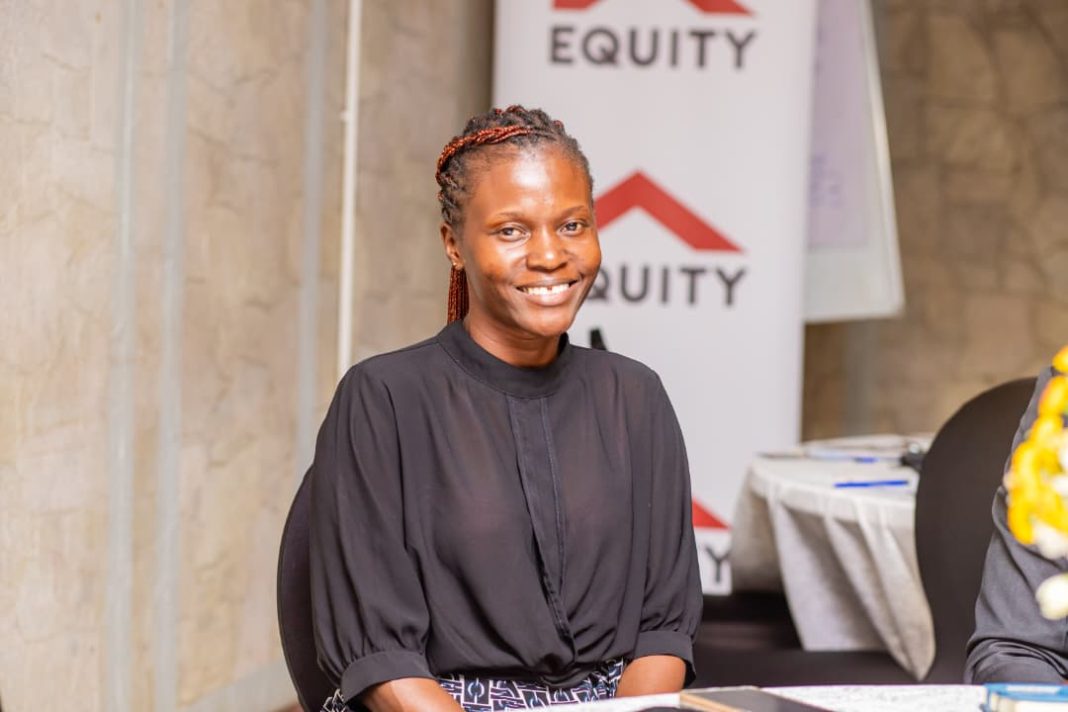
Wearing a Clifton black top, a black skirt with matching black heels, Winfred Phiona Adong walked into Hotel Africana’s Sezibwa Hall with quiet confidence.
When she spoke, she was calm and articulate. She had the ease of someone accustomed to boardrooms and negotiation tables
Adong was one of the few invited customers during Equity Bank’s Customer Service Week Stakeholder breakfast held at Hotel Africana on October 7, 2025.
The engagement was titled Listening to the Sound of the River, a focused group discussion designed to strengthen trust and relationships but also to ensure that the bank gathers customer feedback.
Adong the proprietor of Ayoma Manufacturing Company based in Soroti District was there to get avenues on how she can further broaden her dream of, “Empowering struggling women especially the single mothers and the entire community,” she says.
That dream started three years ago when she quit her sales job in one of the corporate companies in Kampala.
“I am a very ambitious person, and I thought it was time to relocate and invest my intellectual capacity elsewhere. So, I decided to venture into having a manufacturing solution enterprise,” a smiling Adong narrates.
As one who describes herself as “One who lives and breathes adventure.” She took on a bold move to venture into construction. “Many women are afraid of going into male-dominated businesses, but I wasn’t,” she says.
Despite vain attempts with other banks and financial institutions, when Adong approached Equity Bank, she was immediately given a green light and, as such, was able to access a loan of Shs300 million.
“Equity made my start journey very smooth. Not only did they just give me money. I have a good payback period, coupled with the provision of capacity building and financial literacy, I was able to check many boxes which have helped shape my company to where it is today,” Adong explains.
With that, Ayoma Manufacturing and Construction Company was born in January this year. This has seen her construct the state-of-the-art, Waterborne Toilets at Queen Elizabeth National Park, completed this year in September, as well as the new Staff Accommodation quarters at Mount Elgon National Park.
But that wasn’t all, with the Construction department kicking off on a high, Adong diversified her business to open up, Ayoma Toilet Papers Industry Ltd.
“Everyone needs toilet paper, so when we sat with my business partners, we thought it best to venture into that field and further expand to more stationery.”
However, it was an uphill task, “We needed a capital investment of $330,000, which you just can’t access from anywhere and still, like at the start of the construction company, Equity is there to hold my hand.”
Through Contract Financing, the bank has been able to support her in her efforts to mobilize raw materials such as pulp wood which eased her way into the market.
Claver Serumaga, Executive Director of Equity Bank, gives more clarity on the support that the bank is giving to various customers like Adong, “We are reorganizing how we engage with our customers, following up on their progress, providing additional capacity support, because as they grow, we also grow.”
Currently Ayoma Manufactures is looking at a ten-fold growth, extending its product line to all forms of stationery plus having an automated line of production.
As such, distribution of its toilet paper product has expanded to Lira, Gulu, Mbale, Jinja, and will soon be in Kampala. “I started small, but now, slowly, I am changing lives; most of the casual employees I have are single mothers because this helps them get money in their pockets,” Adong says.
Her last outcry is to the Government of Uganda to provide tax holidays to indigenous manufacturers like her so as to help them broaden their spheres.
Related Posts
-
-

Now that the African Continental Free Trade Area (AfCFTA) has come into force , policymakers and the business community should prioritize, develop, and implement smarter local strategies to seize the rising opportunities in manufacturing and industrialization across a variety of sectors and increase the global competitiveness of the continent. Right now, only 10 African countries (Mauritius, South Africa, Seychelles, Morocco, Tunisia, Botswana, Algeria, Kenya, Egypt, and Namibia) are ranked among the top 100 most competitive countries in world, per the 2018 Global Competitiveness Index. Given that an integrated continent will have a larger supply market, decreased trade restrictions, and free movement of people, manufacturing specialization will accelerate and make Africa’s industrialization globally competitive. As we have noted before, if the AfCFTA is successfully implemented, Africa’s manufacturing sector is projected to double in size with annual output increasing to $1 trillion by 2025 and create over 14 million jobs. Notably, one of the key objectives of the AfCFTA is to “enhance competitiveness at the industry and enterprise level through exploiting opportunities for scale production, continental market access and better reallocation of resources.” One pathway to success will be effective AfCFTA implementation and better national ownership and alignment with Agenda 2063, the African Union’s strategic framework for the socio-economic transformation of the continent. Agenda 2063 aims at creating a “strong, united, and influential global player and partner,” turning African countries into the best performers in global quality of life measures and accelerating inclusive growth, including through industrialization, import substitution, and employment. Unsurprisingly, manufacturing and industry—fundamental for overall economic growth and poverty alleviation—feature prominently. A robust manufacturing industry can provide well-paid jobs for large numbers of low-skilled workers, increase average household incomes, boost domestic demand, stabilize economies against external shocks, and contribute to innovation and diversification. The AfCFTA and Agenda 2063 hope to reverse Africa’s premature deindustrialization and tap into the vast number of manufacturing opportunities that persist, including in software, auto components, industrial and business machinery, chemicals, agro-processing, and clothing and footwear subsectors, among others. Indeed, some countries already claim advantages in certain subsectors. One example is Kenya, whose relatively strong industrial manufacturing sector accounts for nearly 20 percent of the country’s economic activity and 12.5 percent of all formal jobs, and which has become the primary supplier of motor vehicles for East African markets. National efforts toward a globally competitive industrialization Already, in countries such as Cameroon, Egypt, Kenya, Morocco, Nigeria, Senegal, and South Africa, business-to-business spending is a major contributor to growth, and these countries are beginning to implement policies to capitalize on this opportunity. Increased business-to-business spending will also improve African firms’ ability to specialize—an essential determinant of growth in manufacturing—as necessary inputs can be sourced from other businesses or neighboring markets, rather than produced in-house. The projected increase in Africa’s business-to-business spending in manufacturing by $200 billion to a total of $666.3 billion by 2030 presents further opportunities to advance manufacturing for the continent given the free trade area. In fact, manufacturing goods constitute a higher percentage of intra-African exports, compared to extra-African ones (41.9 percent compared to 14.8 percent in 2014). The business-to-business market is made up of thousands of firms, many of them smaller businesses, with substantial demand for materials, goods, and services across a wide range of sectors. Attachments areaThe United Nations Conference on Trade and Development (Unctad) will establish trade facilitation portals in Africa through a…