Stanbic Bank
Stanbic Bank
21.6 C
Kampala
Stanbic Bank
Stanbic Bank
Home Blog Page 119

Beyond CSR – Why the Private Sector Must Become Co-Creators of Social Change in Uganda

By Emmanuel Njuki, Country Legal & Corporate Affairs Lead, Nile Breweries Limited

For decades, “corporate social responsibility” (CSR) has been the catch-all phrase for how companies give back to society. However, the traditional model of CSR, often characterised by photo-op donations, short-term and self-promotional charity drives, or once-a-year sponsorships disconnected from a company’s core mission. These initiatives, while well-intended, are proving insufficient for the scale and complexity of today’s challenges, be it climate change, unemployment, skills development, public health, or educational inequality.

A few weeks back, I was invited to join a panel at the Annual Philanthropy Symposium to discuss Beyond Corporate Social Responsibility: Private Sector Leadership in Reclaiming Local Giving and Social Investment. That conversation underscored the urgent need to rethink how businesses engage with communities, moving beyond surface-level initiatives toward sustainable, ecosystem-building investments.

The truth is that charity alone cannot fix systemic problems. And when corporate giving is still ad-hoc, reactive, and disconnected from community priorities, it undermines the very impact it intends to create.

From chequebook charity to shared value creation

In Uganda, the private sector holds immense untapped potential to shape transformational societal change by leveraging its resources, reach, and influence strategically. When CSR is integrated into annual planning and aligned with business strategy, it stops being a tick-box exercise and becomes a driver of shared value, strengthening communities while also creating long-term benefits for companies. Sustainable CSR fosters meaningful, measurable change that empowers communities, enhances brand trust, and drives enduring business success. This transformation begins with three mindset shifts:

• Communities as co-creators – instead of seeing communities as passive recipients of goodwill, companies should regard them as active partners in shaping solutions.

• Alignment with development priorities – CSR should complement national and local agendas such as job creation, climate resilience, education, and health.

• Measuring what truly matters – impact should be measured not only in money spent, but in lives improved, systems strengthened, and ability built.

Why the Stakes Are Higher Now

Uganda, like many countries, is navigating a complex development landscape. Rapid urbanisation, youth unemployment, and environmental degradation demand interventions that go beyond surface-level fixes. The corporate sector cannot afford to run in isolation from these realities.

Done right, corporate philanthropy has the power to strengthen the ecosystems that enable businesses and communities to thrive together. This is not just a moral imperative. It is a strategic one.

What “Beyond CSR” looks like in practice

In our work at Nile Breweries Limited, we have learned that meaningful social investment begins with deep listening, thrives on broad collaboration, and endures through long-term commitment.

Take the River Rwizi Water Catchment Initiative, for example. Instead of designing a top-down environmental programme, we co-created solutions with local leaders and residents in communities. This approach ensured that interventions from riverbank restoration served over 1,000 households. Similarly, our Equality Scholarship Programme goes beyond tuition fees to empower students from rural farming families through mentorship and welfare support, nurturing future leaders who can contribute back to their communities. To date, the programme has spent millions of Ugandan shillings and assisted over 72 beneficiaries. 

These examples are not acts of charity. They are strategic investments in the people, systems, and environments that sustain both society and business.

Building an enabling environment for corporate philanthropy

To mainstream the beyond CSR approach, the private sector requires an enabling policy framework that actively supports and rewards meaningful social investment. This could take the form of tax incentives for companies that channel resources into community-driven initiatives. A recognition of non-financial contributions such as skills transfers, employee volunteering, and mentorship as legitimate and valuable components of corporate philanthropy. 

Additionally, setting up public-private platforms that foster co-investment, innovation, and shared learning would create collaborative spaces where businesses, government, and civil society can address complex challenges together in Uganda. Collectively, these reforms would help institutionalise the role of companies not merely as donors, but as co-leaders in driving national development and supporting the national agenda.

call to action

We are at a turning point. Companies can no longer treat their role in society as peripheral. The question is no longer “How much can we give?” but “How can we build together?” By moving beyond traditional CSR into genuine co-creation, the private sector can help design enduring solutions, strengthening communities, shaping policy, and driving sustainable growth for all.

Stories Continues after ad

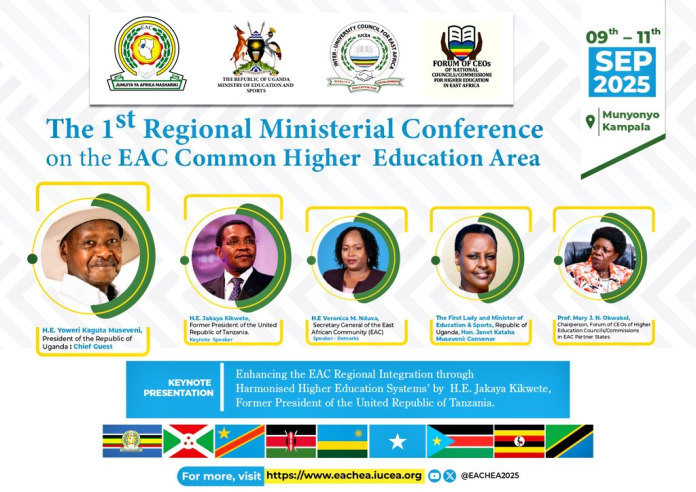
Uganda to host 1st Regional Ministerial Conference on East African Higher Education at Speke Resort Munyonyo

Uganda is set to host the 1st Regional Ministerial Conference on the East African Common Higher Education Area (EACHEA) scheduled for September 9–11, 2025 at Speke Resort Munyonyo.

The premier conference will be convened by the Minister of Education and Sports, Hon. Janet Kataha Museveni under the theme “Enhancing the EAC Regional Integration Through Harmonised Higher Education Systems for Sustainable Development in East Africa.”

According to organisers, the conference will bring together higher education stakeholders from the eight East African Community (EAC) member states to deliberate on key issues such as harmonising higher education systems, promoting academic mobility and strengthening regional cooperation.

Professor Mary J. N. Okwakol, the Executive Director of the National Council for Higher Education emphasized the significance of this gathering.

“This is the first time East Africa is hosting a ministerial-level conference dedicated to building a common higher education area. It provides a historic opportunity for us to shape the future of education in the region,” she noted.

She further highlighted the expected impact of the deliberations.

“Through harmonised systems, we aim to ensure that qualifications are recognised across borders, making it easier for students, lecturers, and researchers to move freely and contribute to development across East Africa,” Prof. Okwakol explained.

The conference is jointly organised by the EAC Forum for CEOs of Councils/Commissions for Higher Education and the Inter-University Council for East Africa (IUCEA).

Prof. Okwakol encouraged broad participation from education leaders, policymakers, and academic institutions.

“We welcome all stakeholders to register and be part of this transformative dialogue. The outcomes of this conference will have a lasting impact on the future of higher education and regional integration,” she added.

Stories Continues after ad

ULS president Ssemakadde rejects Justice Abodo’s appointment as Principal Judge

Mobile Money transaction.
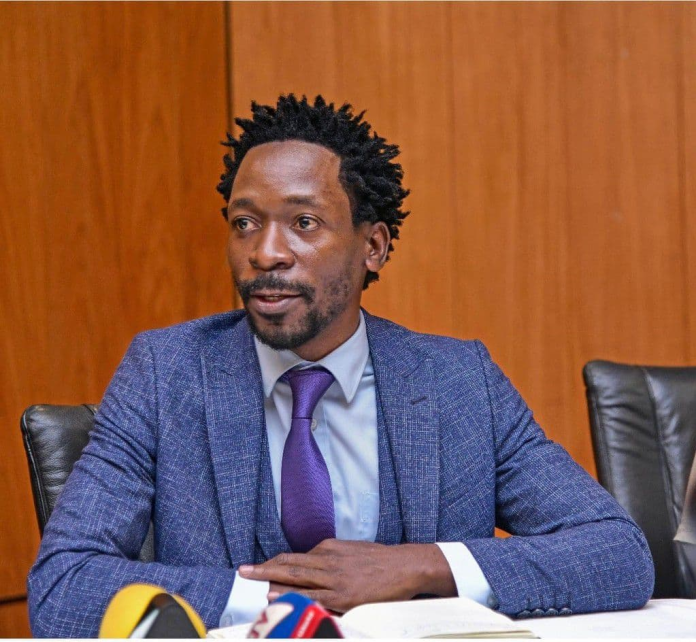
President of Uganda Law Society, Isaac Ssemakadde.

President of Uganda Law Society, Isaac Ssemakadde has criticized the appointment of Lady Justice Jane Frances Abodo as Uganda’s new Principal Judge, describing it as a blow to judicial independence and public trust.

In a press release issued on Monday, September 1, 2025, Ssemakadde, who also serves as President of the Uganda Law Society (ULS), questioned the legitimacy of the process and Abodo’s qualifications for the role.

“Public trust in the judiciary has reached an all-time low and appointing Jane Frances Abodo as Principal Judge, in blatant disregard of Uganda Law Society’s Constitutional Application No. 11 of 2025 seeking orders to halt the recruitment of judicial officers by a yet-to-be fully constituted Judicial Service Commission, is a recipe for disaster,” Ssemakadde said.

He further challenged Abodo’s professional track record citing her handling of high-profile cases as Director of Public Prosecutions (DPP).

“Her five-year tenure as a bent prosecutor, marked by allegations of bias and deliberate weaponisation of criminal justice to destroy critics and political opponents of her appointing authority, raises serious concerns about her capacity to preserve judicial independence and integrity,” he noted.

Ssemakadde also invoked past court battles, accusing Abodo of disregarding a Supreme Court ruling in Attorney General v Kabaziguruka (Constitutional Appeal 2 of 2021) which ordered the transfer of civilians from military courts to civilian courts.

“How did she even qualify for this appointment given her blatant defiance of the Supreme Court order?” he asked.

Ssemakadde recalled his own challenges against Abodo’s leadership, particularly at the East African Court of Justice.

“I am indeed proud of my role in constantly challenging her legitimacy as Director of Public Prosecutions, notably in our landmark case at the East African Court of Justice (Reference No. 15 of 2020), a judgment she appears to have evaded,” he added.

Ssemakadde argued that the office of the Principal Judge has become largely ceremonial, warning that Abodo’s appointment may accelerate the judiciary’s decline.

“With the office of the Principal Judge already largely relegated to a ceremonial mascot and an artery of external influence, Abodo’s appointment by a discredited JSC through an opaque process will likely hasten the judiciary’s decline,” he said.

He noted, “It is my hope that this downward trajectory will ultimately force a reckoning, making the need for radical surgery of our judiciary undeniable, even to those who have previously tolerated incompetent leadership under the guise of feminism. May she fail spectacularly!”

His complaint comes just days after President Yoweri Museveni confirmed Justice Abodo’s appointment, pending parliamentary approval.

Stories Continues after ad

FDC celebrates Nandala Mafabi homecoming, unveils Kampala Lord Mayor candidate

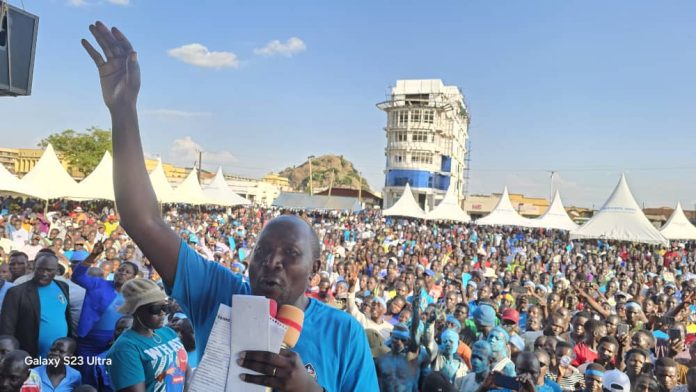
The Forum for Democratic Change (FDC) has hailed the homecoming of its Secretary General, Rt. Hon. Nathan Nandala Mafabi, as a resounding success. The event, held at Mbale Cricket Grounds on August 30, 2025 drew thousands of supporters who warmly received their son back home.

“We wish to thank the people of Mbale and all the towns along where the presidential caravan passed for the warm reception,” the party said in a statement.

The homecoming capped a caravan that began at the FDC Headquarters in Najjanankumbi, Kampala, on August 29, 2025. Party President Eng. Patrick Amuriat Oboi led the journey which encountered heavy tear gas in Iganga, Nakalama and Busembatya. Despite the police confrontations, the caravan pressed on, arriving triumphantly in Mbale.

The religious leaders including Rt. Rev. Patrick Gidudu, retired Anglican Bishop of Mbale Diocese and Sheikh Jowali Isiko of Jinja Muslim District offered blessings to Mafabi and his wife, Mama Flora Nandala.

The event also marked a major political shift, as over 160 NRM defectors publicly crossed over to the FDC. “The FDC Party extends its heartfelt appreciation to the people of Mbale and all the places the candidate visited, from Kampala to Mbale, for their overwhelming support,” the statement read.

During the journey, the FDC President also presided over the official opening of the party’s Buikwe District branch office in Lugazi Municipality and the Iganga District branch office in Iganga Municipality. The party also extended gratitude to journalists who braved difficult circumstances to cover the caravan.

As the 2026 elections approach, the FDC has launched an intensive mobilization and recruitment drive.

“Our extensive leadership structure across the country has been engaging with various leaders and individuals, encouraging them to join the FDC,” the party announced.

Recently, three former NRM parliamentary aspirants joined during the national council meeting, while more than 160 leaders from Bugisu and Budaka followed suit during the Mbale homecoming.

Talks are also ongoing with leaders and former candidates from the NUP, NRM and other parties, especially in Buganda, Busoga and western Uganda, as FDC positions itself to field strong candidates at all levels.

Meanwhile, Kampala Metropolitan aspiring candidates are meeting this week for induction into FDC values and nomination guidelines.

In a related development, Kasozi Ibrahim Biribawa has declared his bid for the position of Kampala Lord Mayor under the FDC ticket. Kasozi, a lawyer with a diploma in law, a Bachelor of Laws and a Master of Laws in Corporate and Commercial Law said his candidacy is rooted in integrity, accountability and results.

“I am deeply grateful for the trust the FDC party has vested in me to hold their flag. I am aware of the responsibilities that come with serving our city, and I am ready to work tirelessly to build a Kampala that is safe, clean, prosperous, and inclusive for every resident,” he stated.

He pledged to prioritize public safety, better infrastructure, improved waste management, job creation, good governance, and social services. “This campaign is about serving with humility, listening to communities, and delivering results that elevate our city for generations to come,” he added.

Over the coming weeks, Kasozi plans to engage with residents across Kampala’s five divisions, business communities, and civil society to present his manifesto in detail.

Stories Continues after ad

Kyabazinga of Busoga announces birth of twin princes

Kyabazinga of Busoga, His Majesty William Gabula Nadiope IV, and his wife Inhebantu Jovia Mutesiare welcome the twins.

The Kyabazinga of Busoga, His Majesty William Gabula Nadiope IV has announced the birth of his twin sons, describing their arrival as a “double blessing” for the royal family and the Kingdom of Busoga.

The Kyabazinga via X (formerly Twitter) expressed profound gratitude to God and the people of Busoga for their support and prayers.

“With profound joy and heartfelt gratitude, I am delighted to formally announce the birth of our twin sons: Prince William Ethan Nadiope and Prince Arnold Eli Nadiope, born on the 27th day of August 2025,” the Kyabazinga said.

He noted that both the newborns and their mother, Inhebantu Jovia Mutesiare in good health and high spirits, bringing great joy to the royal household.

“The arrival of the newborns marks a deeply cherished milestone in our family’s journey, and we are overwhelmed and humbled by the magnitude of this double blessing. Both newborns, along with their remarkable mother, are in high spirits and excellent health,” he added.

The Kyabazinga also extended his appreciation to well-wishers who have shared their goodwill messages with the royal family.

“The outpouring of love, goodwill and prayers from all our friends and well-wishers has been profoundly uplifting, and we remain sincerely appreciative of your continued support,” the statement read.

He further assured the people of Busoga and Uganda at large that the royal family looks forward to formally introducing the young princes to the public at the appropriate time.

“We give thanks to Almighty God for His blessings and abundant grace and for ushering us into this new chapter as a family of four. We look forward to the opportunity to introduce our sons to you in due course. May God’s blessings be upon you all. Busoga Okwisania N’amanhi.”

The joyful news has been met with an outpouring of congratulations from across the country. Speaker of Parliament Anita Among joined in celebrating the royal birth, sending her warm wishes to the Kyabazinga, the Inhebantu, and the people of Busoga.

“Sincere congratulations to you, Isebantu, the beautiful Inhebantu, the royal family, and the people of Busoga on this wonderful news! May the royals bring even more happiness to you and the people of Busoga! Congratulations,” Speaker Among said.

Stories Continues after ad

EC sets nomination dates for 2026 Local Government elections

A voter casting his vote.

The Electoral Commission (EC) has announced that the nomination of candidates for the 2026 Local Government Councils Elections will take place from September 3 to September 24, 2025.

According to EC Chairperson Justice Byabakama Mugenyi Simon, the exercise will run on weekdays from 9:00 a.m. to 5:00 p.m. at gazetted nomination centres across the country.

“The Electoral Commission has appointed 3rd September to 24th September 2025 as the period for the nomination of candidates for Local Government Councils Elections 2026,” Justice Byabakama said in a statement issued on Friday, August 29, 2025.

The process will be conducted in phases according to levels of Local Government Councils. District and City Chairpersons, the Lord Mayor, Councillors, and Special Interest Groups (SIGs) will be nominated between September 3 and September 5, 2025.

Nominations for Municipality and City Division Chairpersons, as well as Councillors and SIGs, will follow from September 8 to September 10, 2025. Candidates for Municipal Division, Sub-County, and Town Councils will then be nominated from September 11 to September 24, 2025.

“All persons aspiring to contest in the Local Government Councils Elections are urged to familiarize themselves with the requirements for nomination for each elective position, as outlined in the guidelines issued by the Electoral Commission,” Byabakama emphasized.

The Commission further advised aspirants to collect nomination forms and guidelines from district offices or download them directly from its official website.

“Aspirants can collect copies of the nomination forms and guidelines from the District Electoral Commission offices across the country, or obtain soft copies from the Commission website,” Byabakama added.

The EC stressed that the exercise is part of its commitment to ensuring a regular, free, and fair electoral process ahead of the 2026 General Elections.

Stories Continues after ad

Uganda, Kenya seal free trade deal to eliminate barriers and boost cross-border commerce

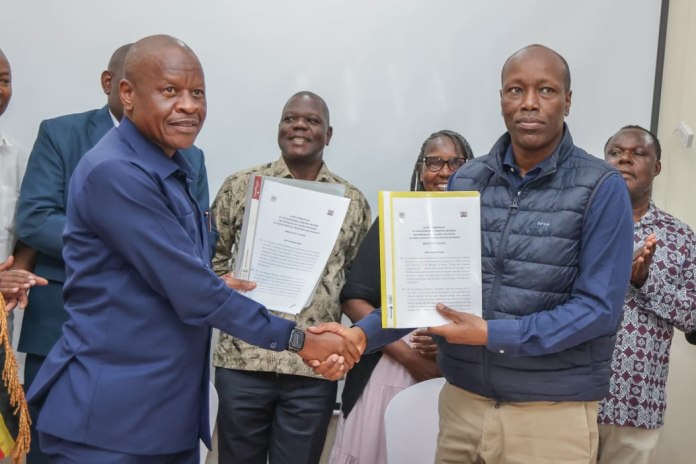
Uganda's State Minister for Trade, Gen. Wilson Mbadi, and his Kenyan counterpart for Cabinet Secretary for Investments, Trade and Industry, Lee Kinyanjui.

The governments of Uganda and Kenya have signed a landmark free trade agreement aimed at eliminating trade barriers, decongesting border posts, and boosting economic cooperation between the two East African neighbours.

The deal, signed last Friday in Mbale City, follows a directive by President Yoweri Kaguta Museveni and his Kenyan counterpart, Dr. William Samoei Ruto, who in July instructed their respective trade ministers to urgently resolve all obstacles hindering bilateral trade.

Kenyan Cabinet Secretary for Investments, Trade and Industry, Lee Kinyanjui, said the agreement ensures that all products between the two countries will now be treated as domestic transfers rather than imports.

“We have adopted that Kenya will treat products from Uganda as though they are from Kenya. So it will just be a transfer from Uganda to Kenya, or Kenya to Uganda, which means it will not attract any duties,” Kinyanjui said.

The Joint Communiqué issued after the ministerial meeting in Mbale on August 30, 2025, underlined that the two countries had agreed to eliminate all tariff and non-tariff barriers, including discriminatory excise duties, levies, and other charges, in line with East African Community (EAC) protocols.

Uganda’s State Minister for Trade, Gen. Wilson Mbasu Mbadi, welcomed the deal, noting that it would break down long-standing obstacles to the free movement of goods and services.

“We are now able to remove or break these non-tariff barriers that were coming through the levy of certain duties that go against the East African Community Treaty and Protocols,” Mbadi said.

The ministers also conducted joint inspections at key border points, including Suam, Busia, Malaba, and Lwakhakha, where they identified operational, infrastructural, and logistical challenges behind persistent congestion.

To address this, they directed border agencies to immediately clear backlogs: at Malaba, congestion must be reduced within 24 hours and maintained at no more than four kilometres, while at Busia, queues should not exceed 500 metres. They also ordered 24/7 operations at all border posts and the removal of unnecessary checkpoints.

On infrastructure, both governments pledged to mobilize resources for critical upgrades, including road works and bridge construction, while fast-tracking the completion of the Suam One-Stop Border Post (OSBP) and improving facilities at Lwakhakha. Uganda also committed to resolving delays linked to weighbridge operations along major corridors.

Kinyanjui acknowledged that past disputes—including Kenya’s bans on Ugandan eggs in 2021 and powdered milk earlier this year—had strained relations but said the new agreement, backed by clear timelines and monitoring mechanisms, marked a turning point.

“We want to ensure that nobody wastes more than two hours at the border… so that our people can trade,” he said, adding that delays had reduced the efficiency of cargo trucks traveling between Mombasa and Kampala.

The communiqué further directed the operationalization of Joint Border Committees (JBCs) and the establishment of a standing joint technical committee to monitor and resolve emerging trade concerns, while also keeping the private sector fully engaged in the process.

Truck drivers, however, raised concerns during the Mbale meeting, alleging that Uganda Revenue Authority officers were demanding bribes of 2,000 shillings (about 50 cents) per truck to expedite clearance.

“They cannot allow you to proceed until you have paid the money,” one driver said.

In response, Kinyanjui announced the formation of a joint team to investigate and address such grievances.

The ministers concluded by expressing appreciation to Presidents Museveni and Ruto for their leadership and reaffirmed that all products originating from either country will henceforth be treated as transfers in line with EAC protocols.

Stories Continues after ad

Businessman Hassan Basajjabalaba endorsed unopposed as NRM’s Entrepreneurs League Chairman

President Museveni talks to city businessman, Hassan Basajjabalaba, as Deputy Speaker of Parliament, Thomas Tayebwa looks on. Mr Basajjabalaba was declared unopposed for the position of chairman of the Entrepreneurs League of the NRM party.

President Yoweri Kaguta Museveni has welcomed the consensus reached among candidates for the position of Chairperson of the National Resistance Movement (NRM) Entrepreneurs League, which has resulted in the unopposed endorsement of Al Hajj Hassan Basajjabalaba for the period 2025–2031.

“I have met with the candidates for the position of NRM Chairperson of the Entrepreneurs League. They have agreed to unconditionally endorse Al Hajj Hassan Basajjabalaba, who is now unopposed,”Museveni announced.

The President commended Deputy Speaker of Parliament, Thomas Tayebwa for facilitating dialogue and uniting the various contenders during a meeting held on August 30, 2025, at State Lodge Nakasero.

“First, I would like to thank Thomas Tayebwa for bringing these factions together and thank all the aspirants for their foresight. As I often say, it is not just about who is in the position, but what can be achieved,” Museveni said. 

He added,“I congratulate Al Hajji Basajjabalaba and commend the other candidates for their selfless act.”

According to a communiqué signed by the aspirants, Sanjay Tanna, Mr. Kakuru Phillip, King Ceasor Mulenga, and witnessed by Deputy Speaker Tayebwa the decision was reached in the spirit of party unity and cohesion, as emphasized by the NRM Chairman.

“Following a dialogue initiated by H.E. Yoweri K. Museveni, Chairman of the NRM, and facilitated by Thomas Tayebwa, we the undersigned candidates for the position of Chairperson of the NRM Entrepreneurs League… have unconditionally endorsed Al Hajj Hassan Basajjabalaba as the unopposed Chairperson of the NRM Entrepreneurs League for the period 2025–2031,” the communiqué read in part.

Stories Continues after ad

Rotary Club, Health Ministry partner to fight against Polio, Malaria and Cancer

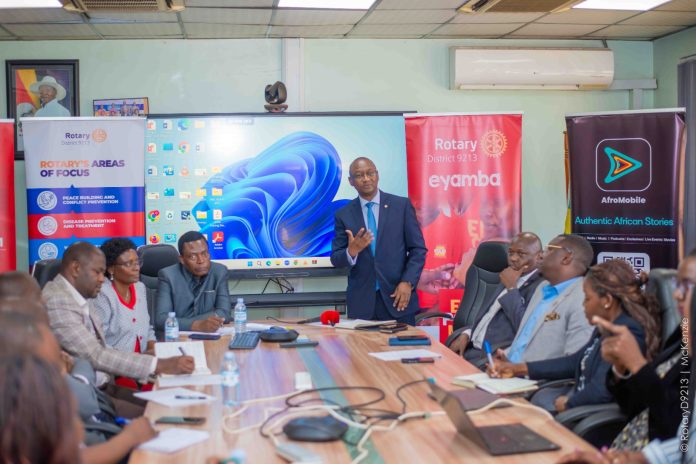
Rotary District 9213 Governor Geoffrey Kitakule addressing other participants.

The Rotary District 9213 has reaffirmed its partnership with the Ministry of Health in championing public health causes, with renewed commitments towards ending polio, combating malaria and scaling up cancer interventions.

Speaking on the partnership, Rotary District 9213 Governor Geoffrey Kitakule said the collaboration has already shown remarkable results and will only grow stronger.

“Our Rotary District 9213 and the Ministry of Health have cemented their unity, and the impact is going to be multiplied,” Kitakule said.

The announcement follows an invitation by the Past President of the Rotary Club of Sonde, who also doubles as the Director General of Health Services, Dr. Charles Olara. The two institutions agreed to jointly commemorate World Polio Day on October 24, a reminder that vigilance must remain against a disease that still poses a threat worldwide.

“We agreed to commemorate World Polio Day, keeping vigilance against a disease where even one case is a threat,” Kitakule noted.

Rotary has been at the forefront of the global End Polio Now campaign, investing over US $850 million and supporting the immunization of billions of children across the globe.

In Uganda, Rotary has also expanded its footprint to tackle other pressing health challenges, including malaria, cancer, and access to specialized medical care. Uganda continues to grapple with over 12 million malaria cases annually, and Rotary District 9213, together with Rotaract, has been complementing government efforts through community health days and public health education, in partnership with the Ministry of Health and Malaria Partners Uganda.

Cancer also remains a major public health challenge, claiming 33,000 lives annually. Through the annual Rotary Cancer Run, the fraternity has raised nearly Shs5 billion, which has been used to build facilities such as the cancer ward at St. Francis Hospital Nsambya and radiotherapy bunkers.

“Through our joint health camps, surgical missions, and the Little Hearts Project, we reaffirm that no Ugandan should be left behind in the fight for health, hope, and dignity,” Kitakule emphasized.

The Ministry of Health welcomed Rotary’s continued partnership, noting that collaborations between government and civic organizations remain crucial in addressing Uganda’s disease burden.

This year’s joint commemorations on World Polio Day are expected to further mobilize communities, raise awareness, and strengthen the campaign to ensure Uganda remains polio-free.

Stories Continues after ad

Museveni appoints Justice Jane Frances Abodo as new Principal Judge


President Yoweri Kaguta Museveni has appointed Hon. Lady Justice Jane Frances Abodo as Uganda’s new Principal Judge, pending parliamentary approval.

In a letter addressed to the Speaker of Parliament and dated this week, Museveni invoked his constitutional powers under Article 142(1) of the 1995 Constitution, acting on the advice of the Judicial Service Commission.

“In exercise of the powers vested in the President by Article 142(1) of the 1995 Constitution, I have, acting on the advice of the Judicial Service Commission, appointed Hon. Lady Justice Abodo Jane Frances as Principal Judge,” Museveni wrote.

“I hereby forward her name and CV to Parliament for approval,” he added.

The authenticity of the letter was confirmed by Farouk Kirunda, the Deputy Presidential Press Secretary.

“I hereby confirm that the letter circulating on social media regarding the appointment of Hon. Lady Justice Jane Frances Abodo as the new Principal Judge is authentic. Her name has been forwarded to Parliament for the necessary approval. I congratulate her,” Kirunda stated.

Justice Jane Frances Abodo is a seasoned judicial officer with an outstanding career in Uganda’s justice system. She has served as the Director of Public Prosecutions (DPP) since April 2020, making history as the first woman to hold the position. Before her appointment as DPP, she was a judge of the High Court and previously headed the Anti-Corruption Division of the Directorate of Public Prosecutions.

Renowned for her integrity and commitment to fighting corruption, Justice Abodo has handled several high-profile cases and has been vocal about strengthening Uganda’s justice system to ensure fairness and accountability.

Her appointment as Principal Judge places her at the helm of supervising High Court judges and magistrates across the country, a role critical to judicial efficiency and timely delivery of justice.

If approved by Parliament, Justice Abodo will succeed Justice Dr. Flavian Zeija, who has served in the role since 2019.

Stories Continues after ad