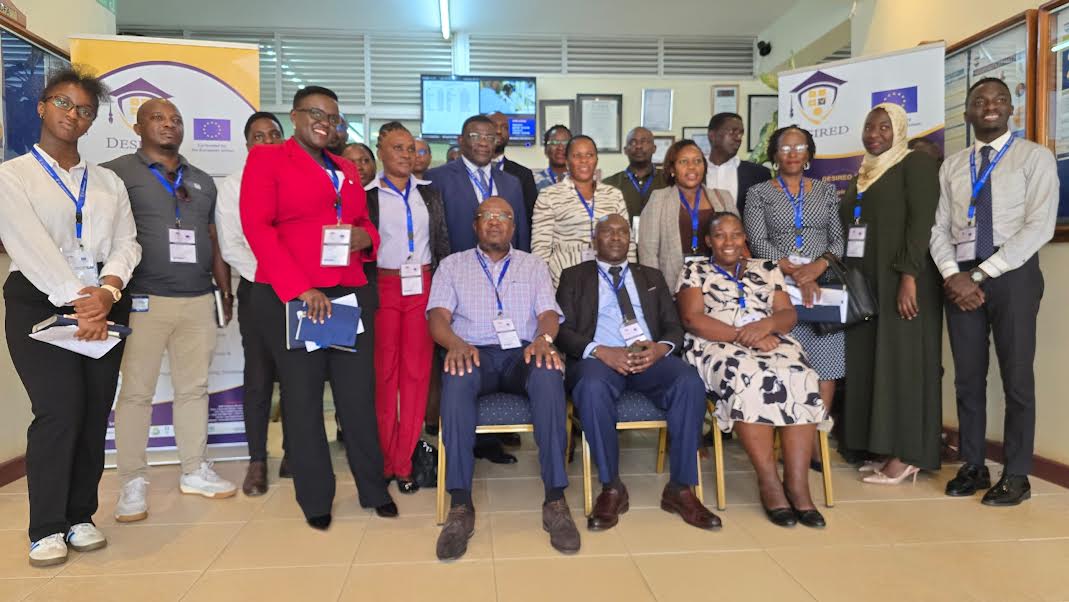
The MAT ABACUS Business School, in partnership with leading universities from Uganda, Nigeria, Portugal, and the Netherlands has officially launched the Developing Employability Skills in Accounting Education (DESIRED) Project; a European Union–funded initiative aimed at bridging the gap between academic learning and workplace demands for accounting graduates.
Valued at €400,000 (approximately Shs1.64 billion), the two-year project seeks to strengthen the employability of accounting students through work-integrated learning, experiential teaching, and closer collaboration between academia and industry.

Speaking at the launch, Mr. Samuel Ssekajja, Chairperson of the DESIRED Project, said the initiative aims to ensure that accounting graduates are equipped with both theoretical knowledge and practical experience needed in today’s competitive job market.
“The DESIRED Project is funded by the European Union to the tune of 400,000 euros and will take two years to implement in both Nigeria and Uganda. The intention is to improve the skill level of accountants we train so that they are work-ready and have some experience about what goes on in the workplace,” Mr. Ssekajja said.
He added that the project will employ practical methods such as internships, case studies, and experiential learning to simulate real-life business environments.

“We are creating work situations in which students are required to make decisions and act. That is what this project is about, and today marks its official kickoff,” he explained.
Mr. Ssekajja also addressed concerns about the cost of accounting services, noting that the focus should be on producing highly skilled professionals rather than reducing costs.
“We are not funding SMEs to pay employees, but we can have accountants who possess better skills to serve. When we train people who understand real workplace demands, both businesses and the economy benefit,” he said.
Delivering his remarks, Prof. Twaha Kigongo Kaawaasa, the First Deputy Prime Minister for Buganda Kingdom, commended the initiative, describing it as a vital collaboration between Africa and Europe to make accounting education more responsive to modern realities.
“This project brings together countries in Europe that are Portugal and the Netherlands and countries in Africa, namely Uganda and Nigeria to ensure that accountants coming out of universities are ready for employment. Employers have noted a gap where universities produce accountants who are not work-ready, and this project is developing new pedagogies and these are methods of training to close that gap,” Prof. Kaawaasa said.
He emphasized that the initiative comes at a time when the world is rapidly changing due to technological advancement.
“We are in a century where artificial intelligence is advancing rapidly, where machines are trying to replace human beings, but human beings remain irreplaceable. We must ensure that accountants are relevant in terms of accounting competence, communication, and other soft skills required by employers,” he noted.
Prof. Kaawaasa further highlighted that the DESIRED Project aligns with Uganda’s transition to competency-based training.
“Universities like MAT ABACUS and others must be ready to produce graduates who are competent and employable. The training must adapt to ensure that students coming out of our institutions meet the expectations of employers,” he said.
Ayeza Mutegeki, a student at MAT ABACUS and one of the beneficiaries of the DESIRED Project, expressed optimism that the initiative would transform the employability landscape for accounting graduates.
“Among students, one of the biggest challenges we face is the lack of jobs — not because they don’t exist, but because we often lack the expertise required,” Ayeza said.
She noted, “Yes, we have studied accounting, but the reality in the workplace is not exactly the same scenario. I believe this program will change the course of accounting education and enhance both our learning and work standards.”
She added that the project connects learners directly to employers through hands-on experiences.
“The project links us to employers through simulations, internships, and other practical engagements. We are learning how things are done in real organizations and how we can adapt those lessons to our future careers,” she explained.
Adding her voice, Associate Prof. Irene Nalukenge, the Deputy Dean of the Faculty of Commerce at Makerere University Business School (MUBS), said the project will be instrumental in addressing the long-standing employability gaps noted by employers.
“I believe that this project; Enhancing the Employability of Accounting Graduates is going to be very handy in improving the employability of our students. It will include practical elements such as internships and mentorships, where students will be placed with different employers to gain real-world experience,” Prof. Nalukenge said.
She noted that many employers have expressed concern over graduates’ lack of essential workplace skills.
“Employers have long been complaining about the readiness of our graduates,” she observed.
She added, “They lack soft skills and the ability to use certain accounting software — issues this project is going to address.”
Prof. Nalukenge added that one of the project’s most important deliverables will be a long-term academic framework for use across universities.
“At the end of this project, we shall have a framework that can be used by our university and other interested institutions to improve the employability of their graduates,” she said.
She added, “We believe this framework will form part of a curriculum that any university seeking to enhance the skills of its students will be able to adopt.”
The DESIRED Project is being implemented by MAT ABACUS Business School, Makerere University Business School (MUBS) and partner institutions in Nigeria, Portugal, and the Netherlands with funding from the European Union.
Its expected outcomes include graduates equipped with job-ready skills, reduced youth unemployment, stronger collaboration between academia and industry and a new generation of empowered professionals driving national growth.