The Uganda National Bureau of Standards and the National Lotteries and Gaming Regulatory Board have partnered to strengthen regulation of Uganda’s fast-growing gaming industry through the adoption of internationally recognized standards aimed at enhancing fairness, consumer protection and operator compliance.
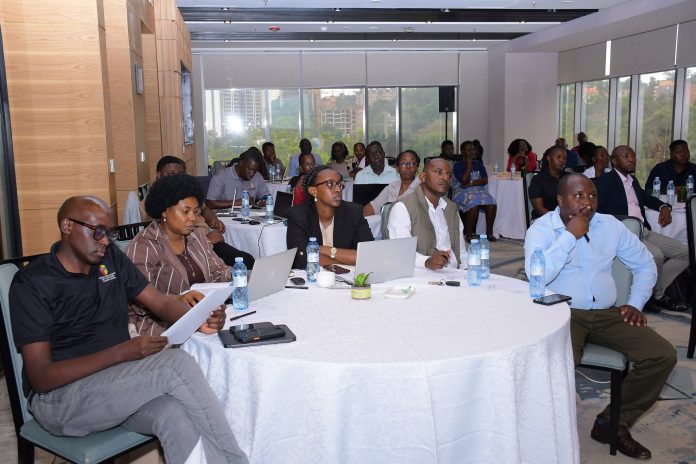
The development follows a technical workshop hosted earlier today by UNBS in collaboration with the gaming regulator, focusing on the Global Standards Approach as guided by the World Trade Organization and the Technical Barriers to Trade Agreement.
The engagement marked a critical step toward developing and implementing technical regulations for Uganda’s gaming sector, amid growing concerns over transparency, integrity of gaming systems, and protection of players from exploitation.
According to the regulators, the workshop introduced officials from the National Lotteries and Gaming Regulatory Board to internationally accepted procedures for regulating gaming equipment and systems, ensuring that operators meet strict compliance requirements.
“The standards are in place to ensure fairness to players, while also guaranteeing that gaming equipment is safe, reliable, and fit for purpose,” said Andrew Othieno, Manager Standards at the Uganda National Bureau of Standards.
Othieno noted that adopting global standards would help Uganda build a more credible gaming industry capable of attracting responsible investment while protecting the public from manipulation and unsafe gaming practices.
The gaming sector in Uganda has witnessed rapid expansion over the past decade, with sports betting, casinos, slot machines, and online gaming becoming increasingly popular, especially among young people. The growth has significantly boosted government revenue collections through taxes and licensing fees, but it has also raised regulatory and social concerns, including illegal operations, underage gambling, and lack of uniform technical standards.
The absence of comprehensive technical regulations has in some cases exposed players to unfair gaming systems and unverified equipment, prompting calls for tighter oversight by authorities.
The National Lotteries and Gaming Regulatory Board said the new collaboration with UNBS is intended to close those gaps by aligning Uganda’s gaming industry with international best practices.
“The National Lotteries and Gaming Regulatory Board remains dedicated to adopting global best practices that promote transparency, public confidence, and a well regulated gaming industry,” the Board said in a statement.
The technical standards are essential in ensuring gaming machines and digital betting platforms operate fairly, generate accurate outcomes and meet safety requirements for consumers.
The move also comes at a time when government agencies are intensifying efforts to improve compliance within the gaming industry and enhance domestic revenue mobilization from licensed operators.
The adoption of WTO guided standards will strengthen Uganda’s reputation as a regulated gaming market while helping authorities crack down on illegal operators who evade licensing and taxation requirements.
The regulators believe stronger standards and enforcement mechanisms will be critical in safeguarding players, boosting public trust and ensuring sustainable growth of the sector.
A police officer attached to the Counter Terrorism Directorate and reportedly assigned to the security detail of the Speaker of Parliament, Anita Among, has been charged with attempted murder following a shooting incident in Kampala’s upscale Nakasero area.
Corporal Humphrey Muhanguzi, 38, was formally charged under Police Form 53 issued by Wandegeya Police Station under CRB 198/2026 dated May 8, 2026.
According to the charge sheet, Muhanguzi is a resident of Naguru Police Barracks in Nakawa Division and is attached to the Counter Terrorism Directorate.
The charge sheet states that the officer is accused of attempted murder contrary to Section 187 of the Penal Code Act.
Prosecution alleges that on April 30, 2026, along Kafu Road in Nakasero Village, Kampala, Muhanguzi attempted to cause the death of a woman identified as Kemirembe Annet.
The case stems from a shooting incident that reportedly occurred near the residence of Speaker Anita Among, an incident that attracted widespread public attention and triggered investigations by security agencies.
Earlier police reports indicated that the shooting followed an alleged confrontation between the officer and the female motorist moments before gunfire erupted.
Authorities said the victim was driving a Toyota Harrier registration number UBQ 138A at the time of the incident.
Kampala Metropolitan Police spokesperson Racheal Kawala earlier confirmed the arrest of the officer and said investigations into the shooting had immediately commenced.
“We confirm a suspected shooting which allegedly resulted in the injury of a person. We have picked interest in the matter, and investigations are ongoing,” Kawala said at the time.
Investigators reportedly recovered the firearm suspected to have been used during the shooting as inquiries into the incident continued.
The incident has since renewed public concern over the conduct of armed security personnel operating in civilian areas within Kampala.
However, police have not yet communicated when the suspect will be produced before court for further proceedings.
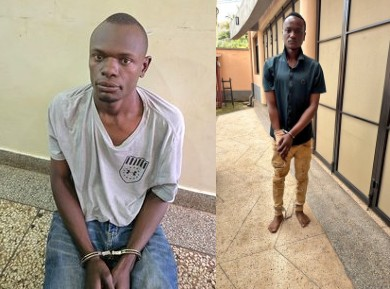
The two arrested alleged suspects in the Bank of Uganda break-in.
Police have confirmed the arrest of two suspects linked to the dramatic break-in at the Bank of Uganda headquarters in Kampala, where seven laptops and sensitive security equipment were stolen in a coordinated overnight raid that investigators now believe may have involved insider facilitation.
Police spokesperson, Kituuma Lusoke has revealed that intelligence-led operations led to the capture of the suspects on 7 May 2026, just days after the incident was reported at the central bank’s headquarters along Kampala Road near City Square.
“We wish to confirm the arrest of two suspects linked to the break-in at the Bank of Uganda,” Kituuma said.
He added that the arrests were the result of targeted intelligence work following the incident that occurred on 4 May 2026.
“On 7 May 2026, our intelligence teams successfully apprehended two suspects linked to the Bank of Uganda break-in that occurred on 4 May 2026,” he stated.
The suspects have been identified as Kule Boaz Michael, a 19-year-old resident of Wabigalo, and Kabuye Ramadhan, also known as Rhama, a resident of Nsambya Zone C in Kampala. Police confirmed that both are currently in custody and that part of the stolen property has already been recovered.
“The suspects have been identified as Kule Boaz Michael, 19, a resident of Wabigalo, and Kabuye Ramadhan, also known as Rhama, a resident of Nsambya Zone C, both in Kampala City,” Kituuma said.
He further confirmed partial recovery of the stolen items, including laptops believed to have been taken during the raid.
“The suspects are currently in police custody, and two stolen laptops have since been recovered. They will be arraigned before court in due course,” he added.
The arrests come against the backdrop of an investigation into a carefully executed break-in at Uganda’s central bank, which was undetected for hours. Earlier findings revealed that attackers accessed the facility at night and remained inside for nearly three hours, targeting commercial offices within the institution.
Preliminary internal reports indicated that seven laptops were stolen, alongside critical security equipment including surveillance systems and network devices valued at tens of millions of shillings. Investigators also established that a CCTV server and internet router were taken, significantly disrupting monitoring systems during the incident.
Security sources previously told investigators that the attackers may have used duplicated keys to gain entry without forcing doors, raising early suspicions of inside assistance. The ease of access to restricted areas inside one of the country’s most secure institutions deepened concerns about possible collusion.
“They gained entry through the gate opposite City Square, moved into the commercial building, and stayed inside for nearly three hours before leaving with the laptops,” one investigator familiar with the case previously said.
Another security source indicated that the suspects also attempted to access the bank’s strong room but were unsuccessful, suggesting the operation was carefully planned but partially contained before escalating further.
“They did not break the main doors. The use of duplicate keys suggests inside facilitation, which remains a key line of inquiry,” the source added.
Investigators also believe the attackers interfered with surveillance systems during the operation, including disabling internet connectivity to delay detection and vandalising parts of the CCTV network.
Footage recovered from compromised systems reportedly shows a group of individuals moving within restricted sections of the building, reinforcing the view that the operation was coordinated and not opportunistic.
Following the discovery of the breach, joint security teams launched a wider citywide operation, tracing electronic and physical leads to several downtown Kampala buildings, including Mutaasa Kafeero Plaza and surrounding commercial centres. The dragnet led to multiple arrests as investigators pursued suspects believed to be connected to the wider network behind the break-in.
While police have now confirmed the arrest of two primary suspects linked directly to the Bank of Uganda incident, investigators are continuing to pursue additional leads, particularly around the possibility of insider involvement and the recovery of the remaining stolen equipment.
Despite the breach, the Bank of Uganda previously assured the public that its core financial operations remain stable and unaffected, while investigations into the security lapse continue under close coordination with security agencies.
Further arrests are possible as the probe widens into a carefully coordinated operation targeting one of Uganda’s most secure financial institutions.
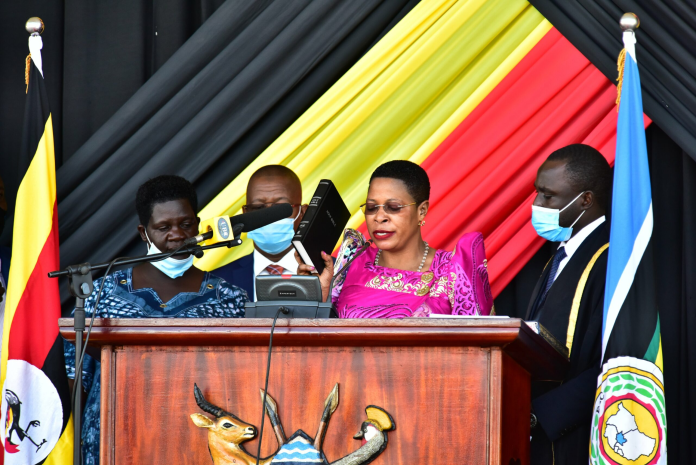
A total of 555 Members of Parliament-elect will next week be sworn in at Parliament House as Uganda officially ushers in the 12th Parliament following the 2026 General Elections.
The swearing-in exercise will take place on May 13, 14 and 15, 2026, in line with constitutional and parliamentary requirements that compel all elected legislators to take the oath of allegiance and oath of office before assuming their duties.
The 12th Parliament will comprise 353 directly elected constituency Members of Parliament, 146 District Woman Representatives and 30 representatives from special interest groups including the Uganda People’s Defence Forces (UPDF), youth, workers and persons with disabilities, bringing the total number of legislators to 555.
Preliminary parliamentary composition shows that the ruling National Resistance Movement (NRM) maintains overwhelming dominance in the House with more than 370 MPs, an increase from the 334 legislators the party held in the 11th Parliament.
The opposition National Unity Platform (NUP), which emerged as the leading opposition party in the previous Parliament, is projected to have between 43 and 57 legislators according to early election results from different districts across the country.
Independent candidates are expected to account for about 45 seats, while other political parties including the Forum for Democratic Change (FDC), Democratic Party (DP), Uganda People’s Congress (UPC), Justice Forum (JEEMA) and the People’s Progressive Party (PPP) will also have representation in the House.
The UPDF parliamentary representatives were elected earlier this year on January 28, 2026, with senior military officers including Sam Okiding and Sylvia Meeme among the elected representatives.
The swearing-in exercise is a constitutional requirement under Article 81(4) of the Constitution, which states that every person elected to Parliament shall take and subscribe to the oath of allegiance and oath of a Member of Parliament as prescribed in the Fourth Schedule of the Constitution.
Article 81(5) further bars any elected member from sitting or voting in Parliament before taking the oath.
The Rules of Procedure of Parliament also reinforce the constitutional provisions.
Rule 3(1) states that every member shall, before formally taking his or her seat in Parliament, take and subscribe, in the manner prescribed by law, to the oath of allegiance and oath of a Member of Parliament.
Rule 3(2) prohibits legislators from participating in parliamentary proceedings before taking the oath, while Rule 3(3) mandates the Clerk to Parliament to administer the oaths prior to the first sitting of Parliament.
The commencement of the new Parliament will pave the way for the election of the Speaker and Deputy Speaker, a process that traditionally shapes the balance of power and direction of legislative business in the House.
The strong numerical advantage enjoyed by the NRM is likely to give the ruling party significant leverage in passing legislation, approving budgets and controlling parliamentary committees during the next five-year term.
However, opposition legislators are expected to continue pushing the government on issues of accountability, corruption, governance, human rights and public service delivery.
Uganda’s Parliament remains one of the key arms of government with powers to make laws, approve national budgets, scrutinize public expenditure and provide oversight over the Executive.
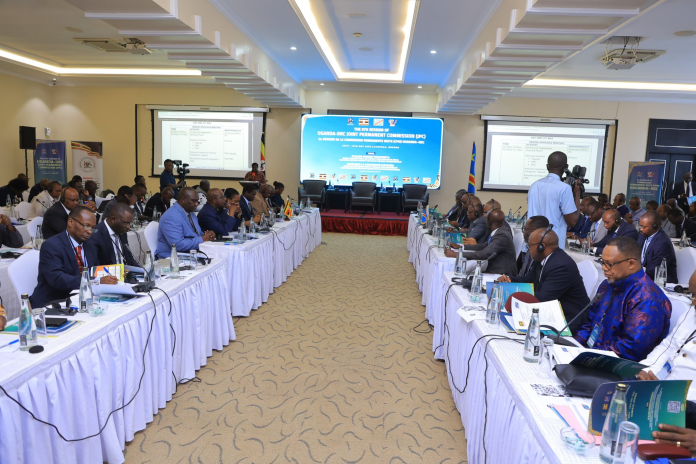
The 9th Session of the Uganda–Democratic Republic of Congo Joint Permanent Commission (JPC) has opened in Kampala at Hotel Méstil, with both countries setting an agenda to strengthen security cooperation, expand cross-border trade and accelerate strategic infrastructure projects seen as vital to regional stability and economic transformation.
The three-day meeting, running from 8th to 10th May 2026, is being held under the theme “Scaling Shared Prosperity: Trade Infrastructure and Security for Enhanced Bilateral Relations, Regional Stability and Socioeconomic Transformation.”
The session commenced today with technical officials’ discussions, which are expected to shape the direction of high-level negotiations in the coming days.
Opening the meeting, Ambassador John Leonard Mugerwa reaffirmed Uganda’s longstanding friendship with the Democratic Republic of Congo, describing the relationship as one anchored in shared history, cultural ties, and growing economic interdependence. He emphasized that the two countries continue to benefit from their geographic proximity, which has enabled steady growth in trade, investment flows, and people-to-people exchange.
Ambassador Mugerwa noted that bilateral trade between Uganda and the DRC has continued to expand, driven by strong demand across both markets. He said the movement of goods, services, and labour reflects the complementary nature of the two economies, adding that this creates significant opportunities for deeper regional integration and inclusive growth.
He further underscored the importance of the Joint Permanent Commission as a strategic platform for addressing shared priorities, including security, infrastructure development, and energy cooperation, agriculture and investment facilitation. He called on delegates to maintain a spirit of partnership, trust, and mutual responsibility as they pursue solutions that enhance peace and prosperity in the region.
The Kampala session builds on outcomes from a midterm review held in Mpondwe in February 2026, where both countries assessed progress in streamlining economic cooperation and advancing security coordination. Key among the earlier commitments was the operationalization of visa waivers and the simplification of cross-border trade systems.
Security cooperation remains a central focus of the current discussions, with delegations reviewing progress under Operation Shujaa, the joint military initiative targeting the Allied Democratic Forces and other armed groups operating in eastern DRC. The talks are also examining technical border verification processes, particularly in the Busanza sector, aimed at strengthening coordination and reducing cross-border insecurity.
On trade and economic integration, officials are working to eliminate persistent non-tariff barriers that continue to slow regional commerce. A revised memorandum of understanding on trade cooperation is expected to be concluded during the session, paving the way for smoother cross-border business operations and improved market access.
Infrastructure development is also taking centre stage. The Kasindi–Beni road project is now about 60 percent complete, while progress on the Beni–Butembo stretch remains at an early stage. These transport corridors are seen as critical lifelines linking eastern DRC to Ugandan markets and ports.
Both countries are also aligning technical studies and timelines for the proposed Standard Gauge Railway network, building on momentum from the March 2026 Uganda–Tanzania rail agreement aimed at strengthening regional connectivity. In the aviation sector, discussions are ongoing on the Bilateral Air Services Agreement alongside the finalization of a Search and Rescue framework to improve safety and emergency response coordination.
Energy cooperation features prominently on the agenda, with technical teams advancing plans for the Nkenda–Beni–Bunia–Butembo high-voltage transmission line. The project is expected to enhance electricity supply reliability and support industrial growth across border regions. Updates are also being made to hydrocarbons cooperation frameworks to support investment and resource development.
The session is also addressing sensitive social and legal matters, including the management of approximately 500,000 Congolese refugees currently hosted in Uganda. In addition, discussions are focusing on strengthening judicial cooperation and finalizing arrangements for the transfer of convicted persons, aimed at improving legal coordination between the two countries.
The Kampala meeting is a decisive moment in Uganda–DRC relations, the outcomes will reinforce security cooperation while unlocking greater trade, infrastructure development and long-term regional stability across the Great Lakes region.
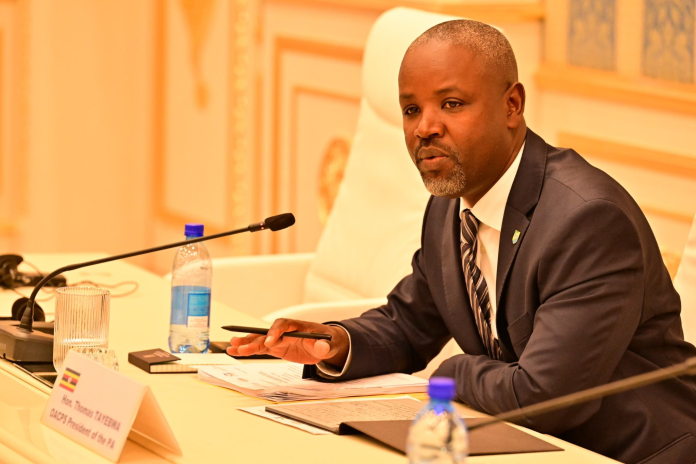
Uganda’s Deputy Speaker of Parliament, Thomas Tayebwa, has called on European countries to respect the sovereignty of Uganda and other African nations and warned against the continued interference in the internal affairs of countries on the continent.
Tayebwa made the remarks while addressing legislators from the Eastern Africa Regional Parliamentary Group of the Organization of African, Caribbean and Pacific States during ongoing meetings in Eswatini ahead of this week’s OACPS–EU Joint Parliamentary Assembly.
Speaking in his capacity as President of the OACPS and Co President of the OACPS–EU Joint Parliamentary Assembly, Tayebwa said African countries must remain united and firm while engaging European Union counterparts on issues affecting the continent.
“One of the key issues I raised is the need to demand respect for African countries from our EU counterparts. Uganda recently held elections that were free, fair and successful. However, the European Parliament summoned Uganda’s Ambassador over the election. This was not right and we rejected it. A similar situation occurred with Tanzania and, in our engagements with EU colleagues, we will be seeking firm guarantees that such incidents will not happen again,” Tayebwa said.
His remarks come amid growing tensions between some African governments and European institutions over governance, elections, climate policies and control of natural resources.
Tayebwa also revisited the long standing dispute surrounding the East African Crude Oil Pipeline, saying African countries must stand firm in protecting strategic development projects from external pressure.
The European Parliament had previously passed a resolution seeking to halt the construction of the pipeline, citing environmental and human rights concerns, a move Uganda and Tanzania strongly opposed.
“Previously, the European Parliament passed a resolution seeking to halt the construction of the East African Crude Oil Pipeline. We opposed it strongly and the resolution was later rescinded during an OACPS meeting in Maputo. This demonstrates the value of standing firm for Africa’s sovereignty. We must unite around clear and strategic priorities to strengthen our collective voice in global negotiations,” Tayebwa said.
The Deputy Speaker said African legislators have a responsibility to ensure international agreements and partnerships directly benefit ordinary citizens rather than foreign interests.
He urged African countries to take full advantage of the African Continental Free Trade Area by addressing non-tariff barriers that continue to hinder trade and limit access to key markets.
“As legislators, we must assert our oversight role to ensure agreements deliver tangible benefits to our citizens. We must fully leverage the African Continental Free Trade Area while addressing non-tariff barriers that continue to limit access to key markets, and push for improved access to EU markets. We also need transparency and accountability in climate financing commitments and partnerships grounded in mutual respect,” he said.
Tayebwa further challenged delegates attending the assembly for the first time to approach negotiations with seriousness and attention to detail, warning that weak preparation could disadvantage African countries during international engagements.
“Read all documents thoroughly and understand every detail, even down to a comma, so that we can negotiate from a position of strength,” he advised.
Tayebwa revealed the increasing frustration among African leaders who believe Western powers often use diplomatic and international institutions to influence domestic political decisions on the continent.
The OACPS–EU Joint Parliamentary Assembly brings together lawmakers from African, Caribbean and Pacific countries alongside members of the European Parliament to discuss trade, governance, climate financing, development cooperation and global economic issues.
Alex Byarugaba, Chairperson of Parliament’s Presidential Affairs Committee.
The Government has proposed a high salary enhancement for Resident District Commissioners (RDCs), Deputy RDCs and Assistant RDCs in a bid to improve their welfare and strengthen supervision of government programs across the country.
The proposed increments, which were revealed by the Chairperson of Parliament’s Presidential Affairs Committee, Alex Byarugaba, would see RDCs earn Shs9 million per month, up from the current Shs2,293,200.
Deputy RDCs would have their salaries increased from Shs1,282,369 to Shs5 million, while Assistant RDCs would move from Shs877,216 to Shs2,695,000.
If approved, taxpayers will spend an additional Shs29.079 billion annually on the salaries of the officials.
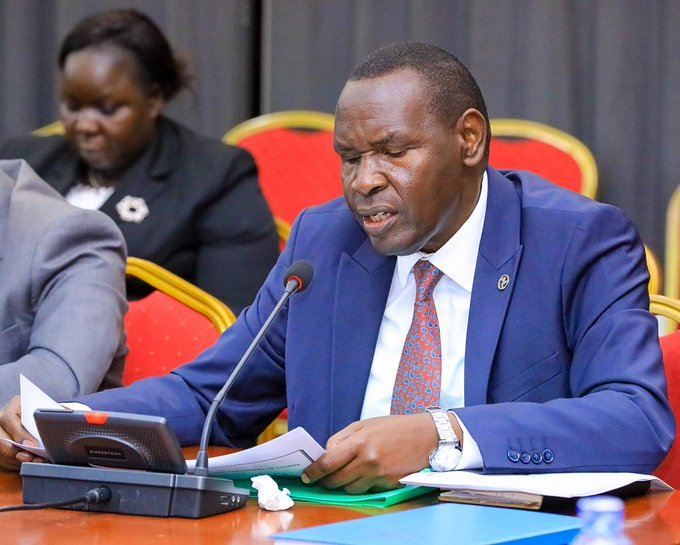
Presenting the committee report on the 2026/27 Ministerial Policy Statement for the Office of the President, Byarugaba said the salaries of RDCs and their deputies had remained stagnant for nearly two decades despite the rising cost of living and expanding responsibilities.
“The Committee established that, for almost 20 Financial Years, salaries for RDCs and Deputy RDCs have been stagnant. The Committee is cognizant of factors like inflation that erodes the purchasing power. In addition, by comparison, other public servants over whom the RDCs play an oversight role, like the District Chief Administrative Officers, received significant salary enhancement,” Byarugaba said.
According to the report, Uganda currently has 146 RDCs, 170 Deputy RDCs and 432 Assistant RDCs deployed across the country.
Byarugaba explained that the Cabinet had already proposed substantial increases for the officials to align their pay with the sensitive nature of their work and the demands of government supervision at district level.
“The Committee was informed that Cabinet proposed an increment of Shs6,706,800, resulting in a monthly salary of Shs9 million for an RDC. This translates into Shs11,750,313,600 for the 146 RDCs,” he said.
He added that the committee also found the proposed increments for Deputy RDCs and Assistant RDCs reasonable in comparison to those of RDCs.
“The Committee considers a salary enhancement of Shs3,722,631 for Deputy RDCs and Shs1,877,784 for Assistant RDCs sufficient, when compared to the proposed enhancement for the RDCs. This results into a monthly salary of Shs5 million for Deputy RDCs and Shs2,695,000 for Assistant RDCs,” Byarugaba added.
The committee further noted that the proposed enhancements for Deputy RDCs and Assistant RDCs would require an additional Shs7.594 billion and Shs9.734 billion respectively in the 2026/27 financial year.
“The Committee recommends that a total of Shs29.079 billion be allocated to the Office of the President to cater for the salary enhancement of the 146 RDCs, 170 Deputy RDCs and 432 Assistant RDCs in the FY 2026/27,” the report states.
RDCs are presidential representatives stationed in districts and cities to monitor the implementation of government programs, coordinate security matters and mobilize citizens for national development initiatives.
Under the Constitution and the Local Government Act, RDCs chair district security committees and play a central role in maintaining law and order. They also monitor public service delivery, oversee government projects and ensure that local governments comply with national policies.
In recent years, RDCs have become key actors in the monitoring of flagship government programs such as the Parish Development Model, Emyooga, road infrastructure projects and health service delivery.
The proposal for salary enhancement comes amid growing calls for improved remuneration for public officials tasked with oversight and anti-corruption work at local government level.
GZone Tournament fairness continues to gain attention as more players explore structured competition within the GameZone platform. GZone Tournament matches show how digital systems create balanced gameplay with consistent rules and reliable performance. Many users turn to GameZone online play to experience competitive sessions that feel fair, stable, and easy to follow. GameZone supports this demand by maintaining transparent systems and smooth gameplay flow across every match. This approach allows players to focus on strategy while competing in a controlled and dependable environment.
GameZone builds fair competition through a structured matchmaking system that groups players under equal conditions. Every GZone Tournament match follows a consistent process that ensures balanced participation. Players enter matches where system rules apply equally, reducing the chance of uneven gameplay conditions.
The matchmaking system uses predefined criteria to organize players into appropriate brackets. This structure allows users to compete against others with similar experience or familiarity levels. As a result, each match feels competitive without becoming overwhelming or unbalanced.
GameZone also ensures that every tournament round follows the same structure. This consistency removes confusion and allows players to focus on their decisions instead of adjusting to changing rules. When players understand how matches are organized, they can engage more confidently throughout the tournament.
The system design encourages continuous participation. Players remain engaged as they move from one round to the next because the process stays clear and predictable. This structured approach plays a key role in maintaining fairness across all GZone Tournament sessions.
Transparent Gameplay Keeps Tournament Matches Clear and Trustworthy
Transparency is essential in maintaining fair competition, and GameZone applies this principle across all tournament matches. Every action within a GZone Tournament is recorded and displayed clearly. Players can track match progress in real time without confusion.
The platform delivers updates during each round, including results, rankings, and next match details. This direct communication ensures that players always understand their current position. It also removes uncertainty, which helps build trust in the system.
Result displays are simple and immediate. After each round, players receive clear feedback that shows how outcomes were determined. This transparency allows users to verify results without relying on assumptions.
GameZone also presents tournament progression in an organized format. Players can easily view how matches advance from early rounds to final stages. This visibility strengthens confidence in the fairness of the entire tournament structure.
By maintaining clear communication and real-time updates, GameZone creates a tournament environment where players feel informed and secure.
Stable System Performance Supports Fair Competitive Play
System stability is one of the most important factors in ensuring fair GZone Tournament matches. GameZone operates on a reliable infrastructure that supports uninterrupted gameplay. This stability prevents technical issues from affecting match outcomes.
Each match runs within a controlled digital environment. Player actions, game results, and system responses are processed accurately and quickly. This reduces delays and ensures that every decision takes effect as expected.
The platform maintains consistent performance even during peak usage periods. Players can join matches, complete rounds, and move through tournaments without experiencing disruptions. This reliability allows users to stay focused on gameplay instead of technical concerns.
GameZone also ensures equal performance across all devices. Whether players use mobile or desktop systems, they receive the same gameplay quality. This prevents device-based advantages and supports fair competition.
Regular system updates further strengthen performance. These updates improve speed, stability, and overall usability without changing core gameplay mechanics. As a result, fairness remains consistent while the platform continues to evolve.
Accessibility plays a major role in making GZone Tournament matches fair for all participants. GameZone allows players to access tournaments through multiple devices, including mobile phones and desktop systems. This flexibility ensures that more users can join matches without restrictions.
The platform offers a simple login process that allows players to enter tournaments quickly. Once logged in, users can navigate directly to available matches without delays. This efficient access reduces barriers and encourages participation.
GameZone also maintains a consistent interface across all devices. Players experience the same layout, controls, and features regardless of how they access the platform. This consistency ensures that no player gains an advantage based on device familiarity.
Clear instructions and organized menus help new users understand tournament systems quickly. Players can learn how matches work without spending excessive time studying rules. This accessibility supports both beginners and experienced participants.
By combining flexible access with consistent design, GameZone creates equal opportunities for all players to compete in tournaments.
Fairness in GZone Tournament matches depends on consistent rule application. GameZone ensures that every match follows the same set of rules from start to finish. This consistency creates a stable framework that players can rely on.
Each game within the tournament operates under clearly defined mechanics. Players do not need to adjust to different rules between rounds or matches. This allows them to focus entirely on strategy and decision-making.
GameZone enforces rules equally across all participants. The system prevents discrepancies that could affect match outcomes. Every action follows the same logic, ensuring that results remain predictable and fair.
Detailed instructions are also available for players who want to understand game mechanics more deeply. These guidelines provide clarity and reduce confusion during matches. When players understand the rules, they can compete with greater confidence.
This consistent rule structure forms the foundation of fair competition within the GZone Tournament system.
GZone Tournament Sets the Standard for Fair Online Competition
GZone Tournament stands as a strong example of how structured systems create fair and engaging digital competition. The platform combines matchmaking, transparency, performance stability, and consistent rules to deliver balanced gameplay.
Players benefit from an environment where every match follows the same conditions. This consistency allows them to focus on strategy and skill without worrying about system issues. The result is a competitive experience that feels both challenging and fair.
GameZone continues to refine its tournament systems to meet modern expectations. By prioritizing clarity, stability, and accessibility, the platform ensures that fairness remains at the center of every match.
For players seeking organized and reliable competition, GZone Tournament provides a structured path to competitive gameplay. It shows how digital platforms can transform traditional card games into balanced and transparent tournament experiences.
Kampala, Uganda — May 7, 2026-Singer Pallaso has issued a strong warning to fellow musician King Saha following a violent confrontation involving their respective camps at a Kampala nightlife venue. This incident has sparked concern within Uganda’s entertainment industry.
Clash at entertainment venue
The incident reportedly occurred in Nakulabye during a music event where both artists or their entourages were present. Witnesses say tensions began inside the venue before spilling outside, where a physical altercation broke out between members of the two camps. The confrontation is said to have escalated rapidly, with reports alleging that sharp objects were used during the chaos. Several individuals were reportedly injured before security intervened to restore order.
Escalating rivalry
The latest incident adds to a growing pattern of hostility between the two camps, whose relationship has reportedly been strained by ongoing disagreements within the music industry. Over time, their entourages have been involved in multiple heated exchanges at public events, prompting concern from event organizers and fans over increasing tensions.
Pallaso responds
Following the incident, Pallaso took to social media with a strongly worded message directed at King Saha, accusing his camp of initiating the violence and claiming that his team was attacked first. In his remarks, he warned that the situation should not be taken lightly, suggesting that further confrontation could follow if the matter is not addressed.
Industry reaction
The incident has drawn widespread reaction from fans and stakeholders, with many calling for restraint and peaceful resolution between the two camps. Authorities have not yet released an official statement confirming arrests or the full circumstances surrounding the confrontation, as investigations are reportedly ongoing.
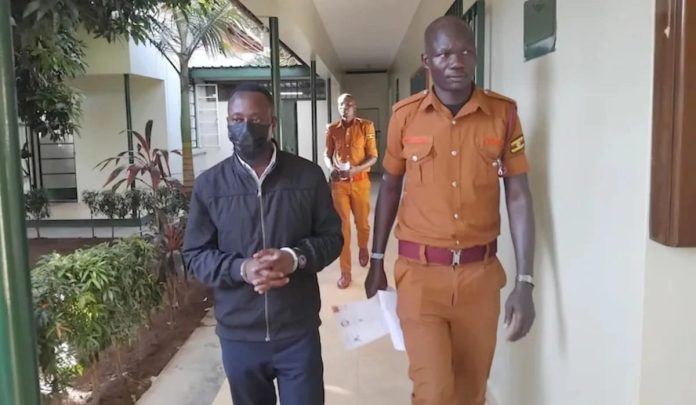
Kampala, Uganda – May 7, 2026-A National Identification and Registration Authority (NIRA) registration assistant has been remanded to prison after being accused of unlawfully accessing and sharing Ugandan citizens’ personal data, which investigators believe was used to support a sex trafficking network operating in Dubai. The suspect, Douglas Kaaya alias Kasozi, appeared before the Makindye Chief Magistrate’s Court and was charged with unlawful disclosure and processing of personal data without consent, contrary to Uganda’s Data Protection and Privacy Act. Court was told that Kaaya, while working at NIRA, allegedly accessed sensitive national identification records and shared them with individuals linked to a trafficking syndicate recruiting young Ugandan women for travel to the United Arab Emirates. Authorities allege the information was used to identify potential victims, process travel arrangements, and facilitate their movement abroad under false promises of employment. Investigators say some of the women were later exploited in sex work networks after arrival in Dubai. The case comes amid growing concern over the vulnerability of government data systems and allegations of insider involvement in cross-border trafficking operations targeting Ugandan youth. Kaaya denied the charges but was remanded after failing to meet bail conditions, including providing a valid national identity card and a local council recommendation letter. He is expected to return to court on May 18, 2026, for a further hearing of the case.