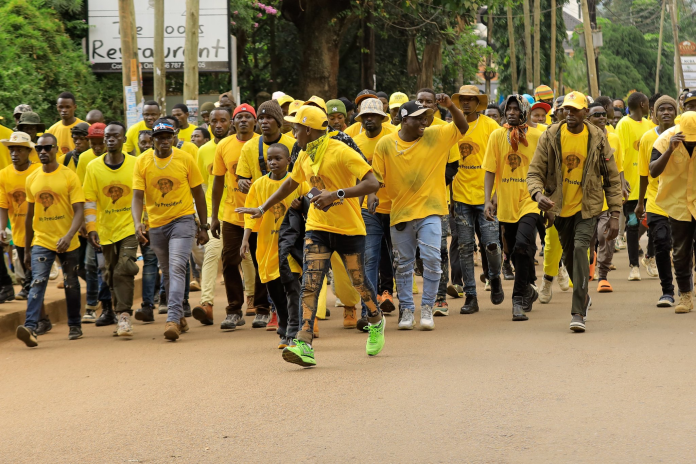
Some of the NRM supporters who escorted President Museveni to NRM secretariat to pick nomination forms.
The ruling National Resistance Movement (NRM) has distanced itself from the violent actions of goons who while donned in the party’s signature yellow t-shirts were captured on camera robbing and assaulting civilians in broad daylight around Kampala on June 28, 2025.
In a statement issued following widespread public outcry, NRM Secretary General, Richard Todwong, described the incident as “regrettable” and “very unfortunate,” suggesting it may have been a calculated move by political rivals to tarnish the image of the party especially at a time when President Yoweri Kaguta Museveni had just picked nomination forms to run again as the party’s presidential flagbearer.
“We cannot rule out that those could be elements of the opposition that dressed in our t-shirts and caused that incident,” Todwong told journalists.
He added, “Because in the history of NRM, our youth have never behaved like that. That behaviour is not for NRM. It is similar to the behaviour of other parties.”
The incident occurred around 2:00 PM along the National Theatre and UBC roundabout area, just as thousands of NRM supporters converged to witness the nomination of President Museveni at the party’s Kyadondo headquarters.
“The footage is there, the faces are known. The police are investigating each and every one of them who was involved in this,” Todwong affirmed, adding that the party had initiated joint investigations with state security agencies.
He added, “We don’t condone such behaviour and we do apologize for those that were affected. The fact that they used our t-shirt to cause that is bad enough.”
He was quick to insist that the individuals involved were not representative of the NRM’s youth wing, noting that such conduct is alien to the party’s code of conduct.
Meanwhile, police have confirmed the arrest of 21 suspects, including two females, in connection with the violent incidents.
“Police in Kampala have arrested 21 suspects, including two females, in connection with a string of robberies and assaults that occurred on June 28, 2025, around 2:00 pm, along the National Theatre and UBC roundabout area,” said SSP Patrick Onyango, the Kampala Metropolitan Police Spokesperson.
According to police, the suspects, disguised in yellow T-shirts, targeted people heading to Kyadondo to witness the nomination of President Museveni, as well as motorists, businesspeople, and pedestrians in the vicinity. Using CCTV footage, detectives tracked and intercepted the suspects in various areas.
“The arrested individuals are currently being held at CPS Kampala and Wandegeya Police Station. Victims have recorded statements, and the case file is being prepared for court,” Onyango added.
Police are investigating cases of simple robberies and assault and reviewing additional CCTV footage to identify more suspects involved in the chaos. One suspect sustained injuries while trying to flee and is currently receiving medical treatment.
“We urge anyone who was victimized but hasn’t reported to the police to come forward immediately,” Onyango appealed.
As pressure mounts, both the NRM and security authorities have vowed to ensure justice for the victims and full accountability for those behind the violent attacks.
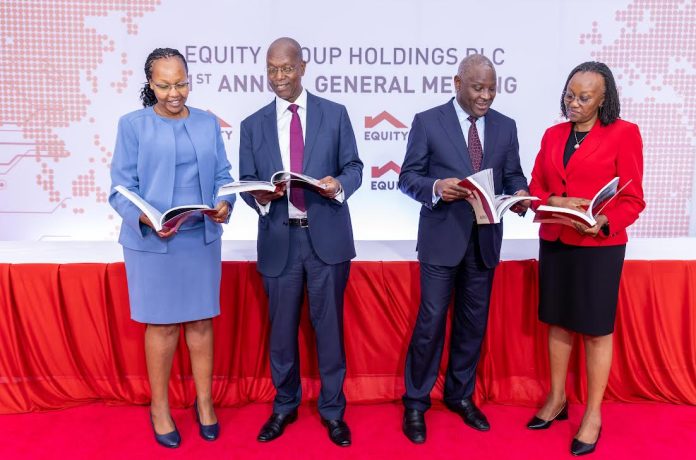
Equity Group executive led by Group Chairman, Prof, Isaac Macharia and Group Managing Director and CEO, Dr. James Mwangi during the 21th annual general meeting .
Equity Group Holdings Plc has declared a record dividend payout of Kshs.16 billion (approximately Uganda Shs444.9 billion), at an enhanced rate of Kshs4.25 (approx. Uganda Shs118) per share. The dividend, approved during the Group’s 21st Annual General Meeting (AGM) held virtually, will be payable on or about June 30, 2025 to shareholders on the register as of close of business on May 23, 2025.
The payout, representing a 34% dividend ratio, reflects Equity Group’s continued commitment to its policy of distributing 30% to 50% of its profits as dividends.
The AGM, attended virtually by shareholders from across the globe, saw unanimous support for all proposed resolutions signaling strong confidence in the Group’s strategic direction and governance.
As part of ongoing efforts to strengthen governance structures and align with the best global practices and regulatory requirements, the Group introduced and secured shareholder approval for several key governance policies. These include policies on directors’ remuneration, stakeholder engagement, transparency and disclosure, dispute resolution, and board appointment procedures. These frameworks are designed to enhance accountability, promote ethical leadership, and ensure the Group continues to uphold the highest standards of corporate governance.
Building on this governance momentum, the AGM also saw the successful election of several new Directors. Mrs. Farida Khambata, a global expert in emerging markets finance with over 30 years of experience in investment and risk management, was elected. Newly elected to the Board, subject to regulatory approvals were Mr. Nick O’Donohoe, a seasoned development finance leader with an over 30-year track record in financial services and impact investing; Dr. Aloysius Uche Ordu, an international development strategist with over three decades of experience in policy and financial innovation; Mr. Obadiah Barara, a veteran public financial management professional with 37 years of experience in public audit and governance across East Africa; Dr. Lakshmi Shyam-Sunder, a renowned financial risk expert with 30 years' experience in multilateral institutions including the World Bank Group; and lastly
Eng. David Mutombo, a global infrastructure and utility executive with over 20 years of experience in sustainable energy and water management. In addition, shareholders approved the appointment of Mr. Obadiah Biraro, Dr. Aloysius Uche Ordu, Dr. Lakshmi Shyam-Sunder, and Dr. Evanson Baiya to serve as members of the Board Audit Committee.
Furthering its strategic expansion, Equity Group received approval to establish a Representative Office in the United Arab Emirates (UAE), subject to regulatory approvals. This move aims to facilitate business, trade and investment opportunities between East and Central Africa, the UAE, and the wider Middle East, India, Central and South Asia regions.
Prof. Isaac Macharia, Chairman of Equity Group Holdings Plc, emphasized the Group’s resilience and strategic focus amidst a challenging global environment, “Despite a complex and evolving macroeconomic landscape in 2024, Equity Group remained resilient, agile, and purpose driven. We strengthened our governance structures across our six markets, aligned with emerging regulatory frameworks, and advanced key strategic initiatives including the successful integration of Cogebanque into Equity Bank Rwanda. Our commitment to the Africa Recovery and Resilience Plan is unwavering, and with the launch of our health insurance subsidiary and plans for a banking holding company underway, we are building a foundation for sustainable, specialized growth.”
“Through strong risk oversight, enhanced board capacity, and deep community impact, ranging from MSME financing and education support to healthcare and clean energy access, we continue to deliver on our promise of inclusive prosperity. The establishment of a Representative Office in the UAE marks a strategic step in deepening regional and global connectivity. With our shareholders’ continued trust, we are confident in our ability to drive meaningful transformation, sustainable development, and long-term value creation across the continent,” he added.
Dr. James Mwangi, Equity Group Managing Director and CEO, highlighted the Group’s positive outlook and strategic vision. “Equity Group continues on a strong growth trajectory, driven by our commitment to innovation, regional expansion, and sustainable practices. The establishment of a Representative Office in the UAE marks an exciting step in our journey to connect Africa with global markets, creating new opportunities for trade and investment. Furthermore, we recognize that sustainability is not just a corporate responsibility but a fundamental driver of long-term success. We are committed to integrating sustainable practices into every aspect of our business, ensuring that we create value for all our stakeholders while protecting our planet for future generations”
Looking ahead, Equity Group remains steadfast in its commitment to driving wealth creation, fostering sustainable development, and delivering exceptional value to its customers and shareholders. With a clear strategic vision, a strong leadership team, and a proven track record of innovation, the Group is well-positioned to capitalize on the opportunities that lie ahead and continue its journey of growth and impact across Africa in 2025 and beyond.
Shareholders approved a record Kshs.16 billion dividend payout at Kshs.4.25 per share, reaffirming the Group’s commitment to shareholder returns. They also endorsed key governance policies, approved new board appointments, acknowledged the retirement of four longtime directors, and authorized the opening of a Representative Office in the UAE.
Equity Group Holdings Plc. is a Pan-African financial services holding company listed at the Nairobi Securities Exchange, Uganda Securities Exchange, and Rwanda Stock Exchange. The Group has banking subsidiaries in Kenya, DRC, Rwanda, Uganda, Tanzania, South Sudan, and a Commercial Representative Office in Ethiopia. It has other subsidiaries in investment banking, insurance, telecom, fintech and social impact investments. Equity Group is the largest integrated financial services firm in the region with a market capitalization of $1.37 billion.
The Group has an asset base of USD 13.5 Billion, a customer base of 22.4 million supported by a footprint of 402 branches, 85,827 Agents, over 1.1 million Pay with Equity (PWE) merchants, 37,825 Point-of-Sale (POS) Merchants, 896 ATMs and an extensive adoption of digital banking channel. The Bank’s strong brand recognition, solid liquidity buffers and resilient funding profile, established domestic franchise and extensive adoption of digital and alternative distribution channels have seen the Bank retain title as Kenya’s most valuable brand in 2025, for second year running, and earned it the honour of being the Second Strongest Financial Brand on Earth in 2024 by Brand Finance. It was also ranked the strongest bank in Africa and 10th most valuable banking brand in Africa, with a Brand Strength Index (BSI) of 92.5 out of 100 and a brand ranking score of AAA+, the highest rating that a brand can attain.
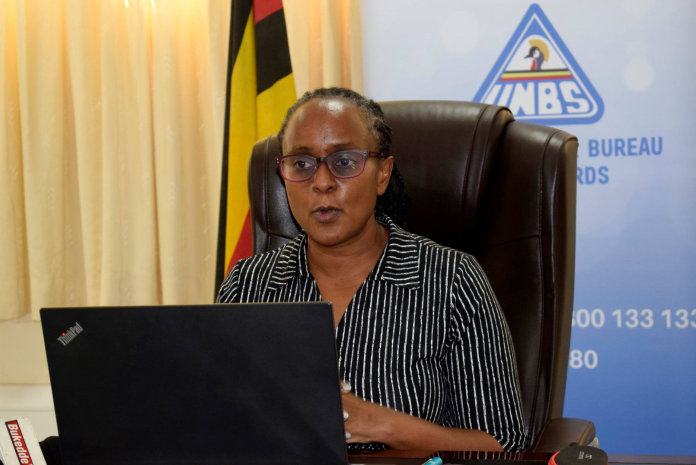
Ms Patricia Bageine Ejalu, UNBS Deputy Executive Director (Standards). eagle.co.ug photo.
Uganda has unveiled stringent new quality control measures for all grain exports in a decisive bid to restore its credibility in regional markets and curb mounting trade losses caused by substandard produce.
Starting in the first quarter of the 2025/2026 financial year, every consignment especially maize must be certified with the Uganda National Bureau of Standards (UNBS) Quality Mark (Q-Mark) and a Sanitary and Phytosanitary (SPS) permit, or risk being blocked at the border.
The policy, developed by the Crop Inspection Department at the Ministry of Agriculture, follows a decade of damaging rejections of Ugandan maize and other grains by regional markets, most notably Kenya, Rwanda, and South Sudan, over safety issues such as aflatoxin contamination.
“There will be no grain allowed out of Uganda without the Q-Mark and SPS permit,” said Ms Patricia Bageine Ejalu, UNBS Deputy Executive Director. “Buyers will now be required to source only from certified premises.”
Speaking during a nationwide training for farmers and grain processors at UNBS headquarters in Bweyogerere, Ms Ejalu said the move is intended to permanently close the quality gap that has plagued Uganda’s grain sector and eroded regional trust.
In 2021, Kenya imposed a ban on Ugandan maize due to excessive aflatoxin levels—triggering a wave of concern about Uganda’s post-harvest handling systems, storage, and processing standards.
Ms Ejalu criticised the continued export of unprocessed or poorly handled grain, warning that Uganda is effectively “donating raw materials to neighbours who process and sell back at higher prices.”
“We must take control of our grain value chain. Everyone—from farmers to millers—must participate responsibly in meeting the required quality,” she said.
She added that many milling facilities in the country fail even the most basic hygiene standards.
“We’ve seen maize being processed in facilities not cleaned for years—dust from roofs, dirt on floors, and pests in storage. It’s not always defiance. Often, people don’t know what standards exist,” she noted.
Uganda loses up to 40% of its grain harvest annually due to poor post-harvest handling, according to Mr Paul Ochuna, Country Program Manager at the Eastern Africa Grain Council (EAGC).
“Drying, sorting, and storage practices are often substandard. That’s why we’re working with farmer cooperatives to build capacity, introduce quality seeds, and offer post-harvest technologies,” he said.
He noted that many handlers lack skills in inventory management, procurement, and quality assurance, adding that EAGC is closing that gap through targeted training.
UNBS, in partnership with the Ministry of Agriculture, has already begun training and deploying inspectors across key grain-producing regions in preparation for the regulation’s rollout.
Ms Ejalu said the national certification strategy is part of a broader effort to boost Uganda’s agricultural competitiveness, secure market access, and protect farmers from future trade shocks.
“We’ve consulted widely and will continue to engage stakeholders to ensure smooth implementation. The days of exporting substandard grain are coming to an end,” she said.
Uganda’s grain sector holds massive potential to serve regional markets, especially amid ongoing food insecurity across East Africa. But experts warn that unless quality control is enforced at every stage—from farm to border—the country risks continued reputational damage and wasted investment.
The Uganda AIDS Commission has announced a major breakthrough in the country’s HIV prevention strategy, with plans to introduce Lenacapavir—a newly developed injectable drug that provides 100% protection against HIV for individuals at high risk. This comes after successful clinical research, in which Ugandan scientists played a key role.
“Uganda was one of the countries where our scientists participated in carrying out this groundbreaking research,” the Commission said in a statement released over the weekend.
Lenacapavir is administered once every six months and was recently approved by the United States Food and Drug Administration (FDA). The Uganda AIDS Commission noted that following this international approval, the drug will be made available in Uganda after consultations with stakeholders and alignment with national health standards.
To facilitate the rollout, the Ministry of Health, working with other relevant agencies, will first require the National Drug Authority to evaluate and license Lenacapavir for use within the country. National HIV prevention guidelines will then be revised to include the drug and provide a policy framework for its application.
Healthcare providers across the country will be trained and equipped with the necessary knowledge and skills to prescribe and monitor Lenacapavir use. The drug will also be incorporated into Uganda’s essential medicines list to ensure accessibility. Furthermore, new data management tools will be introduced to track usage and monitor client outcomes, ensuring accountability at all levels of the program.
“These steps are critical to ensuring the safe, effective, and accountable deployment of Lenacapavir in Uganda,” the Commission emphasized.
Once the framework is in place, Lenacapavir will be integrated into Uganda’s national HIV prevention efforts, targeting those most at risk of infection.
In the interim, the country will continue offering Cabotegravir, another injectable PrEP drug administered every two months, which has already been included in the Ministry of Health’s prevention guidelines.
“Uganda remains committed to providing effective and innovative solutions to end AIDS as a public health threat by 2030,” the Commission affirmed.
Jordan Ssebuliba, about 50 years old, is an estranged son who has severally dragged his father, city businessman Mohan Musisi Kiwanuka to courts of law over the years.
He has also been bonded severally in many police stations in cases that are not related to his battles with the father.
In July 2019, Jordan Sebuliba and Lowerhill Management filed a suit (HCCS No. 555/2019) against Visa Investments Ltd. and Kiwanuka, claiming “equitable interest” in company properties. The case was dismissed.
A month later, in August 2019, Ssebuliba again sued Kiwanuka (HCCS No. 249/2019), this time seeking to take over his estate on grounds of alleged insanity. This claim was also lost
In October 2019, Sebuliba, his mother, Beatrice Luyiga Kavuma, and Lowerhill Management brought a third case against his father Kiwanuka (HCCS No. 253/2019), asserting that company properties were actually marital property. This case, too, was lost
Earlier, in March 2012, a court-ordered eviction under EXD MA 1239/2109 resulted in the removal of Sebuliba and Lowerhill Management after an 18-month legal battle.
In June 2021, Victor Nuwagaba backed by an affidavit from Mr Sebuliba filed a fraudulent purchase claim (Originating Summons No. 4/2021) on company property against Kiwanuka and Visa Investments Ltd. The court dismissed the case on grounds of a fraudulent contract.
In September 2021, Beatrice Luyiga Kavuma filed a marital claim (Civil Suit No. 182/2021) against Kiwanuka, Summit Limited, and the Registrar of Titles over company property. The suit was dismissed but marked to be rescheduled.
That same month, Visa Investments Ltd. filed a contempt of court application (Misc. Application No. 471/2021) against Jordan Sebuliba. The court ruled in favor of Visa Investments and awarded Shs100 million in damages for financial loss.
Most recently, in May 2023, four sisters of Kiwanuka—Jalia Muwanga, Yudaya Nsereko, Berti Nsereko Kawooya, and Sarah Nsereko—sought a public mental examination of their brother (HCCS No. 82/2023). This suit was dismissed on the grounds of res judicata.
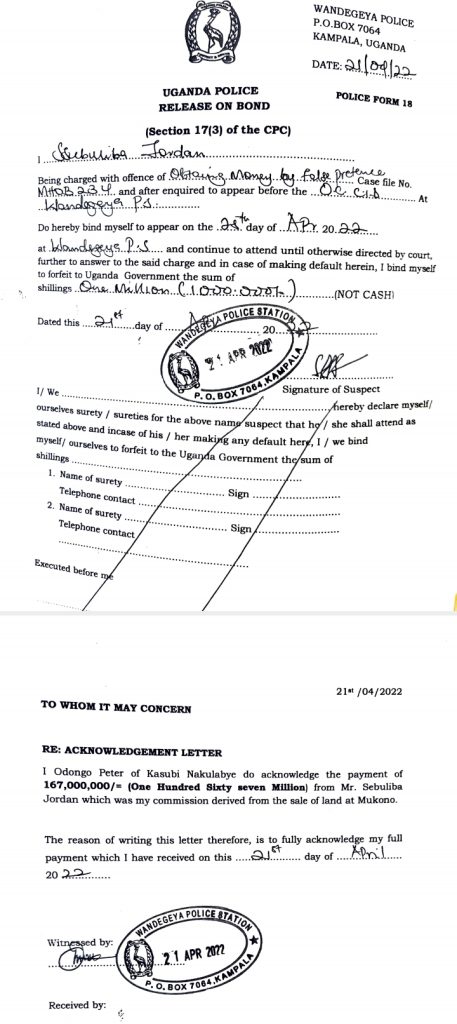
One April 21, 2021, Ssebuliba was given a release bond after being charged for obtaining money by false pretense under the case file no. MHOB 234 and was enquired to appear before the O.C CID at Wandegeya Police Station. He bound himself to appear at the station on of April 25, 2022 and failure to attend was required to pay Shs1 million. Sebuliba had falsely obtained Shs167,000,000/= (one hundred sixty-seven million) from Peter Odongo of Kasubi Nakulabye for the sale of land at Mukono.
Further, on March 18, 2024, Ssebuliba was released on bond over breach of contract under case file No.MU3 and after was required to appear before the Kira Police Station on March 20, 2025, for any default would lead him to pay shs1 million.
On August 29, 2024, Ssebuliba was further released on bond after being charged with the debt of Shs100 million and was enquired to appear before the DPC at Wandegeya Police Station.
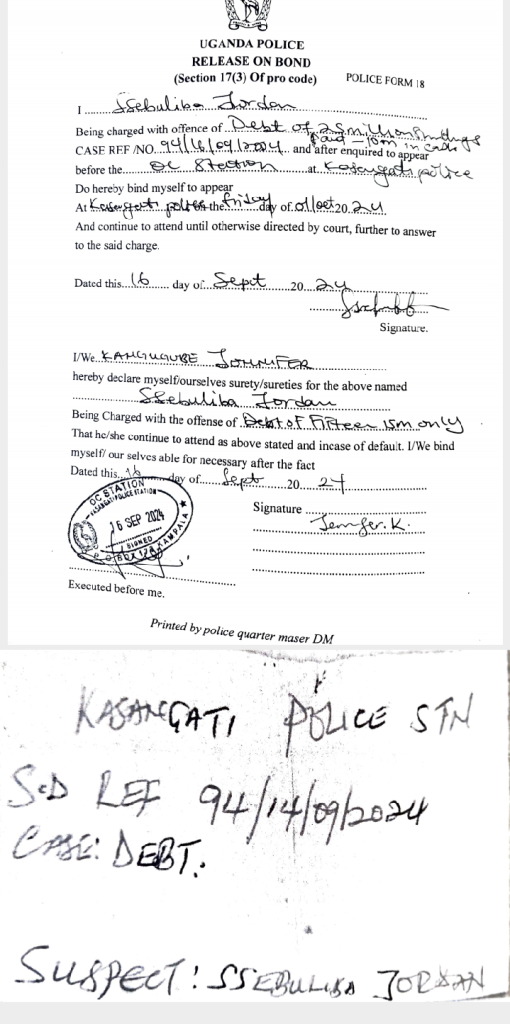
As of September 16, 2024, Ssebuliba was released on bond after being charged with debt of Shs25 million and paid Shs10m and after enquired to appear before the OC station at Kansanga Police. He bound himself to appear at Kansanga Police station on Friday, October, 1, 2024 to continue and attend until otherwise as directed by the court further to answer the said charge. A one Jennifer Kangugure declared surety and bound to pay the remaining Shs15 million.
On October 28, 2024, Ssebuliba was freed on police bond over obtaining money by false pretense and was required to appear before the CID Jinja Road.
On October 24, 2019, Mr. Kiwanuka wrote to the Director, Criminal Investigations in Kibuli addressing the dangerous actions by his son Jordan Sebuliba.
Kiwanuka noted that when he searched through the office of Oscar Industries, he uncovered the documents relating to forgery activities of Mr. Jordan Sebuliba.
‘Authorization for LOWERHILL. MANAGEMENT LIMITED to hire Plots 21-29 Golf course Road by VISA INVESTMENT LIMITED. Tenancy agreement between VISA INVESTMENT LIMITED and LOWERHILL MANAGEMENT LIMITED. Renewal of agreement for premises on plot 1-29 Golf course Road. NEMA clearance certificate for the erection of structure of house up Market Restaurant on plots 21-29 Golf course Road. Rejection by NEMA of application to construct a restaurant and lounge on plot 21- 29 Golf course road and Application for power connection (UMEME) to plot 21-29 Golf course Road’.
He revealed that these were discovered in the cabinet of Adana Damula, Ssebuliba’s sibling and these documents were unknown to the business dealings of Visa Investment Ltd and the signatories were unauthorized persons in the company. He declared that those documents were false and forwarded them to police for further investigations.
Mr. Kiwanuka wondered how a child who was raised by him comes up to claim for the properties he has no share. He questioned whether Ssebuliba had bought these properties and told him (Kiwanuka) to keep them for him.
Ssebuliba claims that Kiwanuka is mentally ill and is unable to run the managerial roles of these properties and should be taken for rehabilitation and then he takes over the ownership of the properties.
“It is just and equitable that court adjudges Mr Mohan Kiwanuka as a person of unsound mind so that his estate can be placed under proper management and that I can be appointed manager for the purpose” Mr Ssebuliba submitted to court in his application affidavit witnessed by Fabian Odongon, a Commissioner of Oaths.
And indeed, on June 19, 2025, Jordan Ssebuliba wrote to court declaring himself as dully appointed manager of the Kiwanuka estate without involving the entire family and close members.
“Two family meetings were dully convened on June 14, 2025, and June 19, 2025, during the meeting held on June 19, 2025, the lineal descendants presented appointed me as the family representative. Accordingly, I hereby forward this notice of appointment for the record of this Honourable Court” Ssebuliba submitted to Court of Appeal on June 25, 2025.
However, Mr. Kiwanuka as a parent had earlier advised Sebuliba to apologize to him and demanded for his vacant possession of the plot at Golf Course Road and another one at Akii Bua Avenue in Nakasero.
Kiwanuka was forced to make this decision following the ‘bad character’ of Ssebuliba entering into possession of his property without Kiwanuka’s acknowledgment. Noting, “You will recall that you entered into the above properties without my knowledge which no other sibling of yours has ever done. You occupied these properties for the last ten years on a commercial basis generating money therefrom without any accountability and without paying any rent.”
Kiwanuka further noted “The reason I am doing this is because that you have decided to blow my decision to take away my properties out of my proportion and to portray me amongst your and other relatives as being inconsiderate and unreasonable which is not true,”
Kiwanuka further revealed that Ssebuliba dared and suggested that his father should close and sell his factory.
“Jordan, I was greatly disappointed and hurt. You cannot phantom where I have come from and achieve whatever I have achieved and for you to have the authority to dare to suggest that I should sell my factory because in your view I can no longer manage to run it was an insult,” Kiwanuka regretted.
The former Spy chief, General David Sejusa, has spoken out on historical land injustices in Uganda’s cattle corridor, urging citizens to distinguish between the so-called Balaalo and indigenous squatters displaced by past regimes.
Sejusa via X (formerly Twitter) said that most of the land in the cattle corridor stretching from the Tanzania border through Masindi and Nakasongola to the River Nile and Lake Kyoga was historically occupied by indigenous cattle-keeping communities, not by foreign pastoralists.
“Let me show you the distinction between the now (in) famous Balaalo and squatters of the cattle corridor ranching scheme,” Gen. Sejusa stated.
He noted, “The areas had traditionally been occupied by mainly cattle keepers. And please, understand that cattle keepers here is not synonymous with being Hima, or Tutsi. There are many other tribes who keep cattle in these areas, including indigenous Banyoro, Baruuli, Batooro, Basongora, etc.”
He recounted how the Obote I government, followed by the Idi Amin regime, implemented a sweeping ranching policy that carved up huge tracts of land into ranches. These were then allocated to government officials and those with political influence leaving out the original landowners most of whom were illiterate and lacked political clout.
“Obote I government created a ranching scheme covering this whole area. Ranches were created and allocated to government officials and those with government connections. The indigenous peoples who owned and occupied these areas were excluded from the scheme… they were never resettled elsewhere! ” Sejusa explained.
He noted that even families like his, which had invested in ranches by building dip tanks and dams in Ranch No. 1 and No. 2, were eventually dispossessed in favour of political elites of the day. The displaced communities, he added, became tenants and squatters on their ancestral lands paying rent in cattle to absentee landlords or powerful ranchers.
“These were Ugandans rendered homeless by their own governments, chased from their ancestral lands where even the wars between the Bachwezi and the Babiito couldn’t remove them,” he lamented, adding, “But Obote and Amin, and their henchmen, like Babiiha, dared!”
However, Sejusa dismissed comparisons between these historical squatters and the modern-day Balaalo pastoralists, some of whom are accused of encroaching on land in northern and western Uganda without legal rights or consideration for local communities.
“Never compare these people to the so-called Balaalo who go loitering in foreign land for greener pastures, literally! “Squatters of the ranch restructuring scheme had suffered great injustice which had to be addressed. The governments of Obote and Amin had not only committed a great wrong but it was criminal,” Sejusa said
Reflecting on his own history of confronting land injustice, Sejusa revealed that his involvement dates back far before the controversial 2010 Buliisa evictions.
“My struggle against land injustice stretches far back. Even in the ranch restructuring scheme, I was central and it wasn’t easy! I remember the then Vice President, comrade Samson Kisekka, grilling me on the floor of Parliament (NRC) and my sister, Miria Matembe calling on the President to sack me as Minister of State for Defence because of my ‘actions’,” he said
Gen. Sejusa concluded by reaffirming his deep commitment to fighting injustice. Noting, “When I hear fellows telling me about Buliisa, I laugh. They know nothing. I don’t like injustice!” he said
In different rural areas of Uganda, a quiet but powerful transformation is unfolding led by young people who are now reshaping their futures through financial literacy and access to capital.
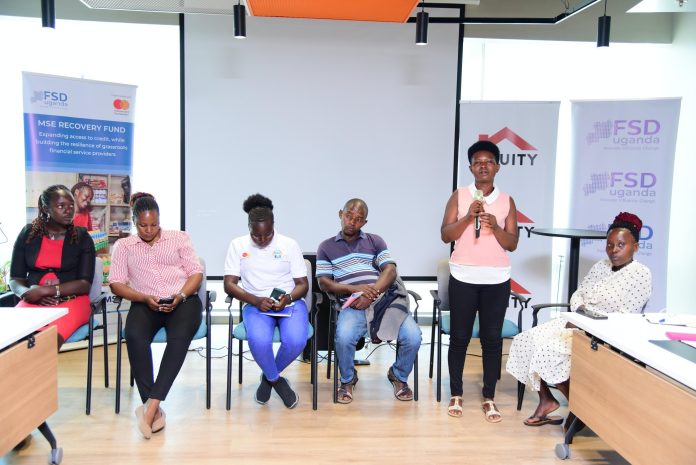
At the heart of this movement is Equity Bank Uganda, whose partnership with the Mastercard Foundation under the Young Africa Works strategy is equipping youth-led micro and small enterprises with the knowledge and resources to succeed.
Many of these young entrepreneurs began their journeys without the tools to manage even the smallest businesses.
“I didn’t keep records or track sales. I would use stock for myself without accounting for it,” a young woman from the Chitwe Youth Farmers Group shared, reflecting on her early challenges running a small salon business.
In Fort Portal, a farmer said he had “no knowledge about money” and often mishandled earnings from agriculture.
In Nakivale, members of the No Empire Women Empowerment Association faced similar chaos. “We had many misunderstandings because we didn’t know how to plan or budget,” a leader admitted.
From Rhino Camp to Isingiro, this pattern repeated—youth struggling with savings, poor business management, and no access to finance. That changed when Equity Bank introduced financial literacy sessions between 2021 and 2023. The training was hands-on and practical, covering bookkeeping, budgeting, inventory management, and how to separate personal and business income.
“I learnt how to track my expenses, monitor stock, and record everything,” said the Chitwe youth, adding, “For the first time, my business made a profit.”
The Fort Portal farmer echoed this shift. “I started budgeting and keeping records. That’s what helped me manage my loan.”
For Nakivale’s No Empire group, the lessons brought structure and trust, helping members align on goals and operate more effectively.
With this new knowledge, youth accessed working capital through Equity Bank’s group lending model. These loans—often between Shs2 million and Shs5 million—require no collateral, making them accessible even to those with limited assets. The Fort Portal entrepreneur used his loan to invest in agriculture, start a mobile money shop, and enroll in a business degree. “Because I understood money, I used it well,” he said.
Others diversified too. In Chitwe, the young salon owner bought large dryers, started poultry farming, and expanded her group’s ventures. In Nakivale, Shs5 million helped No Empire launch tailoring and digital literacy training programs, generating jobs and income. In Rhino Camp, a youth group used funds to construct training facilities and empower 56 members, mostly women, in bakery and catering.
The ripple effects have been remarkable. One formerly struggling salon is now supporting a single mother’s household and educating her children. “My life changed completely,” she shared. “I even mentor others now.” In Isingiro, Misha Dan turned her hair-braiding business around, began poultry farming, and became a mentor to women in six subgroups. “I’m proud to share what I’ve learned,” she said.
In Nakivale, refugee women used their skills to tackle gender-based violence and reduce unemployment. “Each member now has a skill to earn from,” a leader said. Communities have since launched soap-making cooperatives, savings groups, and new enterprises—all sparked by training and accessible finance.
While success stories continue to emerge, these youth are calling for more. “We need refresher courses to help new members and stay sharp,” said the Chitwe entrepreneur.
In Fort Portal, the demand for financial education remains strong. Groups have grown, and members want higher loan limits to support expanding ventures. “Shs5 million isn’t enough when you have 30 people,” a Rhino Camp leader noted.
Still, the progress is undeniable. Many of these youth now run sustainable businesses, employ others, and act as mentors in their communities.
Equity Bank Uganda and the Mastercard Foundation’s vision is becoming a reality one where young people no matter their background have the tools to build lasting livelihoods and drive community development. With continued support and a listening ear, this generation is not just being uplifted—they are lifting others with them.
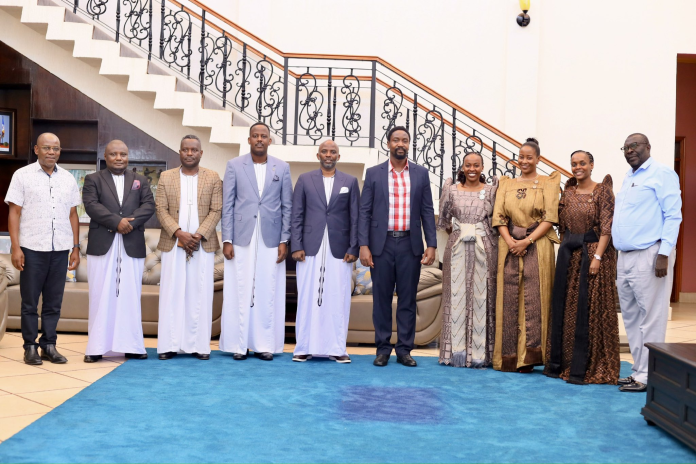
Kyabazinga of Busoga William Gabula Nadiope IV and a team from Victoria University led by the Vice Chancellor, Dr. Lawrence Muganga
at the Igenge Royal Palace.
Victoria University Vice Chancellor, Dr. Lawrence Muganga has announced the institution’s commitment to revolutionizing education in Busoga following a high-level meeting with the Kyabazinga of Busoga, His Majesty William Gabula Nadiope IV, at the Igenge Royal Palace.
“Today, Victoria University was deeply honored to meet His Majesty William Gabula Nadiope IV, the Kyabazinga of Busoga, at the magnificent Igenge Palace. I sincerely thank His Majesty for his warm and gracious invitation, ” Dr. Muganga said.
He praised the Kyabazinga as a forward-thinking monarch whose leadership continues to inspire development and educational advancement in the region.
“His Majesty stands among the world’s most visionary and educated leaders. I greatly admire his firm commitment to the progress and welfare of the people of Busoga,” Muganga noted.
Their meeting, he said, focused on a shared belief in education as the cornerstone of social transformation.
“Our conversation was both inspiring and encouraging, grounded in our shared conviction that quality education transforms lives and strengthens communities,” he said.
Dr. Muganga announced that Victoria University is ready to collaborate with the Busoga Kingdom to extend innovative, technology-powered education to underserved areas.
“Victoria University is eager to join hands with His Majesty and the people of Busoga to bring cutting-edge, tech-driven learning to every corner of the kingdom,” he stated.
“We want to ensure that no learner is left behind.”
He emphasized that the initiative will focus on inclusive and accessible education, empowering future generations through digital tools and modern learning methods.
“This collaboration is particularly meaningful to me because it champions inclusive education through innovative solutions,” Muganga said.
He added, “By working together, I am confident we will unlock new opportunities, empower countless young minds, and build a brighter, more inclusive future for generations of Ugandans in Busoga and beyond.”
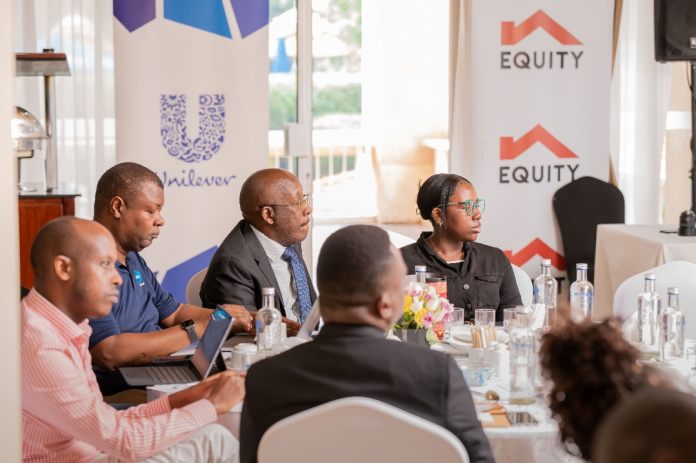
Participants from Equity Bank Uganda in partnership with Unilever Uganda.
Equity Bank Uganda in partnership with Unilever Uganda has announced a strategic financing strategy aimed at enhancing liquidity and operational efficiency within Unilever’s distribution network.
The partnership, launched at a breakfast engagement themed “Unlocking Financing Opportunities for Distributors,” introduces the Eazzystock Financing Product, a working capital loan solution specifically designed for distributors, retailers, and stockists.
This initiative provides easier access to affordable working capital, enabling Unilever’s distribution partners to maintain inventory levels, improve cash flow management, and strengthen the supply chain across Uganda.
“At the heart of Equity’s mission in Uganda is driving social and economic transformation,” said Christine Mukasa Mugerwa, Acting Head of Corporate Banking, Equity Bank. “That bar of soap matters. So how do we ensure it reaches the people who need it while transforming the shop attendant’s life in the process?”
The financing offers flexible working capital loans ranging from sh1 million to sh3 billion. The application process involves a single one-time sign-up, with account auto-sweep functionality enabled. Loan terms and usage are reviewed quarterly. Loans up to UGX 1 billion are unsecured, while those exceeding this amount require security or collateral.
“You need funds that move as fast as your business,” added Christine Mukasa Mugerwa. “Equity’s working capital solutions, tailored for real world businesses like those in the Unilever ecosystem, are quick, convenient, and require just a one-time sign-up. Access up to sh3 billion.”
New partnership between Equity Bank Uganda and Unilever Uganda
Barbara Aseera, Head of Manufacturing and Logistics, Equity Bank Uganda, emphasized the strategic impact of the partnership, stating, “This partnership facilitates easier access to affordable working capital, enabling Unilever’s distribution partners to maintain inventory levels, improve cash flow management, and ultimately strengthen the supply chain across Uganda.”
She further noted, “Equity Bank’s stock financing model was born out of a need to keep businesses alive in the wake of COVID-19. We recognised that many longstanding distributors had their working capital wiped out, and we stepped in to ensure business continuity.”
Gerald Tentena, General Manager – Supreme Branch, Equity Bank Uganda, highlighted the tailored approach of the financing solutions: “Together with partners like Unilever, we’ve developed tailored financial solutions that meet the unique needs of specific distributor networks. It’s not a one-size-fits-all model; it’s deliberate and responsive.”
Luck Ochieng, Managing Director—Unilever Kenya & Uganda, speaking virtually from Nairobi, praised the collaboration: “Our success in Uganda is built on the strength of partnerships like the one we have with Equity Bank. Together, we’re not only moving product, we’re creating opportunities for shared growth.”
As Uganda’s biggest wedding exhibition—the Bride and Groom Expo, draws near, Kabira Country Club is set to charm soon-to-be-weds with an unbeatable wedding offer tailored to make dream celebrations a reality.
Slated for June 27–29, 2025, at the UMA Exhibition Hall in Lugogo, the event promises a weekend of glamor, planning and unforgettable deals.
Kabira Country Club will be showcasing at Stall No. 6, where guests will get a chance to explore the hotel’s beautifully curated wedding packages. Among the standout offers is a complete wedding package going for only Shs85,000 per person. This special deal includes a full buffet with soda or water, tables and chairs, two bottles of wine, a one-night stay for the couple on the wedding day, a dedicated service team, and a 10% discount on salon services at Eric’s Salon.
Located in the heart of Bukoto, Kabira Country Club is known for its serene ambience, luxurious amenities, and exceptional event spaces. The offer not only promises value for money but also a stress-free planning experience for couples looking to tie the knot in elegance and style.
The Bride and Groom Expo now in its 16th edition is organized by The New Vision and is the ultimate convergence of Uganda’s wedding industry players. It serves as a platform for vendors, planners, and hospitality providers to network and showcase what’s trending in wedding services.
For those attending the expo, a visit to Kabira Country Club’s stall might be the first step toward planning a perfect wedding celebration. Visitors will also enjoy personalized consultations and access to exclusive expo-only promotions.
For bookings and inquiries, interested couples can reach out via +256 707 780 145 or +256 752 711 738.