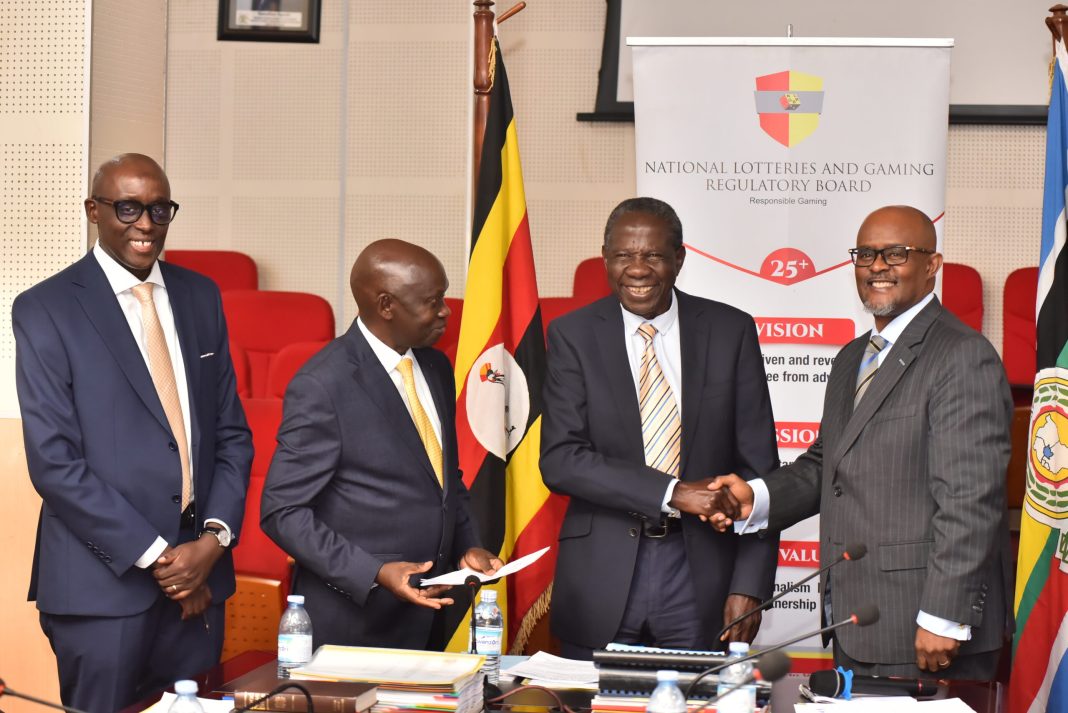
Ten years after its establishment, the National Lotteries and Gaming Regulatory Board has evolved from a modest regulator with limited collections into one of Uganda’s most significant non-tax revenue contributors, with gaming stakes now projected at Shs14.1 trillion.
When the sector was first formalized, projections to the economy stood at just Shs50 billion. A decade later, the numbers tell a dramatically different story.

Appearing before Parliament’s Committee on Finance, Planning, and Economic Development, Acting Executive Director Bernard Winyi recently detailed the Board’s revenue growth trajectory, highlighting reforms in licensing, compliance, and digital monitoring.
“The Board registered an eightfold rise in non-tax revenue collection which was driven by improved licensing, revised fee structures and strengthened compliance systems,” Winyi told legislators.
Non-tax revenue collections have increased from Shs1.14 billion in the 2019/2020 financial year to Shs8.79 billion in 2024/2025. Since the Board’s inception in the 2015/2016 financial year, total annual revenue collections have expanded from Shs17.4 billion to Shs323 billion in 2024/2025. By the close of the current financial year 2025/2026, collections are projected to hit Shs391 billion, with even higher targets ahead.

Central to this transformation has been the rollout of the National Central Electronic Monitoring System, introduced after Parliament boosted the Board’s budget in the 2022/2023 financial year. The system replaced reliance on operator self-reporting with real-time digital tracking of gaming activities.
“Before we operationalised the system, operators made a self-declaration of money staked by individuals into gambling. When we operationalised the system, the stakes grew to Shs4.3 trillion in 2023/2024 and Shs8.3 trillion in 2024/2025. In the financial year 2025/2026, we are projecting that gambling stakes will go up to Shs14.1 trillion. This visibility has enabled us to improve on tax collection,” Winyi explained.
Lawmakers welcomed the progress. Otuke County MP Paul Omara praised the Board’s management and pledged to support increased funding.
“This particular team is moving in line with what URA is doing and have grown tremendously. When they started, their collection was very small but look at the projections which they are making now, over Shs400 billion in revenue collections,” Omara said.
However, concerns were raised about the continued presence of illegal gaming machines across the country. Sheema Municipality MP Dicksons Kateshumbwa questioned how the regulator is addressing illicit imports.
“You have confiscated 1,418 illegal gaming equipment and devices but these are not manufactured in Uganda. They are definitely imported. How do you collaborate with URA to curtail these illegal machines from coming in at importation?” he asked.
Winyi acknowledged the enforcement challenges.
“Most of these illegal machines do not pass through customs as gambling machines, but as spare parts for computers like motherboards that are exempt from tax. They later get assembled into complete machines. We have engaged the URA customs team and agreed on how to identify them,” he said.
Looking ahead, the Board’s 2026/2027 budget targets Shs450 billion in revenue, a 15 percent increase from the projected Shs391 billion in 2025/2026. The strategy focuses on strengthening enforcement against illegal gambling, tightening compliance, and maximising the electronic monitoring system.
State Minister for Finance and Planning Amos Lugoloobi urged Parliament to sustain investment in the sector, arguing that with stronger regulation and enforcement, gaming revenues could rise even further.
A decade on, the figures reflect more than growth in gambling activity. They signal the impact of regulatory reform, technology-driven oversight, and parliamentary backing in turning a once modest sector into a significant pillar of Uganda’s domestic revenue mobilisation.